SQL vs NoSQL
The real fork is not tables vs. no tables — it is where the data gets assembled and who enforces its shape. A relational engine stores each fact once in a normalized table and re-assembles the answer at read time with a JOIN, while the server guarantees the schema and referential rules on every write. A document/key-value store does the opposite: it stores the answer pre-assembled under one key so a read is a single fetch, and it pushes the job of keeping that shape correct onto your application code. Almost every practical trade-off below — joins, transactions, scaling, evolution — falls out of that one difference.
Take one concrete row of business: rendering the order page for order #4471 (one customer, three line items, a total). Here is the same data in both shapes.
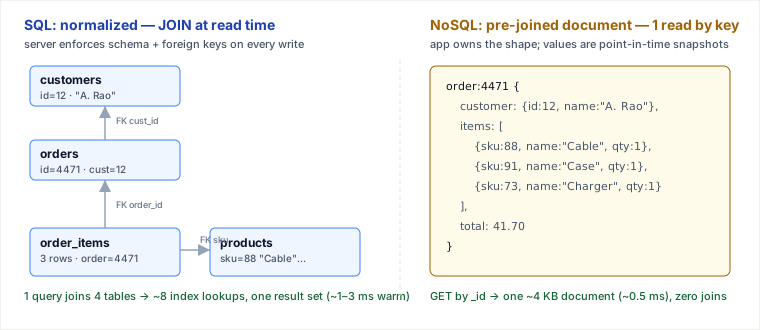
Worked trace: the same read and the same write, both ways
Follow the two operations the order service actually runs. The numbers are representative of a warm cache on a mid-size instance — orders of magnitude, not benchmarks.
| Operation | SQL (PostgreSQL, normalized) | NoSQL (DynamoDB/Mongo, embedded doc) |
|---|---|---|
| Read order #4471 | One SQL query joins customers ⋈ orders ⋈ order_items ⋈ products: ~8 B-tree index lookups, planner returns one result set. ~1–3 ms. Product names are always current. | GetItem(pk="order:4471"): one ~4 KB document read, no joins. ~0.5 ms. Product names are the snapshot taken when the order was placed. |
| Place order: sell 1 unit of sku 88 (stock 12 → 11) and insert the order | BEGIN; UPDATE products SET stock=stock-1 WHERE sku=88 AND stock>0; INSERT INTO orders …; COMMIT; — one ACID transaction. Both rows change or neither does. Two concurrent buyers cannot both win the last unit. | Two documents live in different partitions. A plain two-write flow can insert the order but fail to decrement stock → oversell. You need a multi-item transaction (TransactWriteItems / multi-doc txn) or a saga with compensation — extra latency, size limits, and code you own. |
Read that table twice: NoSQL wins the read by pre-joining, and pays for it on the write by giving up the free cross-entity transaction. That single sentence is 80% of the decision.
Correcting a claim you will hear everywhere
"SQL schema changes require modifying the entire database structure" is false and it drives people to the wrong database. In modern PostgreSQL, ALTER TABLE ADD COLUMN note text — or even with a constant default since PG 11 — is a metadata-only change: it updates the catalog in milliseconds and does not rewrite existing rows. What actually hurts is a narrower set of operations: changing a column's type, adding a NOT NULL with a volatile default, or (pre-PG-11) any default, which forces a full table rewrite and holds an ACCESS EXCLUSIVE lock. So the honest statement is: additive schema evolution in SQL is cheap and online; rewriting evolution on a large hot table is the risk you plan a migration around. NoSQL's edge is not "no schema" — it is "no coordinated migration step," because old and new document shapes coexist and the app reconciles them on read (schema-on-read). You have simply moved the schema from the database into your code, where nothing enforces it for you.
The six-dimension decision matrix
Each row is a signal you can observe in your own requirements, then where it points and why.
| Dimension | Signal in your requirements | Points to | Why (mechanism) |
|---|---|---|---|
| Data model | Many entities linked by shared references; you query them from many angles. | SQL | Store each fact once; JOIN composes new views without duplicating data. |
| Data model | One dominant access pattern; data is a self-contained blob (a document, an event, a session). | NoSQL | Embed everything the read needs under one key → one fetch, no joins. |
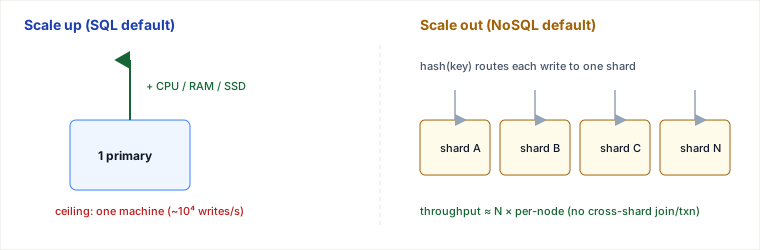
| Scalability | Write throughput fits one primary (roughly ≤ tens of thousands writes/s, ≤ a few TB). | SQL | A single authoritative node keeps transactions and joins cheap; scale up + read replicas. |
| Scalability | Writes must scale near-linearly to millions/s across regions. | NoSQL | Partition by key across N shards; no cross-shard invariant means each node scales independently. |
| Consistency | Multi-row invariants must never break (money, inventory, bookings). | SQL | ACID transactions + FKs enforce the invariant inside the engine. |
| Consistency | Stale-by-seconds is fine; availability under partition matters more. | NoSQL | Eventual consistency / tunable quorums trade freshness for uptime (CAP: choose A over C). |
| Query complexity | Ad-hoc filters, aggregations, reporting the product team hasn't invented yet. | SQL | The optimizer answers arbitrary joins/GROUP BY without you pre-designing an index for each. |
| Query complexity | Known, fixed lookups only (get-by-key, ranges within a partition). | NoSQL | Access patterns are designed up front into the key/index; anything else needs a scan. |
| Performance | Mixed workload, predictable single-digit-ms latency at moderate scale. | SQL | General-purpose engine; one box avoids network hops for joins/transactions. |
| Performance | Very high write rate or huge datasets where per-op latency must stay flat as data grows. | NoSQL | O(1) partition routing + LSM write path keep writes fast independent of total size. |
| Operations | Small team, want a managed relational service; migrations are planned events. | SQL | Mature tooling, one node to reason about; the risk is the online-migration playbook. |
| Operations | You accept running/paying for a distributed cluster to get elasticity. | NoSQL | Managed sharding + replication, but you own data modeling, hot-partition tuning, and cross-doc consistency. |
Pitfalls
- Choosing NoSQL for "flexibility," then querying it like SQL. You picked a key-value store, and now the dashboard needs "orders by region last month." There is no index for it, so it becomes a full scan across every shard — slow and expensive. NoSQL isn't schema-free, it is query-pattern-locked: you must know the queries before you model the keys.
- Assuming your document store gives you cross-document transactions. The oversell bug in the trace above is the classic production incident: two writes to two partitions, one succeeds, one doesn't, inventory is now wrong. Multi-document transactions exist but are opt-in, size-limited, and slower — many teams discover this only after the first double-sold item.
- Fearing SQL schema changes and denormalizing prematurely. Teams pick NoSQL to "avoid migrations," then hand-roll consistency between duplicated copies of the same fact — reinventing foreign keys badly. Additive SQL migrations are online and millisecond-cheap; only large-table rewrites need a real playbook.
- Embedding unbounded arrays in a document. An
order.itemsarray is bounded; auser.activityLogthat grows forever will blow past the document size cap (e.g., 16 MB in Mongo, 400 KB item limit in DynamoDB) and turn every read of that user into a large fetch. - Treating "NoSQL = web scale" as a default. A single well-indexed Postgres instance comfortably serves tens of thousands of writes/s and terabytes. Most products never outgrow it; reaching for a distributed store early buys operational cost and a harder data model for scale you don't have.
When to use it / when NOT — and the trade-off
Choose SQL (PostgreSQL, MySQL) when the data is relational and queried from many angles, correctness across multiple rows is non-negotiable (payments, inventory, ledgers, bookings), your reporting needs are open-ended, and one primary can hold the write load. You gain enforced invariants and arbitrary queries for free; you pay with a write ceiling on a single node and the need to plan large migrations.
Prefer NoSQL when there is one dominant, known access pattern over self-contained records, write volume or dataset size exceeds a single node, and eventual consistency is acceptable — and pick the sub-type by access shape: key-value/document (DynamoDB, Mongo) for get-by-key, wide-column (Cassandra) for huge write-heavy time series, graph (Neo4j) for deep relationship traversals that would be JOIN-explosions in SQL. You gain flat latency at massive scale and painless additive shape changes; you pay with lost cross-entity transactions, query patterns frozen at design time, and consistency logic you now own in application code.
Choose SQL when in doubt. Its constraints (schema, single primary) surface problems early and loudly; NoSQL's freedom lets bad data and lost writes accumulate silently until they surface as a customer-facing incident. A very common senior move is the hybrid: Postgres as the system of record for anything transactional, plus a NoSQL store (or a cache/search index) for the one high-scale, denormalized read path — SQL owns truth, NoSQL owns scale.
Takeaways
- The core difference is assemble-at-read (SQL: JOIN, one copy of each fact) vs. assemble-at-write (NoSQL: pre-joined document, one fetch); every other trade-off follows.
- SQL gives you multi-row ACID transactions and arbitrary queries for free; NoSQL gives you near-linear write scaling and flat latency — at the cost of those transactions and open-ended queries.
- "NoSQL is schema-free" really means "schema lives in your app"; and additive SQL schema changes are cheap and online — evolution is rarely the deciding factor people think it is.
- Default to SQL, reach for NoSQL for a specific high-scale known-pattern read path, and don't be afraid to run both.
Re-authored and deepened for this guide, drawing on Martin Kleppmann, Designing Data-Intensive Applications (Ch. 2–3, storage & encoding); the PostgreSQL manual on ALTER TABLE (metadata-only column adds since 11) and locking; Amazon DynamoDB and MongoDB documentation on item/document size limits and multi-item transactions; and Alex Xu, System Design Interview (database selection). Latency and throughput figures are representative orders of magnitude, not benchmarks.
🤖 Don't fully get this? Learn it with Claude
Stuck on SQL vs NoSQL? Open Claude, copy a block below, and it'll teach you this exact concept — visually and interactively.
Build the mental picture, not memorization.
I just read a lesson on **SQL vs NoSQL** (System Design) and want to truly understand it. Explain SQL vs NoSQL from first principles using ONE vivid real-world analogy and a visual mental model — draw it as ASCII art or a clear step-by-step diagram — with a concrete example using real numbers. Then ask me one question to check I got the mental picture, and wait for my reply. If you're unsure or a claim isn't standard, say so and reason from first principles instead of guessing.
Socratic — adapts to where you're stuck.
Teach me **SQL vs NoSQL** interactively. Ask me ONE guiding question at a time, wait for my answer, and adapt to my confusion — build the idea with me step by step instead of explaining it all at once. If you're unsure or a claim isn't standard, say so and reason from first principles instead of guessing.
Active recall exposes what you missed.
Quiz me on **SQL vs NoSQL** with 5 questions, easy to tricky, ONE at a time. Tell me if each answer is right; at the end, explain clearly what I got wrong and why. If you're unsure or a claim isn't standard, say so and reason from first principles instead of guessing.
Intuition + hook + flashcards for long-term memory.
Help me remember **SQL vs NoSQL** for the long term: give the one-sentence intuition, a memorable hook/mnemonic, a tiny worked example, and 3 active-recall flashcards (Q -> A). If you're unsure or a claim isn't standard, say so and reason from first principles instead of guessing.