API Gateway vs Direct Service Exposure
Mechanism. An API gateway inserts one Layer-7 process at the edge so the mapping from a single public endpoint to N internal services lives in one configurable place instead of being hard-wired into every client — you pay one extra network hop per request in exchange for the freedom to split, merge, rename, or relocate backend services without touching a line of client code. Direct service exposure deletes that hop (each client calls each service's own address), but in doing so it wires every client to the physical service topology and forces every service to re-implement the cross-cutting work — authentication, TLS termination, rate limiting, request logging — that a gateway does exactly once.
The trade the title actually names: one hop vs total coupling
The catalog version of this comparison ends at "gateway adds latency, direct exposure is simpler." That misses the real decision. The gateway's cost is a fixed, small, per-request tax — a few milliseconds and a shared failure domain. Its benefit is decoupling: clients know one address and one contract, and the internal service graph becomes a private implementation detail you can refactor freely. Direct exposure's benefit is the removed hop; its cost is that the client's code now encodes your architecture, and any cross-cutting policy must be duplicated (and kept consistent) across every service. Whether the hop is worth it flips entirely on how chatty the workload is — which the worked trace below makes concrete.
Worked latency trace: a mobile home screen
The home screen needs three things: the user profile, their 3 most recent orders, and a cart count. Hold these numbers fixed across both designs: mobile round-trip time (RTT) with a warm TLS connection = 90 ms; internal east-west RTT inside the datacenter = 1 ms; each service p50 compute = 12 ms; gateway routing + auth + aggregation overhead = 4 ms. Notice where the fan-out happens — that is the whole game.
| Scenario | Direct exposure (wall-clock) | Via gateway / BFF | Winner |
|---|---|---|---|
| 3 independent calls, client parallelizes over HTTP/2 | 3 parallel × (90 + 12) = 102 ms; 3 mobile connections, 3 radio wake-ups | 90 + 4 + (1 + 12) ≈ 107 ms; 1 connection, 1 payload | Direct by ~5 ms — but gateway wins on battery & bytes |
orders needs the account tier from profile first (a dependency) | profile 102 ms, then orders‖cart 102 ms = 204 ms | 90 + 4 + (13 profile + 13 orders) ≈ 120 ms | Gateway by ~84 ms |
single hot-path call: GET /orders/{id} | 90 + 12 = 102 ms | 90 + 4 + 1 + 12 = 107 ms | Direct by ~5 ms (the pure hop tax) |
The naive claim "a gateway always adds latency" is only true for the single-call row. The moment the screen is chatty or has inter-call dependencies, moving the fan-out off the 90 ms mobile network and onto the 1 ms internal network makes the gateway faster, not slower — because it collapses many slow round trips into one. That is the mechanism the diagram shows.
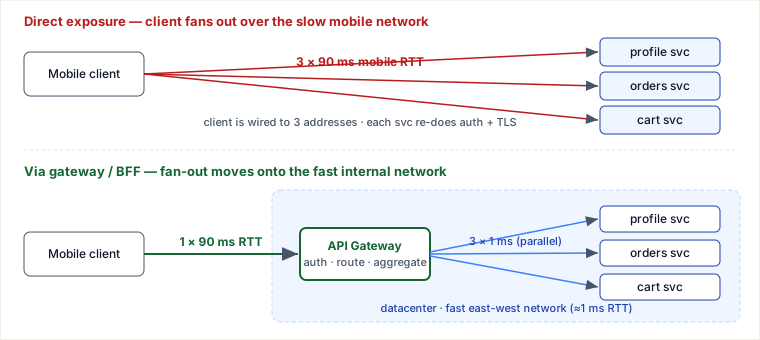
Backend-for-Frontend (BFF): the gateway, specialized per client
A single company-wide gateway drifts toward a shared bottleneck: the mobile team wants a lean payload, the web team wants a richer one, the partner-API team wants strict quotas, and all three now negotiate changes to one config owned by no one. The BFF pattern resolves this by giving each front-end its own gateway, owned by that front-end's team. The mobile BFF aggregates and trims for a phone on LTE; the web BFF shapes for a browser; the partner BFF enforces contracts and rate limits. Each BFF still does the datacenter-side fan-out from the trace above — it just tailors the aggregation to one consumer instead of serving a lowest-common-denominator response to everyone.
Choose a BFF over one central gateway when you have two or more front-ends with genuinely divergent shaping needs and separate teams; the cost is more gateway processes to run and some duplicated routing logic. Prefer a single gateway when you have one dominant client or the front-ends want essentially the same responses — a BFF-per-client there is just extra deployments for no decoupling gain.
Service mesh: the other way to kill duplication — without a chokepoint
The strongest argument for a gateway is centralizing cross-cutting concerns so services don't each re-implement them. But that is not the only way to centralize them. A service mesh (Istio/Envoy, Linkerd) attaches a sidecar proxy next to every service instance and pushes mTLS, retries, timeouts, rate limiting, and observability into that data-plane layer — configured centrally, executed locally. Crucially, it has no single choke point: policy is enforced at each hop, so there is no shared blast radius and no aggregation bottleneck.
The distinction that matters: a gateway handles north-south traffic (client-to-service ingress) and can do request aggregation and expose one public endpoint; a mesh handles east-west traffic (service-to-service) and does neither aggregation nor public exposure. They are not substitutes — the mature answer is usually both: a gateway/BFF at the edge for client-facing shaping and auth, a mesh inside for uniform service-to-service policy. Direct exposure of internal services to each other, hardened by a mesh, is completely reasonable; direct exposure of internal services to external clients rarely is.
When to use it / when NOT to
Reach for a gateway (or BFF) when you see any of these signals: multiple client types (mobile/web/partner); chatty screens that need aggregation of several services; a public API where you cannot trust callers and must terminate TLS, authenticate, and rate-limit centrally; a service graph you expect to refactor (split a monolith, merge two services) without breaking clients; or a need for one place to enforce API versioning and observability.
Prefer direct exposure when the caller is a single trusted internal client on the same network; the path is a latency-critical single hop where even 5 ms of gateway tax matters (high-frequency trading, some real-time gaming backends); the system is small enough that one shared contract is not yet a burden; or the traffic is service-to-service, where a mesh gives you the cross-cutting hygiene without a central hop.
Crisply: choose a gateway when clients are external/heterogeneous and workloads aggregate; choose a BFF when several front-end teams need divergent shaping; choose a mesh when the concern is service-to-service policy, not client aggregation; choose direct exposure only for trusted, single-hop, latency-critical calls or an internal graph already covered by a mesh. What the gateway costs you: one extra hop, a shared scaling and failure domain, and an operational component to own. What direct exposure costs you: client coupling to topology and duplicated, drift-prone cross-cutting logic.
Pitfalls
- The gateway becomes a distributed monolith. Teams pile business logic (validation, orchestration, data transforms) into the gateway until every service change requires a gateway deploy and every team blocks on one config. Keep the gateway to routing, auth, rate limiting, and shallow aggregation; push logic back into services or split into BFFs.
- Shared blast radius. If the gateway is down, everything is down. It must be horizontally scaled, health-checked, and fronted so a single instance failure is invisible — otherwise you have merely relocated the single point of failure, not removed it.
- Synchronous fan-out head-of-line blocking. A gateway that aggregates 5 downstreams is as slow as its slowest one, and a single hung service can exhaust the gateway's connection pool. Set per-downstream timeouts, use circuit breakers, and return partial responses rather than blocking the whole screen.
- Timeout inversion. If the gateway's client-facing timeout is shorter than the sum of its downstream calls, clients get spurious 504s while work is still running; if it is much longer, slow downstreams pile up requests until the gateway falls over. Budget timeouts top-down.
- Direct exposure: cross-cutting drift. Ten services each implement auth slightly differently; one forgets rate limiting and becomes the DDoS entry point; a token-validation bug must be fixed in ten places. This is the failure the gateway (or a mesh) exists to prevent.
- Direct exposure: topology lock-in. Clients hard-code internal hostnames, so you can never split
ordersintoorders+fulfilmentwithout a coordinated client release — which for a shipped mobile app can take months.
Takeaways
- The real trade is one small fixed hop (latency + shared failure domain) versus client-to-topology coupling and duplicated cross-cutting logic — not "gateway = slow."
- Chattiness decides it: moving fan-out off the 90 ms mobile network onto the 1 ms internal network makes a gateway/BFF faster for aggregation, and only a few ms slower for a lone hot-path call.
- BFF = a gateway specialized per front-end team; a service mesh centralizes cross-cutting concerns for east-west traffic without a chokepoint — gateway (north-south) and mesh (east-west) compose, they don't compete.
- Direct exposure is defensible for trusted internal, single-hop, latency-critical paths; it is rarely defensible for external, heterogeneous clients.
Re-authored and deepened for this guide. Sources: Sam Newman, Building Microservices (2nd ed., O'Reilly) on the API Gateway and Backend-for-Frontend patterns; Chris Richardson, microservices.io (API Gateway / BFF pattern pages); Kong and NGINX gateway documentation; the Istio and Envoy documentation on north-south vs east-west traffic and sidecar data planes; and Google's Site Reliability Engineering on timeout budgets, circuit breaking, and blast-radius containment. Latency figures are representative order-of-magnitude values for illustration, not benchmarks.
🤖 Don't fully get this? Learn it with Claude
Stuck on API Gateway vs Direct Service Exposure? Open Claude, copy a block below, and it'll teach you this exact concept — visually and interactively.
Build the mental picture, not memorization.
I just read a lesson on **API Gateway vs Direct Service Exposure** (System Design) and want to truly understand it. Explain API Gateway vs Direct Service Exposure from first principles using ONE vivid real-world analogy and a visual mental model — draw it as ASCII art or a clear step-by-step diagram — with a concrete example using real numbers. Then ask me one question to check I got the mental picture, and wait for my reply. If you're unsure or a claim isn't standard, say so and reason from first principles instead of guessing.
Socratic — adapts to where you're stuck.
Teach me **API Gateway vs Direct Service Exposure** interactively. Ask me ONE guiding question at a time, wait for my answer, and adapt to my confusion — build the idea with me step by step instead of explaining it all at once. If you're unsure or a claim isn't standard, say so and reason from first principles instead of guessing.
Active recall exposes what you missed.
Quiz me on **API Gateway vs Direct Service Exposure** with 5 questions, easy to tricky, ONE at a time. Tell me if each answer is right; at the end, explain clearly what I got wrong and why. If you're unsure or a claim isn't standard, say so and reason from first principles instead of guessing.
Intuition + hook + flashcards for long-term memory.
Help me remember **API Gateway vs Direct Service Exposure** for the long term: give the one-sentence intuition, a memorable hook/mnemonic, a tiny worked example, and 3 active-recall flashcards (Q -> A). If you're unsure or a claim isn't standard, say so and reason from first principles instead of guessing.