System Design Trade-offs — Partitioning Strategy, Monolith-vs-Microservices & Sync-vs-Async/Streaming (Deep Dive)
Three of the most common "how do you split this" questions in a system-design interview are really one question asked three ways: what axis do you cut along, and what breaks at the seam? Partitioning splits data across nodes (by range, by hash, or by a hash ring). Monolith vs microservices splits an application across processes. Sync vs async splits a call into an immediate round-trip or a handed-off message. In every case, the split buys you something (parallelism, independent scaling, non-blocking throughput) and it buys it by trading away a single point of coordination — and that missing coordination point is exactly where partial failure, hot spots, and eventual consistency come from.
This page treats the three as one lens and gives the concrete decision rule for each. It leans on mechanisms this guide already covers elsewhere and stays terse there: the consistent-hashing ring itself (token ranges, replica placement) is owned by the dedicated Consistent Hashing page and the Rebalancing Strategies page ; Kafka’s log/offset internals and the RabbitMQ-vs-Kafka comparison own the queue-vs-stream mechanism; SQL vs NoSQL and the replication-type pages own how partitioning interacts with consistency. Here the job is the decision layer on top of those mechanisms.
Partitioning strategy: range vs hash vs consistent hashing
A partitioning scheme is a function from key to shard, and every one of the three common schemes trades off the same two things: whether nearby keys land near each other (so a range scan touches one shard instead of all of them), and how much data has to move when the number of shards changes.
Range partitioning gives each shard a contiguous slice of the key space — usernames A–F on shard 1, timestamps for one week on shard 2, and so on. Because adjacent keys stay adjacent, a query like "all orders from the last 7 days" touches one or two shards instead of scanning everything. The failure mode is the hot shard: if keys are monotonic — auto-incrementing IDs, event timestamps, anything that only grows — every new write chases the same shard (the one holding the newest range) while the others sit idle. Bigtable and HBase use range partitioning for exactly this reason and defend against the hot-shard problem with automatic region splitting.
Hash partitioning
sends each key through a hash function and assigns
shard = hash(key) mod N
. Because the hash scrambles key order, sequential keys land on different shards — the time-series hot-shard problem above disappears. The cost is twofold: you lose range-scan locality (adjacent keys are now scattered across every shard), and resharding is expensive — changing
N
changes
hash(key) mod N
for almost every key, forcing a near-total remap. This is the scheme behind classic Cassandra-style and DynamoDB-style hash partitioning.
Consistent hashing
maps both keys and nodes onto the same hash ring (0 to 2^32−1, wrapped). A key belongs to the first node found walking clockwise from its hash position. Adding or removing a node only moves the keys in the arc that node newly owns or gives up — roughly
1/N
of the keyspace, not everything — because every other node’s arc is untouched. Small
N
makes that arc lumpy, so production systems (Cassandra, Dynamo, most CDNs and cache pools) add
virtual nodes
: each physical node claims many small arcs scattered around the ring instead of one big one, which evens out load and keeps the "
~1/N
moves" guarantee tight even with few physical nodes. The ring mechanics themselves — token ranges, replica placement, virtual-node counts — are covered in depth on the dedicated Consistent Hashing page; the decision below is what to actually pick.
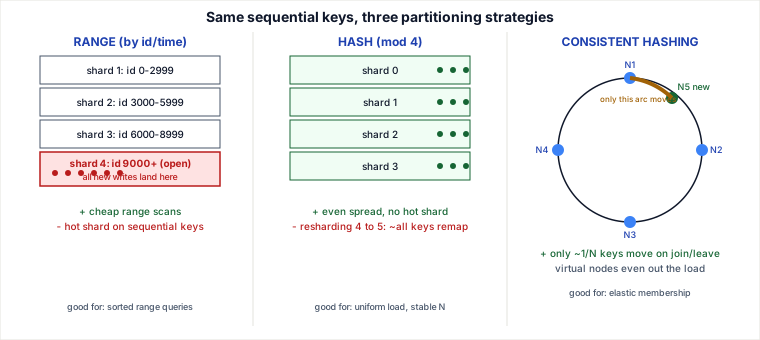
Worked trace: the same hot-key event under all three schemes
Say an order-processing table is keyed by an auto-incrementing
order_id
, sharded across 4 shards. The range boundaries were fixed back when the table held about 12,000 rows — [0, 3,000), [3,000, 6,000), [6,000, 9,000), [9,000, ∞) — with the last range open-ended, as in the diagram above. In one hour, 100,000 new orders arrive with IDs 40,000–140,000 — all higher than anything seen before, because the key is monotonic.
| Scheme | Where the 100,000 new writes land | Resharding 4 → 5 shards |
|---|---|---|
| Range (boundaries fixed at creation, last range open-ended) | 100% land on shard 4 (the only shard whose range covers IDs above 9,000) — a fully saturated hot shard while shards 1–3 idle | ~12.5% of total keys: only the hot shard’s range is split in two — roughly half of that one shard’s data (1/2 × 1/4 of the total) moves to the new shard; shards 1–3 are fully untouched (this is the surgical, auto-splitting move Bigtable/HBase make) |
Hash (
id mod 4
)
|
Each new ID hashes independently, so roughly 25,000 land on each of the 4 shards — no hot shard |
~80–100%:
mod 4
and
mod 5
buckets barely overlap, so nearly every key’s target shard changes even though only one shard was added
|
| Consistent hashing (ring, 4 nodes → 5) | Same as hash — roughly even, ~25,000 per node, because ring position is also a hash of the key |
~20% (
1/N
): only the arc the 5th node claims moves; the other 4 nodes’ arcs, and the keys in them, are untouched
|
Read the two columns together: hash and consistent hashing both fix the sequential-key hot-shard problem range has, but they differ sharply on what a capacity change costs — hash forces you to move almost everything, consistent hashing moves a fifth. That gap is the entire reason consistent hashing exists; plain hashing was already good enough for the "spread the load" half of the problem.
The gotcha interviewers probe:
none of the three schemes fixes a genuinely
hot individual key
— a single celebrity user or a promotional product ID that is 40× hotter than average still hashes (or ranges) to exactly one shard no matter which scheme you use, because a deterministic function of one key always produces one answer. Hashing only fixes skew caused by key
structure
(many sequential keys clustering together); it does nothing for one individual overloaded key. The real fix is orthogonal to partitioning scheme:
salt the hot key
into several sub-keys (
therm-8842#0
..
therm-8842#7
, fanned across shards, merged on read) or put a dedicated cache/read-replica in front of that one key.
When to use which
- Range — choose it when range queries are the primary access pattern (time-range scans, sorted pagination, "last 7 days") and either keys are not monotonic, or your store has automatic hot-shard splitting (Bigtable, HBase, DynamoDB adaptive capacity). Avoid plain range partitioning on strictly increasing keys without auto-splitting — you are choosing the hot-shard failure mode on day one.
-
Hash
— the default for pure key-value access with no range-scan requirement and infrequent resharding: it is simpler to reason about than a ring and is fine as long as you rarely change
N. Mitigate the resharding cost by over-provisioning virtual buckets up front (hash into, say, 4096 logical buckets, then map buckets to physical nodes) so scaling nodes reassigns buckets instead of rehashing keys. - Consistent hashing — choose it whenever node membership changes often: elastic autoscaling, a distributed cache pool (memcached, a CDN edge tier), or a peer-to-peer/Dynamo-style store where nodes routinely join and leave. This is why it is the default for caches and Dynamo-style databases specifically, not for a data warehouse that resizes twice a year.
Monolith vs microservices
A monolith is one process (or a few tightly-coupled ones) sharing one codebase, one deploy pipeline, and usually one database — an in-process function call costs nanoseconds, and a multi-table write either all commits inside one ACID transaction or all rolls back. Microservices split that same logic into independently deployable processes talking over a network — the same call is now a network hop that can time out, arrive twice, or half-succeed, and there is no single transaction spanning both sides anymore.
| Monolith | Microservices | |
|---|---|---|
| Deploy | One artifact, one pipeline — simple | Independent per service — teams ship on their own cadence, but you now run N pipelines |
| Transactions | Cross-table ACID in one process, for free | No cross-service ACID; needs sagas or eventual consistency |
| Refactoring | Rename a function, the compiler/tests catch every call site | A shared contract change means coordinating every consuming service’s release |
| Scaling | All-or-nothing — scale the whole app even if one module is hot | Scale exactly the hot service independently |
| Failure domain | One process: a leak or crash in one module can take down everything | Isolated in principle — if, and only if, calls have timeouts/circuit breakers |
| Team autonomy | Everyone merges to one release train — deploy contention grows with headcount | Each team owns a service end to end (Conway’s Law alignment) |
| Operational surface | One thing to monitor, log, and put on-call | N deploy pipelines, N sets of dashboards, service discovery, distributed tracing |
Traced decision: extracting one service out of a monolith
An e-commerce monolith runs catalog, checkout, inventory, and email inside one app with one Postgres database. Trace the actual decision to extract just checkout, and what it costs.
- Symptom 1 (scale mismatch). On Black Friday, checkout traffic spikes 20× while catalog browsing only spikes 3×. Scaling the whole monolith to survive checkout’s peak means running 20× replicas of catalog and email code paths that never needed it — wasted compute, every release.
- Symptom 2 (team contention). The catalog team’s bug-fix release has to wait behind a promotion-driven deploy freeze the checkout team declared. Two teams are blocked by one shared release train — a people problem, not a performance problem.
- Decision: extract checkout into its own service, leave catalog/email in the monolith.
- What you now must add: checkout no longer shares a transaction with inventory, so "reserve stock, charge card, confirm order" becomes a saga — reserve inventory (compensable), charge payment, confirm order (commits the reservation), with a compensating "release inventory" step if payment fails. The call from checkout to inventory is now a network hop: it needs a timeout, a retry, and an idempotency key so a retried decrement does not double-charge stock. Debugging a failed checkout now needs a request ID threaded through both services ( distributed tracing ) where one stack trace used to suffice. And there are now two deploy pipelines and two on-call rotations to run.
- Net: you traded deploy contention and a scaling mismatch for network latency, saga complexity, and roughly double the operational surface — worth it here because both the team pain and the scale mismatch were specific and real. Extracting catalog too, with no such pain behind it, would add the same tax for nothing.
The rule: start monolith, extract on real pain
Martin Fowler’s widely-cited "MonolithFirst" argument (2015) is still the load-bearing rule of thumb: microservices are primarily an organizational solution — they let independent teams ship independently — not a performance one. A monolith handled well (vertical scaling, read replicas, caching) usually scales fine, and splitting it does not, by itself, make anything faster; a network hop is strictly slower than a function call, so a premature split can make things slower unless the split relieves a genuine team-ownership or scaling-mismatch bottleneck. Decision rule: stay monolith until you can name the specific deploy-contention or scale-mismatch pain (as in the trace above) that a service boundary would remove — then extract just that one boundary, not the whole app at once.
Sync vs async communication
A synchronous call (REST, gRPC) blocks the caller until the callee responds, so the caller’s own success now depends on the callee being both up
and
fast — and that dependency composes across a chain: N synchronous hops multiply availability (roughly
A1 × A2 × ... × An
, each factor under 100%) and add latency (at least the sum of every hop, often more once queueing under load is added). An asynchronous call hands a message to a broker and returns immediately: the caller’s success now depends only on the broker being available, and the broker can buffer a burst that would have overwhelmed a downstream service handling it synchronously.
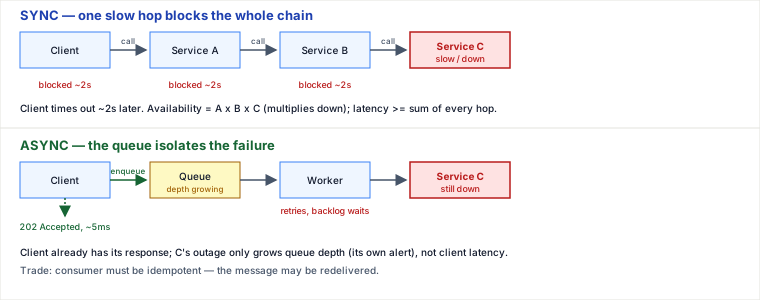
Once you go async: message queue vs event streaming (Kafka)
Going async still leaves a choice between a message queue (RabbitMQ, SQS) and an event log (Kafka-style streaming). The mechanism — offsets, partitions, consumer groups, delivery semantics — is covered in depth on the RabbitMQ vs Kafka vs ActiveMQ page and the Kafka Internals pages; the decision is:
- Message queue — a message goes to one consumer among a competing pool (work distribution), and the broker deletes it once acknowledged. No replay: once consumed, it is gone. This is the right shape for task distribution and RPC-style work items — "process this one job exactly once, then forget it."
-
Event streaming
— every event is appended to a durable, ordered log; multiple independent consumer groups can each read the
same
events at their own pace and offset, and a new consumer can join later and replay history within the retention window. This is the right shape when several independent systems each need to react to the same event (fraud scoring, email, and an analytics warehouse all reacting to
order.created), or when you need to reprocess history after a bug fix.
The decision rules
- Choose sync when the caller needs the result to proceed (checking stock before enabling "add to cart"), the call is fast and simple, and you want the fewest moving parts. Choose async when the caller does not need an immediate answer to keep going (send a confirmation email after checkout), you must absorb bursty load without dropping requests (a flash sale), or you want to isolate a fragile/slow downstream from the caller’s own latency budget.
- Choose event streaming over a plain queue when more than one independent consumer needs the same events, or you need to replay history. Choose a plain queue over streaming when it is pure work distribution to one logical consumer group with no replay requirement — it is the operationally simpler default, and reaching for Kafka when a queue would do adds partitions, offsets, and consumer-group rebalancing for no benefit.
- The cost you always pay for async is idempotency. A message can be delivered more than once — a broker retry, or a consumer crash after processing but before acking — so at-least-once is the realistic default. True exactly-once delivery across an unreliable network is not achievable in general; what you actually build is effectively-once processing on top of at-least-once delivery, via idempotency keys or dedup, and every async consumer must be written assuming redelivery.
Sync vs async/streaming decision matrix
| Choice | Best for | Failure mode | Mitigation |
|---|---|---|---|
| Sync REST/gRPC | Caller needs the result to continue; fast, simple calls. | Callee latency/failure propagates back to the caller; availability multiplies across chains. | Timeouts, circuit breakers, retries with jitter, idempotency keys, bulkheads. |
| Message queue (RabbitMQ, SQS) | Work distribution to one logical consumer group; no replay needed. | Consumer crash after processing but before ack → duplicate work; queue backlog grows silently. | Idempotent consumers; monitor queue depth and consumer lag; dead-letter queues for poison messages. |
| Event streaming (Kafka) | Multiple independent consumers need the same events; replay history. | Consumer lag during bursts; reprocessing can re-emit side effects if not idempotent. | Idempotent consumers; partition/count sizing for throughput; retention policy sized to replay window. |
| Async request/response (callback, polling) | Long-running work where caller needs the outcome later. | Callback lost; polling client gives up; state-machine divergence. | Durable status store with TTL; bounded retries on callback; idempotent status endpoint. |
Monolith → microservices migration case study
An e-commerce monolith runs catalog, pricing, inventory, checkout, shipping, and email in one deployable with one Postgres database. The team decides to extract checkout first because Black Friday checkout traffic spikes 20× while catalog only spikes 3×, and because the checkout team is blocked by the catalog team's deploy freezes. The migration proceeds in phases with explicit rollback triggers.
Phase 0: draw the boundary and the data line
Define the checkout bounded context: cart, pricing calculation, payment authorization, and order confirmation. Draw the data-ownership boundary: checkout owns its own orders and payment-status tables; catalog still owns product data; inventory still owns stock reservations. Any cross-boundary table access must become an API or an event.
Rollback trigger: you cannot draw the boundary without a shared table appearing on both sides. If catalog, pricing, and checkout all write the same promotions table, the seam is wrong — stop and redesign before writing code.
Phase 1: code-level seam without a new process
Refactor the monolith internally so checkout code lives in its own module with a clean interface. Calls from catalog to checkout logic stay in-process, but they now cross a module boundary with an explicit contract. This proves the interface is stable before network latency is introduced.
Rollback trigger: every change still requires touching catalog code because the checkout module leaks abstractions. If the seam is not clean in-process, it will not be clean over the network.
Phase 2: deploy the checkout service as a proxy
Stand up a checkout service that forwards reads and writes to the monolith's checkout module. The monolith still owns the data, but traffic now routes through the new service. Add health checks, metrics, and a circuit breaker on every call path. No business logic changes yet.
Rollback trigger: latency or error rate from the proxy exceeds the SLO for more than one hour. Roll back to direct monolith calls and fix the network path before proceeding.
Phase 3: migrate data ownership
Move the orders and payment-status tables to a database owned by the checkout service. The monolith writes to the checkout service's API instead of the tables. Catalog and inventory read product or stock data through their existing APIs. This is the point of no return; plan a maintenance window or dual-write period.
Rollback trigger: data-consistency checks between the monolith and the new checkout DB show divergence that cannot be reconciled automatically. Dual-write must be proven consistent before cutting over.
Phase 4: retire the monolith checkout module
Once checkout traffic runs exclusively through the new service and the monolith no longer references checkout tables, delete the in-process module. The monolith is now smaller and owns catalog, pricing, inventory, shipping, and email.
Net result: checkout can scale 20× independently, the checkout team ships on its own cadence, and the rest of the monolith is untouched. The tax paid is a network hop, saga-style compensation for inventory reservations, distributed tracing, and a second deploy pipeline — all justified by specific, measured pain.
Data-ownership boundary example
In the checkout extraction above, the boundary rule is simple: only one service writes a given table or document. The table below shows who owns what and how cross-boundary access works.
| Data | Owner | Why | Accessed by others via |
|---|---|---|---|
orders, payment_status |
Checkout service | Checkout decides order lifecycle and payment outcome. | REST/gRPC API or OrderPlaced events. |
products, categories |
Catalog service | Catalog owns the product catalog; pricing reads it to compute totals. | Catalog API; cached locally with TTL in checkout. |
inventory_reservations |
Inventory service | Stock is an inventory concern; checkout must reserve, not own it. | Synchronous reserve API + compensating release on saga failure. |
shipping_labels |
Shipping service | Fulfillment owns physical shipment. | Async OrderConfirmed event consumed by shipping. |
The anti-pattern is a shared database where checkout, catalog, and inventory all write the same tables. That preserves the network tax while reintroducing the deploy coupling the split was supposed to remove.
Pitfalls
- The distributed-monolith anti-pattern. Services deployed "independently" in name but actually coupled: a hard synchronous call chain (A must call B must call C to answer one request), or every service sharing one database (so a schema change still requires coordinating every team), or services that must ship together because of a breaking API change. You pay the full network and operational tax of microservices while getting neither the independent-deploy nor the failure-isolation benefit — worse than either pure option.
- Premature microservices. Splitting before team size or scale pain justifies it: a small team with modest traffic and a dozen services means every change now touches three repos and a service-mesh config to solve a problem that would have been a function call. The team has to be big enough that one shared deploy pipeline is the actual bottleneck before the split pays for itself.
-
Naive stop-the-world resharding.
Doing a hash resharding (
mod Ntomod N+1) as one blocking cutover moves nearly all data at once and can lock writes for the whole migration window. Production systems shadow-migrate with dual-write/dual-read or bucket-indirection instead of a single big-bang rehash. - Assuming hashing fixes a celebrity key. Neither hash partitioning nor consistent hashing helps a single overloaded key — both still route it deterministically to one shard. The fix is salting the key or adding a dedicated cache in front of it, not a different partitioning scheme.
- Sync fan-out amplifies tail latency. A request that fans out to five synchronous downstream calls has its p99 dominated by the slowest of the five (or the sum, if sequential) — one misbehaving dependency drags every caller down with it. Timeouts and circuit breakers on every synchronous hop are mandatory, not optional hardening.
- A silently growing queue is a deferred outage. Async makes the caller feel fine while the backlog grows; if consumers cannot keep up long-term you have only postponed the failure and moved it downstream. Monitor queue depth and consumer lag directly — a healthy caller response code tells you nothing about a queue that is quietly falling behind.
Takeaways
- Range gives cheap range scans but chases hot shards on sequential keys; hash spreads load evenly but remaps almost everything on resharding; consistent hashing keeps the even spread and moves only ~1/N of keys when nodes change — pick it whenever membership changes often.
- Monolith vs microservices is a team/organizational trade-off first and a performance trade-off a distant second: start monolith, extract a service only when deploy contention or a genuine scaling mismatch makes the network-and-ops tax worth paying.
- Sync composes availability (multiplicatively) and latency (additively) across every hop; async decouples both at the cost of eventual consistency and mandatory idempotency on the consumer.
- Queues hand work to one consumer and forget it once acked; event streams keep a replayable log so many independent consumers can each read the same history at their own pace — pick streaming when more than one downstream needs the same events or history must be reprocessed.
Related pages
- Consistent Hashing — the ring mechanics this page's partitioning section summarizes
- Data Partitioning — Fan-out Stragglers, Salting Read Cost & Vertical-Split Hazards (Deep Dive) — deeper treatment of the hot-key salting fix
- System Design Trade-offs II — Retry Storms, Rate-Limiter Coordination, Sticky-Session Rehash & HA≠Lossless (Deep Dive) — companion trade-offs deep dive
- RabbitMQ vs Kafka vs ActiveMQ — full mechanism behind the queue-vs-stream decision
- A Solution to the Monolithic Mayhem — the microservices-extraction motivation behind this page's monolith section
Sources: Karger et al., "Consistent Hashing and Random Trees" (1997); the Amazon Dynamo paper (DeCandia et al., 2007) on consistent hashing and virtual nodes; Google Bigtable and Apache HBase documentation on range partitioning and region splitting; Martin Fowler, "MonolithFirst" (2015) and Fowler & Lewis, "Microservices" (2014); Garcia-Molina & Salem, "Sagas" (1987); Sam Newman, Building Microservices (on the distributed-monolith anti-pattern); Apache Kafka and RabbitMQ documentation on delivery semantics. Re-authored/Deepened for this guide.
🤖 Don't fully get this? Learn it with Claude
Stuck on System Design Trade-offs — Partitioning Strategy, Monolith-vs-Microservices & Sync-vs-Async/Streaming (Deep Dive)? Open Claude, copy a block below, and it'll teach you this exact concept — visually and interactively.
Build the mental picture, not memorization.
I just read a lesson on **System Design Trade-offs — Partitioning Strategy, Monolith-vs-Microservices & Sync-vs-Async/Streaming (Deep Dive)** (System Design) and want to truly understand it. Explain System Design Trade-offs — Partitioning Strategy, Monolith-vs-Microservices & Sync-vs-Async/Streaming (Deep Dive) from first principles using ONE vivid real-world analogy and a visual mental model — draw it as ASCII art or a clear step-by-step diagram — with a concrete example using real numbers. Then ask me one question to check I got the mental picture, and wait for my reply. If you're unsure or a claim isn't standard, say so and reason from first principles instead of guessing.
Socratic — adapts to where you're stuck.
Teach me **System Design Trade-offs — Partitioning Strategy, Monolith-vs-Microservices & Sync-vs-Async/Streaming (Deep Dive)** interactively. Ask me ONE guiding question at a time, wait for my answer, and adapt to my confusion — build the idea with me step by step instead of explaining it all at once. If you're unsure or a claim isn't standard, say so and reason from first principles instead of guessing.
Active recall exposes what you missed.
Quiz me on **System Design Trade-offs — Partitioning Strategy, Monolith-vs-Microservices & Sync-vs-Async/Streaming (Deep Dive)** with 5 questions, easy to tricky, ONE at a time. Tell me if each answer is right; at the end, explain clearly what I got wrong and why. If you're unsure or a claim isn't standard, say so and reason from first principles instead of guessing.
Intuition + hook + flashcards for long-term memory.
Help me remember **System Design Trade-offs — Partitioning Strategy, Monolith-vs-Microservices & Sync-vs-Async/Streaming (Deep Dive)** for the long term: give the one-sentence intuition, a memorable hook/mnemonic, a tiny worked example, and 3 active-recall flashcards (Q -> A). If you're unsure or a claim isn't standard, say so and reason from first principles instead of guessing.