A Solution to the Monolithic Mayhem
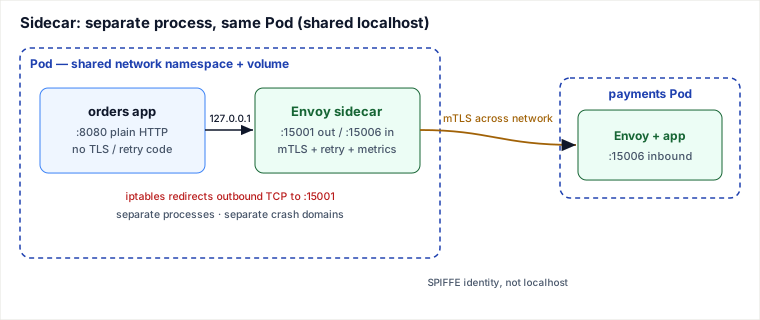
The Sidecar Pattern moves a cross-cutting concern (TLS, retries, telemetry, config sync) out of your application and into a separate process running in its own container, co-deployed alongside the app in the same unit (a Kubernetes Pod), where the two share a network namespace (localhost) and lifecycle but keep separate memory, crash domains, and language runtimes — so the app talks to the sidecar over a loopback socket and stays oblivious to the plumbing.
The name is a motorcycle sidecar: bolted to the main bike, riding everywhere it rides, but its own compartment. That separation — same host, different process — is the entire point. If it ran inside your process it would just be a library.
Correcting the common myth
Two things people get wrong, both of which invert the pattern:
- "The sidecar runs in the same process as the app." No. It is a distinct OS process (usually a distinct container). It shares the Pod's network namespace and volumes, so it reaches the app over
127.0.0.1with no cross-node hop — but a bug or memory leak in the sidecar cannot corrupt the app's heap, and vice-versa. Shared address space would defeat fault isolation and force both to be the same language. - "Scale the auth sidecar independently when logins spike." No. A sidecar is deployed one-per-instance. It is glued to its app container in the same Pod, so it scales with the app: 40 order-service Pods means 40 order sidecars. You cannot run 3 apps and 300 sidecars. Something you scale independently is a separate service, not a sidecar.
A real sidecar: the service-mesh proxy
The canonical production example is Envoy injected by a service mesh (Istio, Linkerd). Your orders service is plain Python speaking unencrypted HTTP and knows nothing about mutual TLS, retries, or metrics. The Envoy sidecar in its Pod handles all of it transparently. Other real sidecars: a log shipper (Fluent Bit tailing a shared volume), a config-reload agent, or a secrets-fetch agent.
Before / after: what the sidecar actually changes
The Problem page ended with the monolith that survives decomposition: 30 services × up to 3 languages, each carrying its own in-process copy of the same plumbing. Here is what moves when that plumbing becomes a sidecar:
| Concern | Before — in-process library (30 services × 3 languages) | After — sidecar |
|---|---|---|
| TLS / mTLS | A TLS library per language stack; patching one CVE = up to 90 library-upgrade builds and a fleet-wide redeploy of application code | 1 proxy image rolled fleet-wide; apps untouched |
| Retries / timeouts | Java, Go, and Python each reimplement the policy; behavior drifts per team and per library version | One policy, declared in config, byte-for-byte identical for every language |
| Metrics / tracing | Instrumentation code in every codebase; coverage gaps wherever a team skipped it | Emitted uniformly by the proxy for every service, zero app code |
| Config / policy change | A code change + redeploy, per service, per language | A config push to the sidecar fleet; no app rebuild |
That is the leverage: the concern lives in a co-located process, not in each language's runtime — so a polyglot fleet gets identical behavior without shared library code, and the upgrade unit shrinks from "every service" to "one image". How the packets actually move through that process — the iptables capture, ports 15001/15006, wire addressing — is traced step-by-step on the Architecture page; this page stays at the before/after level.
Pitfalls
- Who broke it? Debugging spans two processes. A failure could be the app, the sidecar config, or the iptables redirect. Silent redirect misconfiguration is a classic "it works on my machine, times out in prod" trap.
- The operational bill. The recurring costs — per-Pod memory/CPU, the startup and shutdown ordering races, the loopback latency tax, and fleet-wide version skew — are cataloged with numbers in the Introduction to the Sidecar Pattern page's pitfalls; they apply unchanged here.
When to use it, when not to
Choose a sidecar when: a cross-cutting concern (mTLS, retries/circuit-breaking, rate limiting, tracing, log shipping) must be applied uniformly across many services written in different languages, and you cannot realistically ship and upgrade a shared library in every one of them. It shines for east-west (service-to-service) traffic and when each instance needs its own identity or config.
Trade-offs vs. named alternatives
- vs. Shared library / in-process (gRPC interceptors, Resilience4j, Netflix Ribbon/Hystrix): The library has no extra hop and no extra memory — fastest and leanest. But it couples every service to one language and forces lockstep upgrades across all teams whenever the resilience logic changes. A polyglot shop simply can't. Gain of sidecar: language independence + upgrade decoupling; cost: latency hop + per-Pod overhead.
- vs. Node agent / DaemonSet (one proxy per node, shared by all Pods on it): Far less overhead — one process amortized over many Pods. But you lose per-Pod isolation and per-workload identity, and you inherit noisy-neighbor blast radius: one bad tenant can starve the shared agent. Choose sidecar when per-instance identity/isolation matters; choose DaemonSet when aggregate overhead dominates.
- vs. API Gateway / central proxy: A gateway governs north-south edge traffic at one choke point; it does not secure or retry internal service-to-service calls, and centralizing all east-west traffic through it recreates a bottleneck. They are complementary, not substitutes.
Failure modes: when the sidecar breaks
The sidecar is supposed to make the app more resilient, but it is also a new failure domain. Because traffic is transparently redirected through it, a broken sidecar can break the app even when the app itself is fine.
- Sidecar crash / OOM. If Envoy dies, the iptables redirect still points to a dead socket. Outbound calls from the app fail with connection refused until Kubernetes restarts the sidecar. The app sees it as "the network is down." Liveness and readiness probes must catch this quickly; the app should also tolerate brief loopback failures.
- mTLS certificate expiry. Certificates issued by the mesh control plane have a TTL. If rotation breaks or the control plane is unreachable, the sidecar cannot mint or validate identities. Traffic starts failing with TLS handshake errors. Monitor cert expiry and control-plane connectivity.
- Bad sidecar config. A misapplied retry policy, wrong cluster endpoint, or overly aggressive timeout can drop or delay valid traffic. Config changes should roll out canary-by-cell just like application changes.
- Control-plane outage. In many meshes, the data plane (Envoy) can keep routing with its last known config even if Istiod/Linkerd control plane is down — but new Pods cannot bootstrap, and config updates stop. Know whether your mesh is control-plane-dependent for steady-state traffic.
- Observability split. Request metrics live in the sidecar, application metrics live in the app, and logs live in both. Correlate them with a shared trace ID carried across the loopback hop; otherwise you will debug in two disconnected tools.
- Left in PERMISSIVE mTLS mode. During a mesh rollout, mTLS usually runs in
PERMISSIVEmode (accept both plaintext and mTLS) so not-yet-injected callers keep working. If the fleet is never flipped toSTRICTafter the migration deadline, plaintext east-west traffic is silently still accepted — you believe you have mTLS everywhere but you do not. Treat the switch to STRICT as an explicit migration exit-criterion, and alert if PERMISSIVE outlives the cutover.
Decide: choose the sidecar when you have polyglot services, east-west traffic, and per-instance identity; prefer a shared library in a single-language shop where latency/memory are critical; prefer a DaemonSet agent when per-Pod overhead is the binding constraint and strict isolation isn't required.
Takeaways
- A sidecar is a co-located separate process sharing the Pod's network namespace — never the same process; that separation is what buys language independence and fault isolation.
- It scales one-per-instance, in lockstep with its app — independent scaling means you designed a separate service, not a sidecar.
- You pay for the decoupling with per-Pod memory/CPU, an extra loopback hop, and startup/shutdown ordering hazards.
- Pick it for polyglot, east-west cross-cutting concerns; a shared library wins on raw latency/footprint, a DaemonSet wins on aggregate overhead.
Re-authored and deepened for this guide. Sources: Bilgin Ibryam & Roland Huß, Kubernetes Patterns (Sidecar and Ambassador chapters); the Istio and Envoy documentation on sidecar injection, mutual TLS, and retry policies; Microsoft Azure Architecture Center, "Sidecar pattern"; and the CNCF SPIFFE/SPIFFE-ID identity model.
🤖 Don't fully get this? Learn it with Claude
Stuck on A Solution to the Monolithic Mayhem? Open Claude, copy a block below, and it'll teach you this exact concept — visually and interactively.
Build the mental picture, not memorization.
I just read a lesson on **A Solution to the Monolithic Mayhem** (System Design) and want to truly understand it. Explain A Solution to the Monolithic Mayhem from first principles using ONE vivid real-world analogy and a visual mental model — draw it as ASCII art or a clear step-by-step diagram — with a concrete example using real numbers. Then ask me one question to check I got the mental picture, and wait for my reply. If you're unsure or a claim isn't standard, say so and reason from first principles instead of guessing.
Socratic — adapts to where you're stuck.
Teach me **A Solution to the Monolithic Mayhem** interactively. Ask me ONE guiding question at a time, wait for my answer, and adapt to my confusion — build the idea with me step by step instead of explaining it all at once. If you're unsure or a claim isn't standard, say so and reason from first principles instead of guessing.
Active recall exposes what you missed.
Quiz me on **A Solution to the Monolithic Mayhem** with 5 questions, easy to tricky, ONE at a time. Tell me if each answer is right; at the end, explain clearly what I got wrong and why. If you're unsure or a claim isn't standard, say so and reason from first principles instead of guessing.
Intuition + hook + flashcards for long-term memory.
Help me remember **A Solution to the Monolithic Mayhem** for the long term: give the one-sentence intuition, a memorable hook/mnemonic, a tiny worked example, and 3 active-recall flashcards (Q -> A). If you're unsure or a claim isn't standard, say so and reason from first principles instead of guessing.