The Inner Workings of the Event-Driven Architecture Pattern
An event-driven system works because a state change is written once as an immutable record to a durable, append-only log, and every interested consumer reads that record independently, at its own position — so the producer appends, gets an acknowledgement, and moves on without knowing, waiting for, or being slowed by anyone downstream.
The box diagram (producer → bus → consumer) tells you the shape. It does not tell you why the pattern behaves the way it does under load or failure. Two mechanisms do that, and they are what a working engineer actually reasons about:
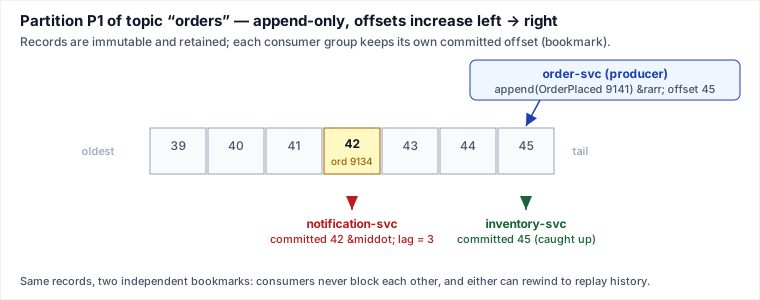
- The log-and-offset model. A channel (Kafka topic, Kinesis stream, a partition) is not a queue that hands out a message and forgets it. It is an ordered sequence of records with monotonically increasing offsets. The broker retains records for a configured window (hours, days, forever). Each consumer group stores its own committed offset — its bookmark. Consumption is just "read from my bookmark forward, then advance it."
- Delivery semantics. Because the bookmark is committed separately from the work, the exact interleaving of process and commit decides whether you get at-most-once, at-least-once, or (with more machinery) effectively-once. This single choice is the source of most EDA bugs.
Trace one event through the log
Topic orders, 3 partitions. The partition is chosen by hash(key) mod 3 where key = customerId — so every event for one customer lands in the same partition and stays ordered relative to each other. Two independent consumer groups subscribe: inventory-svc (reserve stock) and notification-svc (send email). Each group keeps its own committed offset per partition.
A new order arrives:
OrderPlaced { orderId: 9134, customerId: "C-42", total: 79.90, ts: 12:00:03 }
hash("C-42") mod 3 = 1 → partition P1| # | Actor | Action | State after |
|---|---|---|---|
| 1 | order-svc (producer) | Appends OrderPlaced to P1; broker writes it and returns an ack carrying the assigned offset. | P1 tail = offset 42; producer moves on |
| 2 | inventory-svc | Committed offset was 41. Polls P1, receives offset 42, reserves 1 unit of stock, then commits 42. | inventory committed = 42; stock reserved for 9134 |
| 3 | notification-svc | Slower group — committed offset was 39. Polls, receives 40, 41, 42 in order, emails the customer for 9134, commits 42. | notification committed = 42; lag briefly hit 3 |
| 4 | inventory-svc | Crashes after reserving stock for 9134 but before the commit lands. On restart it re-reads from its last committed offset (41) → receives 42 again. | Duplicate delivery of 9134 |
| 5 | inventory-svc | Because it dedupes on orderId 9134 (already reserved), the second processing is a no-op. Commits 42. | Correct: stock reserved once, idempotent |
Nothing in steps 2 and 3 coordinated. The two groups read the same physical records at different speeds and committed different bookmarks. Step 4 is the whole game: at-least-once means "process then commit," which guarantees no lost event but permits duplicates — so the consumer must be idempotent. Flip the order (commit then process) and you get at-most-once: a crash between commit and work silently loses the event.
One bookkeeping nuance: this trace says “commits 42” meaning “42 is done.” Kafka’s API actually stores the next offset to consume, so the literal call commits 43 — a committed position of 42 would mean record 42 itself gets redelivered. Same semantics, off-by-one convention — worth knowing before you read consumer-group tooling output (and it is the convention the PhotoUploaded trace on the previous page uses: reads offset 2, commits offset 3).
Why per-partition ordering is the quiet load-bearing detail
Order is guaranteed only within a partition, never across the topic. That is a direct consequence of the mechanism: a single append-only log is totally ordered, but a topic is many logs read in parallel. So the partition key is a design decision, not a config knob. Key by customerId and every event for C-42 stays in causal order (OrderPlaced before OrderCancelled). Key by eventId (effectively random) and those two events can land in different partitions and be processed out of order — a cancellation applied before the order exists. The pattern gives you ordering; you have to hand it the right key to get the ordering you want.
Pitfalls
- Assuming duplicates won't happen. At-least-once is the default in every real broker. If your consumer isn't idempotent, retries and rebalances double-charge cards and double-ship orders. Dedupe on a business key (
orderId) or an idempotency token — not on "it usually works." - Poison messages block the partition. Because a partition is consumed in strict offset order, one un-processable record (bad schema, a bug that always throws) stalls every record behind it — head-of-line blocking. Without a dead-letter topic and a retry policy, one bad event freezes a whole customer's stream.
- Invisible backpressure via consumer lag. The producer never slows down for a slow consumer — that's the whole point — so a lagging group silently falls further behind (notification-svc at lag 3 today, 300k tomorrow). Lag per partition is the health metric; if you don't alert on it, the first symptom is stale reads with no error anywhere. Two adjacent signals betray a group in trouble before lag explodes: a rising
offset-commitfailure rate (work is done but the bookmark won't advance, so everything will be reprocessed) and rebalance storms (a flapping member repeatedly triggers partition reassignment, and no one makes progress during a rebalance). - Fire-and-forget producers lose events. If the producer doesn't wait for the broker ack (acks=0/1 with no replication), a broker crash drops the record before it's durable. The producer already "succeeded," so nothing retries. Require acks from a quorum of replicas for anything that matters.
- Schema drift breaks consumers you forgot exist. The producer's power to not know its consumers cuts both ways: rename or drop a field and some subscriber deserialization fails in production. Use a schema registry with compatibility rules; add fields, never repurpose them.
When to use it, when not to
The alternative isn't "another queue library" — it's synchronous request/response (REST/gRPC), where a caller invokes a service and blocks for the answer. That is the real fork.
Reach for event-driven when the signals point this way:
- Fan-out. One fact (OrderPlaced) must trigger many independent reactions (inventory, billing, email, analytics) and the set of reactors grows over time. With request/response the producer must call each one and know all of them; with EDA it appends once and new consumers subscribe without the producer changing.
- Temporal decoupling. The consumer may be down, slow, or scaling when the event happens. The log holds the event until it catches up. A synchronous call would fail or block.
- Spiky load. The log absorbs a burst and consumers drain at their own rate — the buffer is the smoothing. Synchronous chains propagate the spike and cascade failures.
- Replay and audit. Retained events let you rebuild a broken read model or onboard a new service by replaying history — the foundation of Event Sourcing, and of CQRS where write-side handlers and read-side views are modelled separately off the same stream.
Prefer request/response when: the caller needs the answer now to proceed (does this user have permission? what's the price?); you need read-your-writes / strong consistency at the point of the call; or the interaction is a simple one-to-one query with no fan-out. Forcing these through events buys you eventual consistency you didn't want and a debugging story spread across five services.
The cost of choosing events: you trade a single stack trace for a distributed one. You inherit eventual consistency, duplicate handling, ordering-by-partition-key, lag monitoring, a schema registry, and dead-letter plumbing. That machinery is worth it exactly when decoupling and fan-out are the point — and pure overhead when they aren't.
Choose this when many independent consumers must react to facts and can tolerate eventual consistency; prefer request/response when the caller needs an immediate, consistent answer from one known service.
(One layer down, if you've already chosen EDA: a broker topology — dumb log, smart consumers, like the trace above — scales fan-out and keeps services decoupled; a mediator/orchestrator topology adds a central component that sequences a multi-step workflow. Prefer the mediator only when a business process has real ordering and compensation logic that needs one owner.)
Takeaways
- The mechanism is a durable, ordered, append-only log plus per-consumer offsets — not a fire-and-forget message bus. Everything else (fan-out, replay, decoupling) falls out of that.
- The process-then-commit ordering gives at-least-once delivery, so idempotent consumers are mandatory, not optional.
- Ordering is per-partition; the partition key is the design lever that decides which events stay causally ordered.
- Choose EDA for fan-out, temporal decoupling, and replay; choose request/response when a caller needs an immediate, consistent answer.
Re-authored and deepened for this guide. Draws on Martin Fowler, “What do you mean by Event-Driven?” and “Event Sourcing / CQRS” (martinfowler.com); the Apache Kafka documentation on partitions, offsets, consumer groups, and delivery semantics; Neha Narkhede, Gwen Shapira & Todd Palino, Kafka: The Definitive Guide (O’Reilly); and Sam Newman, Building Microservices, 2nd ed. (O’Reilly), on event-driven collaboration and its trade-offs versus request/response.
🤖 Don't fully get this? Learn it with Claude
Stuck on The Inner Workings of the Event-Driven Architecture Pattern? Open Claude, copy a block below, and it'll teach you this exact concept — visually and interactively.
Build the mental picture, not memorization.
I just read a lesson on **The Inner Workings of the Event-Driven Architecture Pattern** (System Design) and want to truly understand it. Explain The Inner Workings of the Event-Driven Architecture Pattern from first principles using ONE vivid real-world analogy and a visual mental model — draw it as ASCII art or a clear step-by-step diagram — with a concrete example using real numbers. Then ask me one question to check I got the mental picture, and wait for my reply. If you're unsure or a claim isn't standard, say so and reason from first principles instead of guessing.
Socratic — adapts to where you're stuck.
Teach me **The Inner Workings of the Event-Driven Architecture Pattern** interactively. Ask me ONE guiding question at a time, wait for my answer, and adapt to my confusion — build the idea with me step by step instead of explaining it all at once. If you're unsure or a claim isn't standard, say so and reason from first principles instead of guessing.
Active recall exposes what you missed.
Quiz me on **The Inner Workings of the Event-Driven Architecture Pattern** with 5 questions, easy to tricky, ONE at a time. Tell me if each answer is right; at the end, explain clearly what I got wrong and why. If you're unsure or a claim isn't standard, say so and reason from first principles instead of guessing.
Intuition + hook + flashcards for long-term memory.
Help me remember **The Inner Workings of the Event-Driven Architecture Pattern** for the long term: give the one-sentence intuition, a memorable hook/mnemonic, a tiny worked example, and 3 active-recall flashcards (Q -> A). If you're unsure or a claim isn't standard, say so and reason from first principles instead of guessing.