Transactional Outbox — Solving the Dual-Write Problem
The problem: two writes that cannot be atomic
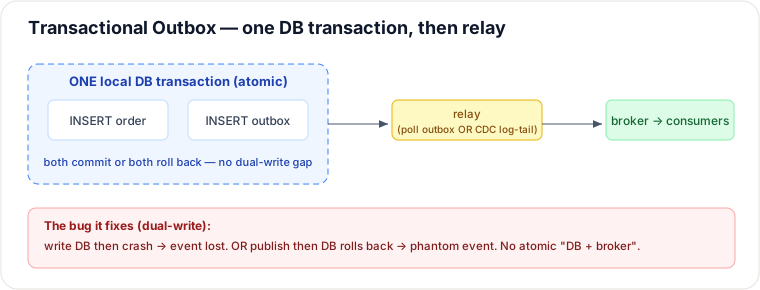
Placing an order must (1) save the order in the database and (2) publish an OrderPlaced event to a broker so Inventory, Email, and Analytics react. Those are two systems with no shared transaction. A crash between them produces one of two disasters:
- DB commits, publish never happens — silent missing event; inventory never reserves.
- Publish succeeds, DB rolls back — phantom event; consumers act on an order that does not exist.
This is the dual-write problem. It is not fixed by "try/catch and hope" or by a distributed transaction across Postgres and Kafka in most real fleets.
The fix: outbox row in the same local transaction
Insert the business change and an outbox row in one local DB transaction. Both commit or both roll back — no dual-write gap. A separate relay reads unsent outbox rows, publishes to the broker, then marks them sent.
- Polling publisher —
SELECT … FOR UPDATE SKIP LOCKEDon pending rows. Simple; adds DB load; latency ≈ poll interval. - CDC log tailing — Debezium/etc. tails WAL/binlog of outbox (or of business tables). Lower poll load; more moving parts.
Crash timeline (the part people skip)
| t | What happens | Outbox state | Broker |
|---|---|---|---|
| 1 | BEGIN; INSERT order; INSERT outbox(id=E9, status=pending); COMMIT | pending | — |
| 2 | Relay reads E9, publishes to Kafka successfully | pending | E9 delivered |
| 3 | Relay crashes before mark-sent | pending | E9 present |
| 4 | Relay restarts, reads E9 again, publishes again | pending → sent | E9 duplicate |
Therefore publishing is at-least-once. Consumers must be idempotent (dedupe on event id or business key). The outbox does not buy exactly-once end-to-end; it buys no silent loss and no phantom without a commit.
Mark-sent must be conditional and safe
-- Wrong: blind update races two relays
UPDATE outbox SET status = 'sent' WHERE id = 'E9';

-- Better: only pending → sent, single winner
UPDATE outbox SET status = 'sent', sent_at = now()
 WHERE id = 'E9' AND status = 'pending';
-- check rowcount == 1; if 0, another worker won or already sent
Use leasing (SKIP LOCKED), partition by id, or a single-threaded relay per shard to limit double-publish windows — but still assume duplicates can occur after publish-before-mark.
Ordering
If consumers need per-aggregate order, either: (1) relay publishes in outbox insertion order for that aggregate key, or (2) put ordering keys on the broker (Kafka partition key = orderId). Concurrent relays without care can reorder — prefer ordered poll per partition or CDC stream order.
When NOT to use an outbox
- No external event consumers — pure single-DB app; skip the pattern.
- Broker is system of record (event-sourced write path appends to log first) — different design; dual-write shape inverted.
- You can keep side effects in the same DB transaction (no message bus) — do that.
- 2PC/XA across DB and broker — rare, operationally heavy; outbox is the usual microservice choice.
Failure / operability
- Relay down — outbox backlog grows; business commits succeed but downstream freezes. Alert: oldest pending age, pending count.
- Poison payload — unparseable row blocks a naive single-threaded poller. Isolate bad rows; DLQ the publish side.
- Table bloat — delete or archive sent rows on a schedule; index status+id.
- Clock / multi-region — one writer region for an aggregate's outbox to avoid split-brain emits.
Decision defensibility
Why not "publish then write DB"? Phantoms on rollback. Why not "write DB then publish in the request thread"? Loss on crash after commit — same dual-write. Why not inbox-only on consumer? Consumer inbox helps idempotent receive; it does not create the missing event if the producer never published. Outbox is the producer-side half of reliable messaging; inbox/idempotency is the consumer-side half.
Drill ladder
- Q: DB committed order, relay never ran. User impact? A: Order exists; no downstream reactions until relay catches up — lag, not permanent loss if outbox row exists.
- Q: Why consumers still need idempotency with outbox? A: Publish-then-crash-before-mark causes redelivery.
- Q: Poll every 5s vs CDC — one trade-off. A: Poll: simple, +latency and DB load. CDC: fresher, more infra and failure modes.
- Q: Dispatcher is down for an hour — walk the blast radius. A: Business commits keep succeeding (no user-facing failure); outbox backlog and oldest-pending age grow; downstream projections/sagas freeze. On restart the relay drains in insertion order, so consumers see a burst of stale-but-ordered events — customer-visible lag, not loss. Alert on oldest-pending age, not just count.
Takeaways
- Cannot atomically write DB + broker → write event to outbox in the same transaction, then relay.
- Relay implies at-least-once publish → idempotent consumers.
- Mark-sent is conditional; monitor backlog age; this is how sagas and CQRS projections receive reliable facts.
Re-authored for this guide. Sources: Richardson, Microservices Patterns (transactional outbox); Kleppmann on dual writes; Debezium outbox routing docs. Diagram hand-authored.
🤖 Don't fully get this? Learn it with Claude
Stuck on Transactional Outbox — Solving the Dual-Write Problem? Open Claude, copy a block below, and it'll teach you this exact concept — visually and interactively.
Build the mental picture, not memorization.
I just read a lesson on **Transactional Outbox — Solving the Dual-Write Problem** (System Design) and want to truly understand it. Explain Transactional Outbox — Solving the Dual-Write Problem from first principles using ONE vivid real-world analogy and a visual mental model — draw it as ASCII art or a clear step-by-step diagram — with a concrete example using real numbers. Then ask me one question to check I got the mental picture, and wait for my reply. If you're unsure or a claim isn't standard, say so and reason from first principles instead of guessing.
Socratic — adapts to where you're stuck.
Teach me **Transactional Outbox — Solving the Dual-Write Problem** interactively. Ask me ONE guiding question at a time, wait for my answer, and adapt to my confusion — build the idea with me step by step instead of explaining it all at once. If you're unsure or a claim isn't standard, say so and reason from first principles instead of guessing.
Active recall exposes what you missed.
Quiz me on **Transactional Outbox — Solving the Dual-Write Problem** with 5 questions, easy to tricky, ONE at a time. Tell me if each answer is right; at the end, explain clearly what I got wrong and why. If you're unsure or a claim isn't standard, say so and reason from first principles instead of guessing.
Intuition + hook + flashcards for long-term memory.
Help me remember **Transactional Outbox — Solving the Dual-Write Problem** for the long term: give the one-sentence intuition, a memorable hook/mnemonic, a tiny worked example, and 3 active-recall flashcards (Q -> A). If you're unsure or a claim isn't standard, say so and reason from first principles instead of guessing.