Performance Implications
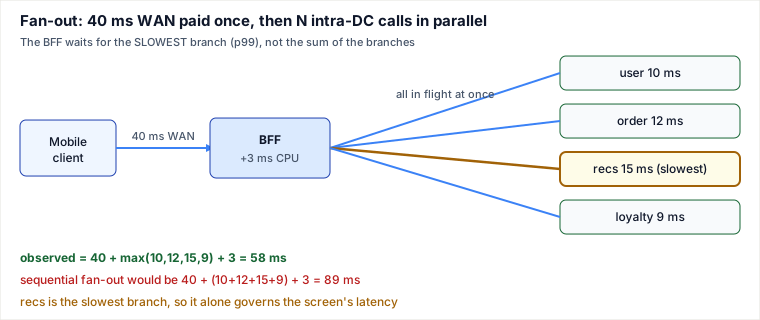
A BFF is not a free extra hop: the client already pays the wide-area round trip to reach the region once, and the BFF turns what would have been N wide-area round trips into N intra-datacenter calls issued in parallel — so its whole latency story is "move the fan-out from the 40 ms WAN side to the 1–2 ms intra-DC side, and then pay for the slowest branch, not the sum."
The archived version of this page was a bullet list — "network latency," "resource utilization," "caching challenges," "load on backend" — each answered with "optimize the code / scale resources." That names the right worries but never quantifies any of them, so it cannot tell you whether a BFF helps or hurts. Below, each implication is traced with real numbers.
1. Marginal cost: the client already paid the expensive hop
Without a BFF a chatty client fetches each resource itself. When the calls are dependent (fetch the order list, then a detail call per order) they serialize into N wide-area round trips; even when they are independent, the client still opens N separate WAN connections from a high-latency radio and its result is bounded by the slowest of N 40 ms legs. With a BFF the client pays one 40 ms WAN RTT to reach the region; the BFF then issues the N calls over the intra-DC network (~1–2 ms each) in parallel, plus a ~2–4 ms CPU tax to decode, trim, and re-encode the merged JSON.
| N resources per screen | Without BFF: N sequential WAN RTTs | With BFF: 40 + max(intra-DC ~2) + 3 ms CPU |
|---|---|---|
| 1 | 40 ms | 45 ms |
| 2 | 80 ms | 45 ms |
| 3 | 120 ms | 45 ms |
| 6 | 240 ms | 45 ms |
At N = 1 the BFF loses by its ~5 ms tax (45 vs 40). The crossover is N = 2; past it the client-side cost grows linearly (N × 40 ms) while the BFF cost stays flat at ~45 ms, because the fan-out now happens on the fast intra-DC network. The honest caveat: a client on a fast link that could perfectly parallelize independent calls also pays ~40 ms once — but it still opens N WAN connections, couples itself to your service topology, and re-implements auth and retry N times. The BFF's win is largest exactly where clients are chatty and links are slow (mobile).
2. Fan-out tail latency: you pay the p99, not the mean
A home screen fans out to user (10 ms), order (12 ms), recs (15 ms), and loyalty (9 ms) in parallel. The aggregate costs max = 15 ms, not the sum = 46 ms — but you only get 15 ms if none of the four hangs, because the response is only as fast as its slowest branch and returns nothing if you await all and one stalls.
Since the BFF blocks on the slowest of N independent calls, its latency is drawn from the tail of the backend distribution, not the mean. If each backend finishes under its p99 (say 10 ms) with probability p = 0.99, then all N finish fast with probability pN, and the chance that at least one is slow is 1 − pN:
| N parallel calls | P(all under 10 ms) = 0.99N | P(≥1 slow) = 1 − 0.99N |
|---|---|---|
| 1 | 0.990 | 1.0% |
| 5 | 0.951 | 4.9% |
| 10 | 0.904 | 9.6% |
| 20 | 0.818 | 18.2% |
| 100 | 0.366 | 63.4% |
A backend that misses its 10 ms p99 only 1% of the time makes ~9.6% of 10-way fan-outs slow (1 − 0.9910 ≈ 0.096), and a 100-way fan-out is slow ~63% of the time. The tail dominates as you widen the fan-out — this is the core result of Dean & Barroso, "The Tail at Scale." Mitigations, in order: (a) fan out in parallel, never sequentially — sequential turns max into sum (89 ms vs 58 ms on the trace below); (b) give each call a deadline below the client timeout (e.g. 80 ms) and return a partial response — render greeting + orders, hide the loyalty widget — so one 900 ms loyalty stall doesn't turn a 15 ms screen into a 900 ms one; (c) hedged requests — after the p95 elapses, fire a duplicate to a second replica and take the first to answer, clipping the tail at the cost of a little extra load.
3. N-BFF read amplification: one fan-out per client type
One BFF per client type (mobile, web, partner) means each client type re-runs the same fan-out, so a shared backend's read QPS is multiplied by the number of BFFs — minus whatever each BFF's cache absorbs. Trace it: the home screen reads user-service once per load, and mobile and web each serve 5,000 screen-loads/s.
| Configuration | user-service read QPS |
|---|---|
| Mobile BFF only | 5,000 |
| + Web BFF | 10,000 |
| + Partner BFF | 15,000 |
| 3 BFFs, each with a 30 s TTL profile cache at 90% hit | 3 × 500 = 1,500 |
Two mechanisms collapse the load:
- BFF-side cache. Because the BFF sees every request of its client type, a warm entry is shared across all of that client's users. Key it by (client-type, resource, version) and honor the downstream
Cache-Control. A 30 s TTL on profile reads (which rarely change within a session) turns repeat reads into hits; at a 90% hit rate each BFF sends only 5,000 × 0.10 = 500 QPS to user-service instead of 5,000, so three BFFs land at 1,500 QPS instead of 15,000 — a 10× cut. Per-client keys also let mobile and web hold different freshness without fighting over one entry. - Batch endpoints kill N+1. A feed of 20 items that each needs an author profile is an N+1 pattern: 1 feed call + 20 profile calls = 21 calls per load. Replace the 20 per-item reads with one
GET /users?ids=…— 2 calls per load. On the profile endpoint specifically that is 5,000 × 20 = 100,000 QPS collapsing to 5,000 QPS (20×); total calls per load fall 21 → 2.
Pitfalls
- Sequential fan-out. Awaiting call A before firing B turns max into sum — 58 ms becomes 89 ms on the trace above, and the gap grows with N. Fire every independent call concurrently; only serialize a call that genuinely needs a prior call's output.
- Await-all with no timeout stalls the whole response. If the BFF awaits every branch with no per-call deadline, one 900 ms loyalty stall holds the entire 15 ms screen — and the BFF's thread/connection — hostage. Set a per-branch deadline below the client timeout and return a partial response for non-critical widgets. Watch the gap
bff_fanout_p99 − max(branch_p99): when the aggregate p99 pulls away from the slowest branch it is calling, that excess is queueing/await overhead inside the BFF, not a slow backend. - BFF sprawl. One BFF per minor client variant multiplies backend read load (section 3) and duplicates aggregation and auth logic across codebases — five BFFs is five places to patch when one auth rule changes. Share common logic via libraries or an internal aggregation service; don't spawn a BFF per trivial variation.
Selection & trade-offs
| Approach | You gain | It costs | Choose it when |
|---|---|---|---|
| BFF (per-client gateway) | Fan-out moves to the fast intra-DC network; one WAN RTT; response tailored and trimmed per client (mobile ships less) | One more edge per client type; duplicated logic; backend read amplification | Client needs diverge (mobile vs web vs partner) and screens are chatty over high-latency links |
| Generic API gateway (one shared edge) | A single edge for every client; uniform auth / TLS / rate-limit; one component to run | Lowest-common-denominator responses; becomes a contended monolith when clients pull it in different directions | Cross-cutting edge concerns dominate and client needs are similar |
| Client-side composition (client calls services directly) | No extra hop or component; fewest moving parts | N WAN round trips from a far device; client coupled to service topology; every client re-implements auth / retry | Few services, trusted low-latency callers, or a web SPA on a fast link making 1–2 calls |
Reach for a BFF when the fan-out is wide, the link is slow, and clients diverge; a generic gateway when clients are uniform and you want one place for edge concerns; client-side composition when the device is on a fast link and the call count is tiny. They compose: a generic gateway for auth/TLS at the public edge, with a BFF per client type behind it for aggregation and shaping.
Takeaways
- The BFF's real cost is marginal: it converts N WAN round trips (N × 40 ms) into one 40 ms RTT + a parallel intra-DC fan-out + ~3 ms CPU (~45 ms, flat in N), so it wins as soon as N ≥ 2 and the gap widens with N.
- Fan-out latency is a tail phenomenon: waiting on the slowest of N calls, a backend that is slow just 1% of the time makes ~9.6% of 10-way fan-outs slow (1 − 0.9910). Parallelize, deadline + partial response, and hedge.
- N BFFs multiply a shared backend's read load N-fold; a 30 s BFF cache at 90% hit and batch endpoints each cut it ~10–20×.
- Prefer a BFF over a generic gateway when clients diverge and links are slow; over client-side composition when the screen is chatty and the device is far.
Re-authored and deepened for this guide. Sources include Jeff Dean & Luiz Barroso, "The Tail at Scale" (CACM, 2013) for fan-out tail latency and hedged requests; Sam Newman, Building Microservices (2nd ed.) on the BFF pattern and aggregation; Chris Richardson, Microservices Patterns (API Gateway / BFF); and standard practice on BFF-side caching, batch endpoints, and N+1 avoidance.
🤖 Don't fully get this? Learn it with Claude
Stuck on Performance Implications? Open Claude, copy a block below, and it'll teach you this exact concept — visually and interactively.
Build the mental picture, not memorization.
I just read a lesson on **Performance Implications** (System Design) and want to truly understand it. Explain Performance Implications from first principles using ONE vivid real-world analogy and a visual mental model — draw it as ASCII art or a clear step-by-step diagram — with a concrete example using real numbers. Then ask me one question to check I got the mental picture, and wait for my reply. If you're unsure or a claim isn't standard, say so and reason from first principles instead of guessing.
Socratic — adapts to where you're stuck.
Teach me **Performance Implications** interactively. Ask me ONE guiding question at a time, wait for my answer, and adapt to my confusion — build the idea with me step by step instead of explaining it all at once. If you're unsure or a claim isn't standard, say so and reason from first principles instead of guessing.
Active recall exposes what you missed.
Quiz me on **Performance Implications** with 5 questions, easy to tricky, ONE at a time. Tell me if each answer is right; at the end, explain clearly what I got wrong and why. If you're unsure or a claim isn't standard, say so and reason from first principles instead of guessing.
Intuition + hook + flashcards for long-term memory.
Help me remember **Performance Implications** for the long term: give the one-sentence intuition, a memorable hook/mnemonic, a tiny worked example, and 3 active-recall flashcards (Q -> A). If you're unsure or a claim isn't standard, say so and reason from first principles instead of guessing.