Introduction to the API Gateway Pattern
Introduction to the API Gateway Pattern
Imagine an e-commerce app whose home screen shows your profile, a cart badge, recommended products, and recent orders. Behind the scenes those live in four different microservices. If the mobile app talked to each service directly, it would need to know four hostnames, hold four TLS connections, attach an auth token four times, and handle four sets of retries and failures. Multiply that by web, iOS, Android, and partner integrations, and every client becomes a fragile map of your internal topology.
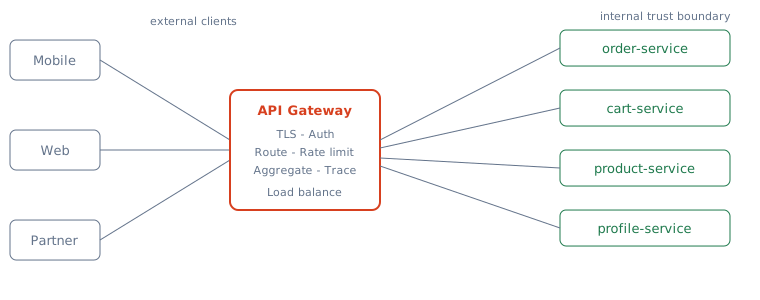
The API Gateway is a single server that sits between all external clients and your fleet of internal services. Every request enters through one front door. The gateway authenticates it, decides which internal service (or services) should handle it, forwards the request, and returns the response. Clients stop caring how many services exist or where they live; they see one stable API. This is the microservices equivalent of a hotel front desk: guests talk to one concierge instead of wandering into the kitchen, laundry, and accounting departments themselves.
How it works, precisely
An API Gateway is a reverse proxy with policy logic layered on top. A request flows through a pipeline of stages, most of which are cross-cutting concerns — work that every service would otherwise duplicate:
- TLS termination: the gateway decrypts inbound HTTPS once, so internal hops can use cheaper mTLS or plaintext inside the trust boundary.
- AuthN / AuthZ: it validates the JWT or API key, rejects anonymous traffic at the edge, and passes a trusted identity header (e.g.
X-User-Id) downstream so services don't each re-verify tokens. - Routing: it matches the path/host to an upstream.
/orders/*→ order-service,/cart/*→ cart-service. This is path-based or host-based routing. - Rate limiting & throttling: it enforces per-client quotas (e.g. token-bucket, 100 req/s per key) to protect fragile backends.
- Load balancing across an upstream's healthy instances, often with circuit breaking and retries with timeouts.
- Observability: it emits a request ID, logs latency, and is a natural place to start a distributed trace.
A richer variant is request aggregation / composition: the gateway calls several services in parallel and merges the JSON into one response, so a chatty screen becomes a single round trip. Push this per-client and you get the Backend for Frontend (BFF) pattern — a dedicated gateway tuned for the mobile app, another for web.
A worked scenario, with numbers
Take the home-screen example at 5,000 QPS peak. Without a gateway, one screen load fans out to 4 direct calls, so clients generate 20,000 QPS of edge traffic and every client re-implements auth, retries, and TLS. Each direct call over mobile networks pays connection setup and its own ~100 ms round trip; done partly serially, the screen can take 300–400 ms just in networking.
Put a gateway in front. The client makes one request, GET /home. The gateway validates the JWT once (~1 ms with a cached signing key), then fans out to the four services in parallel inside the data center, where round trips are ~2–5 ms. Total added latency at the gateway is roughly 5–8 ms, and the screen returns in one ~110 ms round trip (~100 ms cellular RTT + the gateway's tax) instead of four slow ones. Edge QPS drops back to 5,000, and 90% of duplicated auth/retry code disappears from every client. Be precise about what was won: if the client had fired its four calls in parallel, the latency gap mostly evaporates — the durable wins are one TLS handshake and radio wake-up instead of four, auth validated once at the edge, and a server-side deadline the client cannot enforce. Quote those in an interview, not the milliseconds.
The cost is a new hop that must be sized for the full 5,000 QPS and made highly available. In practice you run the gateway as a horizontally scaled, stateless tier (say 6–10 instances behind an L4 load balancer) so any node can die without dropping the door.
Trade-offs, and when to use vs not
Use an API Gateway when you have multiple services behind one product, several client types (mobile/web/partner), and you're tired of duplicating auth, rate limiting, and TLS in every service. It shines the moment cross-cutting concerns and client-facing API shape start to sprawl.
Named alternatives and how they differ:
- Direct client-to-service: lowest latency and no extra hop, but leaks internal topology to clients and duplicates cross-cutting logic everywhere. Fine for a tiny system with one client; painful past a handful of services.
- Service mesh (e.g. Istio/Envoy sidecars): handles east-west (service-to-service) traffic — mTLS, retries, load balancing between internal services. A gateway handles north-south (client-to-system) traffic. They are complementary, not substitutes; large systems run both. Don't propose a mesh when the interviewer only needs an edge entry point.
- Plain reverse proxy / L7 load balancer (nginx, ALB): does routing and TLS but lacks first-class auth, quotas, and aggregation. A gateway is a reverse proxy plus API-aware policy.
- BFF: a gateway variant with one tailored backend per frontend — better client fit, but more gateways to build and operate.
The core trade-off: a gateway adds an extra network hop, operational surface, and a place that can become a development bottleneck (every team waits on gateway config) — in exchange for a stable client contract and DRY cross-cutting concerns.
Pitfalls an interviewer probes
- Single point of failure: "If everything goes through it, what happens when it dies?" Answer: it's a stateless, horizontally scaled tier behind an L4 balancer with health checks and multi-AZ deployment — no single instance is load-bearing.
- The god-gateway / business logic creep: teams sneak domain rules into the gateway until it becomes a distributed monolith. Keep it to routing and cross-cutting concerns; business logic stays in services.
- Added latency and the extra hop: acknowledge the ~single-digit-ms tax and justify it against the round trips and duplicate work it removes.
- Coupling & deploy bottleneck: a shared gateway config owned by one team blocks everyone. Mitigate with per-team routes, declarative config, and BFFs so teams own their edge.
- Where does auth really live?: the gateway does coarse authentication and hands down a trusted identity, but services should still enforce fine-grained authorization — never assume "the gateway checked it" for sensitive operations (defense in depth).
- Fan-out failure semantics: in aggregation, if one of four upstreams is slow, do you block the whole response? Expect to discuss per-call timeouts, partial responses, and circuit breakers.
Worked trace: fan-out / fan-in aggregation
Imagine the mobile home screen needs profile, cart, recommendations, and recent orders. The gateway exposes one endpoint, GET /home, and fans out to four upstream services in parallel.
| Time | Profile | Cart | Recommendations | Orders | Gateway action |
|---|---|---|---|---|---|
| t0 | GET /profile (50 ms timeout) | GET /cart (50 ms) | GET /recs (80 ms) | GET /orders (80 ms) | Dispatch all four |
| t0+18 ms | OK (12 ms) | - | - | - | Hold partial |
| t0+22 ms | - | OK (20 ms) | - | - | Hold partial |
| t0+55 ms | - | - | OK (50 ms) | - | Hold partial |
| t0+80 ms | - | - | - | Timeout | Return cached recent-orders stub with X-Partial-Response: orders |
| t0+85 ms | Merged JSON delivered | Screen loads in ~85 ms instead of failing | |||
Each upstream gets its own timeout. The slowest healthy call (recommendations at 50 ms) sets the floor; the orders timeout caps the tail. Without per-call timeouts, one slow upstream would block the whole screen.
Decision table: auth, rate limit, transform
| Cross-cutting concern | Do it in the gateway? | Why / why not |
|---|---|---|
| TLS termination | Yes | One place to manage certificates; internal hops can use mTLS or plaintext inside trust boundary |
| JWT validation / coarse authN | Yes | Reject anonymous traffic at the edge; pass trusted identity header downstream |
| Fine-grained authorization | No | AuthZ depends on domain state; belongs in services (defense in depth) |
| Rate limiting per client | Yes | Protects all backends from a single noisy tenant |
| Request/response transformation | Sometimes | OK for versioning and field mapping; dangerous when it becomes business logic |
| Request aggregation | Sometimes | Great for chatty screens; adds coupling between gateway and upstream APIs |
Failure trace: backend timeout → circuit open → fallback
| Step | Upstream state | Gateway behavior | User-visible result |
|---|---|---|---|
| 1 | Orders service healthy | Proxy normally; record latency/error metrics | Full order history |
| 2 | Orders degrades; 5 % errors, p99 spikes | Retry idempotent GET once with jitter | Occasional slower load |
| 3 | Errors exceed 50 % over 30 s | Circuit breaker opens; fail fast for 10 s | Orders section shows cached top 3 recent orders |
| 4 | Health probe passes | Half-open probe allowed; circuit closes on success | Full history returns |
| 5 | Hard failure during request | Per-call timeout fires; return partial response | Screen loads with degraded orders section |
The key idea is graceful degradation: the gateway does not let one sick upstream break the entire client experience.
Key takeaways
- An API Gateway is a single, stateless reverse-proxy front door that centralizes north-south cross-cutting concerns — TLS termination, auth, routing, rate limiting, load balancing, and optional request aggregation — so clients see one stable API instead of your internal topology.
- It trades an extra hop and operational surface for a DRY, evolvable edge; size it for full peak QPS and run it multi-instance so it isn't a single point of failure.
- It complements a service mesh (east-west traffic) rather than replacing it, and it is a superset of a plain reverse proxy; the BFF variant tailors one gateway per client type.
- Keep business logic out of the gateway, enforce fine-grained authorization in the services too, and be ready to explain failure and fan-out semantics — those are the questions interviewers press on.
L0 · An API Gateway is a single stateless reverse-proxy front door that centralizes north-south cross-cutting concerns so clients see one stable API.
L1 · ⑥ Cost/Simplicity — "For one client and four services, why not skip the gateway and call each service directly?"
Trap: "Add the gateway anyway — it's always the right pattern, more layers never hurt."
Bar: For a single client type, direct calls really are cheaper — no extra hop, nothing new to operate. The gateway's ROI only appears once you have multiple client types or duplicated auth/TLS/rate-limit code across N clients × M services; only then does trading a single-digit-ms hop for deleting that duplication pay off. connects-to: API Gateway vs Direct Service Exposure
L2 · ② Failure — "The gateway just died at 2am. What's the blast radius, and how did you stop it being your SPOF?"
Trap: "It's one server — put a hot standby behind a failover switch."
Bar: The gateway runs as a stateless fleet (no session affinity, no per-request instance identity) with N≥3 instances spread across multiple AZs behind an L4 load balancer with health checks; losing any instance only drops capacity, never availability. A hot-standby pair reintroduces the exact SPOF — failover lag and split-brain risk — the fleet design exists to remove. connects-to: Fault Tolerance vs High Availability
L3 · ③ Scale — "GET /orders?page=500 through the gateway times out under load; page=2 is instant. Why, and what do you change?"
Trap: "Add an index on the offset column" or "just raise the timeout."
Bar: OFFSET pagination forces the DB to scan and discard page×limit rows before returning results, so cost grows linearly with depth no matter the index, and concurrent writes shift row positions, skipping or duplicating items across pages. Switch to cursor/keyset pagination (WHERE id > last_seen_id ORDER BY id LIMIT k) — O(log n) via the index at any depth, and stable under concurrent inserts. connects-to: API Pagination Strategies — Offset vs Cursor
L4 · ④ Time/Lifecycle — "You need to rename a field the mobile app reads, but that app is 6 months behind on updates. How do you ship it without breaking anyone?"
Trap: "Just change the field and tell mobile to update ASAP" (or the opposite trap: "bump to /v2 for every field tweak").
Bar: Expand-contract: first expand — add the new field alongside the old one and deploy, so both exist; once usage telemetry shows the old field has dropped off (a fixed deprecation window, e.g. 90 days), contract — remove it. Reserve an actual version bump (/v2 route or Accept-Version header) for changes that are truly breaking — removed fields, changed semantics — never for additive ones. connects-to: Evolving APIs & Event Schemas
L5 · ⑤ Adversary/Edge — "Mobile times out waiting on POST /orders, the user taps 'place order' again. Did you just charge them twice?"
Trap: "TCP retries are safe, and the client only retries once, so it's fine."
Bar: HTTP/TCP retries are at-least-once, never exactly-once. The client must send a client-generated Idempotency-Key header on the retry, and the gateway or order-service persists a request-id → response mapping so a repeated key within a TTL window returns the cached original response instead of re-executing the write — otherwise a timeout-triggered retry double-charges the card. connects-to: Idempotency Keys — Implementing Them Safely
The floor keeps dropping: staff+ perturbation — "the gateway validated the JWT, so downstream service X blindly trusts the X-User-Id header; an internal service-to-service call forges that header and now it's a horizontal privilege escalation." The gateway's authentication is coarse and edge-only; every service must still independently authorize the request and treat identity headers as untrusted unless cryptographically signed or mTLS-bound end to end — services can never trust the network, only defense in depth.
Self-locate: died at L1 → mid-level; L4+ → staff signal.
Facing any new concept? Hit it with the six: concurrent? failing? at 100×? over time? adversarial? worth the cost? — that's the interviewer's whole playbook.
Sources: Chris Richardson, Microservices Patterns (Manning, 2018), ch. 8 — API Gateway and Backend-for-Frontend; Sam Newman, Building Microservices, 2nd ed. (O'Reilly, 2021); Netflix Zuul and Envoy/Kong gateway documentation on filter chains, rate limiting, and aggregation.
🤖 Don't fully get this? Learn it with Claude
Stuck on Introduction to the API Gateway Pattern? Open Claude, copy a block below, and it'll teach you this exact concept — visually and interactively.
Build the mental picture, not memorization.
I just read a lesson on **Introduction to the API Gateway Pattern** (System Design) and want to truly understand it. Explain Introduction to the API Gateway Pattern from first principles using ONE vivid real-world analogy and a visual mental model — draw it as ASCII art or a clear step-by-step diagram — with a concrete example using real numbers. Then ask me one question to check I got the mental picture, and wait for my reply. If you're unsure or a claim isn't standard, say so and reason from first principles instead of guessing.
Socratic — adapts to where you're stuck.
Teach me **Introduction to the API Gateway Pattern** interactively. Ask me ONE guiding question at a time, wait for my answer, and adapt to my confusion — build the idea with me step by step instead of explaining it all at once. If you're unsure or a claim isn't standard, say so and reason from first principles instead of guessing.
Active recall exposes what you missed.
Quiz me on **Introduction to the API Gateway Pattern** with 5 questions, easy to tricky, ONE at a time. Tell me if each answer is right; at the end, explain clearly what I got wrong and why. If you're unsure or a claim isn't standard, say so and reason from first principles instead of guessing.
Intuition + hook + flashcards for long-term memory.
Help me remember **Introduction to the API Gateway Pattern** for the long term: give the one-sentence intuition, a memorable hook/mnemonic, a tiny worked example, and 3 active-recall flashcards (Q -> A). If you're unsure or a claim isn't standard, say so and reason from first principles instead of guessing.