System Design Examples Bringing the Sidecar Pattern to Life
A sidecar works because it shares the main container's network namespace and lifecycle inside the same pod, so a cross-cutting concern (TLS, retries, metrics, auth) can be intercepted at 127.0.0.1 without the application ever calling it or knowing it exists. That last clause is the whole trick, and it is exactly what most explanations skip: the app makes an ordinary connect() to reviews:9080; something silently reroutes that packet to a proxy in the same pod first. In Istio that "something" is iptables, and Envoy is the sidecar.
The catalogue: four concerns, one shape
The reason the same pattern keeps reappearing is that all four of these are infrastructure code that must run next to every instance but should not live inside it:
| Concern | What the sidecar does | Real example |
|---|---|---|
| Networking | mTLS, load balancing, retries, circuit breaking, traffic splitting | Istio's Envoy proxy |
| Observability / metrics | Emits request-level RED metrics (rate, errors, duration) the app never instrumented | Envoy exposes Prometheus metrics on :15090 |
| Logging | Tails the app's log stream and ships it onward | A per-pod Fluent Bit / Vector sidecar (note: often better as a node agent — see trade-offs) |
| Security / auth | Terminates TLS, validates JWTs / SPIFFE identities, enforces authz policy | Envoy validates the peer cert spiffe://cluster.local/ns/default/sa/bookinfo-productpage |
Istio is the canonical instance: it injects an Envoy container into every meshed pod and gives you all four at once, with zero application changes. The interesting question — the one the fleet-of-ships analogy never answers — is how Envoy sees traffic the app sent to someone else.
The mechanism: iptables redirection inside the pod
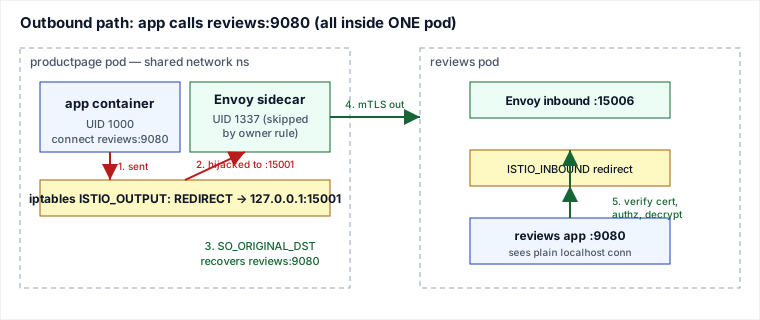
When a pod is meshed, an istio-init container (or the Istio CNI plugin) runs before the app and installs iptables rules in the pod's network namespace. Two redirects matter:
- Outbound: the
OUTPUTchain jumps toISTIO_OUTPUT, whichREDIRECTs all outgoing TCP to127.0.0.1:15001(Envoy's outbound listener). - Inbound: the
PREROUTINGchain jumps toISTIO_INBOUND, which redirects incoming TCP to127.0.0.1:15006(Envoy's inbound listener).
The rule that makes this not an infinite loop: Envoy runs as UID/GID 1337, and ISTIO_OUTPUT has a -m owner --uid-owner 1337 -j RETURN rule. Envoy's own outbound packets skip the redirect; everyone else's don't. Because the redirect is transparent, Envoy recovers the real intended destination from the socket via SO_ORIGINAL_DST — that is how it knows the app meant reviews:9080 even though the kernel delivered the connection to :15001.
Worked trace: when the happy path breaks — three failure variants
The happy-path packet walk (app → ISTIO_OUTPUT owner check → REDIRECT :15001 → Envoy originates mTLS → peer's :15006 → plaintext to the app on loopback) is traced step by step on The Architecture of the Sidecar Pattern — read it first. What that trace can't show you is what the wire looks like when a step fails. These three variants are where real debugging time goes, using the same concrete pods: productpage 10.1.0.5 calling reviews 10.1.0.8:9080.
Variant 1 — Envoy isn't ready yet (failure at step 2)
- The pod just started; the app container races ahead of the proxy and issues
GET http://reviews:9080/…. - iptables doesn't know or care that Envoy is down:
ISTIO_OUTPUTstill matches (UID 1000, not loopback) and redirects the SYN to127.0.0.1:15001. - Nothing is listening on 15001 yet. The kernel answers its own redirect with RST — the app sees
connection refusedto a service that is perfectly healthy. - The tell: refusals only in the first seconds of pod life, from every destination at once, while the same requests succeed after the proxy warms. That signature (all-destinations + startup-window) is what separates this from an actual down dependency. Fix as in the pitfalls:
holdApplicationUntilProxyStartsor native sidecars.
Variant 2 — peer certificate fails verification (failure at step 5)
- Outbound works: productpage's Envoy originates mTLS presenting its SPIFFE identity (
spiffe://cluster.local/ns/default/sa/bookinfo-productpage) and the encrypted bytes reach10.1.0.8. - The reviews-side Envoy terminates the handshake and checks the client cert against its trust bundle. Suppose the root was rotated and productpage's Envoy still holds a cert chained to the old root — or an
AuthorizationPolicyonly admits a different service account. - The handshake (or the authz check just after it) fails between the two proxies. The app on neither side ever sees a byte: productpage's Envoy reports
upstream connect error … TLS error(or a bare 403), and the reviews app's logs are silent — the request died before loopback delivery. - The tell: 503/403s whose detail names TLS or RBAC, with zero corresponding entries in the destination app's log. When the app log is silent but the caller sees errors, suspect the proxy-to-proxy leg — that is the mesh's blast radius, not the application's.
Variant 3 — protocol sniffing misfires on an unnamed port
- reviews exposes port 9080 without a name/
appProtocol, and a client sends a non-HTTP binary protocol over it. - Envoy's listener can't match a configured protocol, so it sniffs the first bytes to guess. A protocol where the server speaks first (as MySQL does) gives the sniffer nothing to read — the connection can hang until timeout; a binary frame that half-resembles HTTP can get mis-routed down the HTTP filter chain and reset mid-stream.
- The tell: works pod-to-pod outside the mesh, hangs or resets inside it, and only for the unnamed port. Fix: name ports (
http-,grpc-,tcp-) or setappProtocolso Envoy never guesses.
The unifying lesson: the sidecar's transparency is asymmetric. Success is invisible to the app — but so is failure, which surfaces as kernel-level refusals, silent drops between proxies, or protocol stalls that no application log explains. Debugging a mesh means learning to read the layer the pattern hid.
Pitfalls
- Startup race. If the app sends traffic before Envoy is ready, iptables still redirects it to
:15001— which nothing is listening on yet — so the app getsconnection refused. Fix:holdApplicationUntilProxyStarts, or Kubernetes 1.28+ native sidecars (init containers withrestartPolicy: Always) that guarantee ordering. - Shutdown race & Jobs that never finish. On pod termination Envoy may die before the app, killing in-flight requests; and for a
Job/CronJobthe sidecar never exits, so the pod never reachesCompleted. You must signal the proxy to quit (native sidecars solve the Job case). - UID 1337 collision. If your app happens to run as UID 1337, the owner rule
RETURNs its traffic and it silently bypasses the mesh — no mTLS, no policy, and no error to tell you. - Protocol misdetection. Unnamed ports fall back to protocol sniffing, which can stall or mis-route non-HTTP traffic. Name ports explicitly (
http-,grpc-,tcp-) or setappProtocol. - The init container needs
NET_ADMIN/NET_RAWto write iptables — blocked under restrictive PodSecurity. Use the Istio CNI plugin so no per-pod privileged init container is required. - The multiplication tax. One Envoy per pod means ~50–100 MB RAM and extra CPU per pod, plus roughly two extra proxy hops of p99 latency per request. At 10,000 pods that is 10,000 proxies to run, patch, and pay for.
When to use it — and when not to
The full alternatives comparison — sidecar vs in-process library vs node agent/DaemonSet vs ambient mesh, with the gains and costs of each — lives in the "When to reach for it — and when not to" section of The Architecture of the Sidecar Pattern; this page adds only the operational reading of it. The failure variants above are the "you pay" column made concrete: every alternative in that table exists to dodge one of them. An in-process library can't race its own app at startup (variant 1 impossible) but re-couples infra to every deploy; a DaemonSet/ambient mesh moves the proxy off the pod so the multiplication tax and injection lifecycle disappear, but variant-2-style silent proxy-leg failures now hit a node-wide blast radius instead of one pod. Pick by which failure mode you can afford to debug at 3am, not just by the resource math.
Takeaways
- The sidecar's power comes from sharing the pod's network namespace + lifecycle, letting infra intercept traffic at
localhostwith zero app changes. - Istio's Envoy captures traffic via iptables REDIRECT to ports
15001(out) /15006(in), avoids a loop by exempting UID1337, and recovers the real destination withSO_ORIGINAL_DST. - The dominant cost is multiplication: one proxy per pod in RAM, CPU, and latency — which is exactly why node agents and ambient meshes exist.
- Decide by matching the concern's scope to the deployment unit: per-workload L7 → sidecar; node-shared → DaemonSet; L4-at-scale → ambient; single-language hot path → library.
Re-authored and deepened for this guide. Sources: Istio documentation — Traffic Management and the sidecar-injection / istio-iptables internals; Envoy documentation on original_dst listeners and SO_ORIGINAL_DST; the Istio Bookinfo sample application; Kubernetes documentation on native sidecar containers (KEP-753, 1.28+); and the Istio Ambient Mesh design notes for the sidecar-less comparison.
🤖 Don't fully get this? Learn it with Claude
Stuck on System Design Examples Bringing the Sidecar Pattern to Life? Open Claude, copy a block below, and it'll teach you this exact concept — visually and interactively.
Build the mental picture, not memorization.
I just read a lesson on **System Design Examples Bringing the Sidecar Pattern to Life** (System Design) and want to truly understand it. Explain System Design Examples Bringing the Sidecar Pattern to Life from first principles using ONE vivid real-world analogy and a visual mental model — draw it as ASCII art or a clear step-by-step diagram — with a concrete example using real numbers. Then ask me one question to check I got the mental picture, and wait for my reply. If you're unsure or a claim isn't standard, say so and reason from first principles instead of guessing.
Socratic — adapts to where you're stuck.
Teach me **System Design Examples Bringing the Sidecar Pattern to Life** interactively. Ask me ONE guiding question at a time, wait for my answer, and adapt to my confusion — build the idea with me step by step instead of explaining it all at once. If you're unsure or a claim isn't standard, say so and reason from first principles instead of guessing.
Active recall exposes what you missed.
Quiz me on **System Design Examples Bringing the Sidecar Pattern to Life** with 5 questions, easy to tricky, ONE at a time. Tell me if each answer is right; at the end, explain clearly what I got wrong and why. If you're unsure or a claim isn't standard, say so and reason from first principles instead of guessing.
Intuition + hook + flashcards for long-term memory.
Help me remember **System Design Examples Bringing the Sidecar Pattern to Life** for the long term: give the one-sentence intuition, a memorable hook/mnemonic, a tiny worked example, and 3 active-recall flashcards (Q -> A). If you're unsure or a claim isn't standard, say so and reason from first principles instead of guessing.