The Problem The Struggles of Distributed Systems and Service Failures
To see why the Circuit Breaker pattern exists, you first have to feel how a single slow dependency can take down a service that is itself perfectly healthy. In a monolith, a slow function call is just a slow function call. In a distributed system, every call to another service is a call across a network you do not control, and the thread making that call is held hostage until the call returns, times out, or fails. That one fact is the root of almost every distributed-systems outage.
Two failure modes flow from it: cascading failures, where one sick service infects its callers, and wasted work, where clients pour effort into a dependency that has no chance of answering. Let's trace each with real numbers.
Cascading failures: how a healthy service dies
Imagine Service A serving 500 requests per second from a fixed pool of 200 worker threads. It depends on Service B (and, independently, on a healthy Service C). The one law you need is Little's Law: the average number of threads tied up equals arrival rate times how long each call takes.
L = λ × W (concurrency = requests/sec × latency)
- Healthy state. B answers in 40 ms. Threads in use = 500/s × 0.040 s = 20 threads. Twenty of two hundred busy — plenty of headroom.
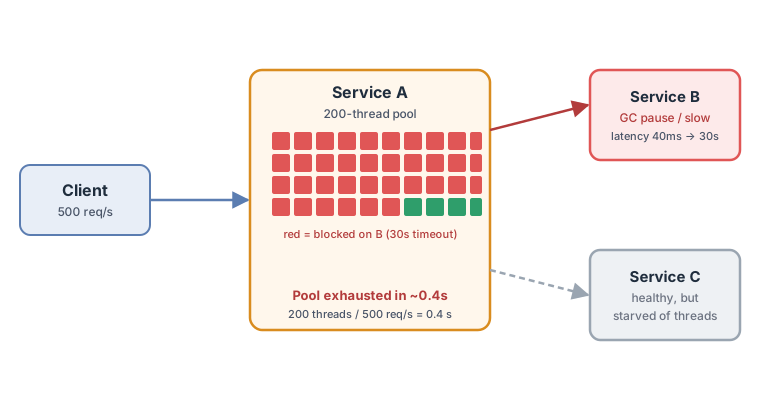
- B degrades. A GC pause pushes B's latency to the client-side timeout of 30 s. Little's Law now demands 500/s × 30 s = 15,000 threads to keep up — but the pool caps at 200.
The pool cannot grow to 15,000, so it simply saturates. Every thread ends up parked on a socket read to a half-dead B, and the diagram below shows the result.
Doing the arithmetic on the collapse
Two numbers tell the whole story.
- Time to exhaustion. With every incoming request grabbing a thread that then blocks for the full 30 s timeout, threads are consumed at 500/s and none are returned. The pool of 200 empties in 200 ÷ 500 = 0.4 seconds. Less than half a second after B stumbles, A has no free threads.
- Sustainable throughput while B is slow. Once every call takes 30 s, the most A can process is 200 threads ÷ 30 s ≈ 6.7 requests/second. It is receiving 500/s. Roughly 98.7% of requests find no thread and are rejected or queued — including every request to the perfectly healthy
Service C. A is now down, even though its own code has no bug.
That is the cascade: B's illness became A's outage, and A's outage will become its callers' outage, propagating up the dependency graph. Contrast this with the fix we are building toward. If A could detect B is bad and fail fast — returning an error in, say, 1 ms instead of waiting 30 s — Little's Law re-prices the damage: 500/s × 0.001 s = 0.5 threads. The pool stays essentially empty, A survives, and Service C keeps its threads. Failing fast is not giving up; it is refusing to hold threads hostage on a call that will not succeed.
The cascade has a recognizable operational signature you can alert on: A's worker-pool active count pinned at its max while B's error rate and latency climb, and A's own availability drops even for endpoints that never touch B. When those three move together, a downstream stall is eating an upstream that has no bug of its own.
Wasted work: why blind retries make it worse
The natural instinct when a call fails is to retry it. In this scenario that instinct is actively harmful, but it is worth being precise about why.
Retries do not make the pool drain faster. At 500 req/s against 200 threads the pool already empties on the very first attempt, in 0.4 s, long before any retry could even complete. What retries change is how long the pool stays drained. With a typical 3-attempt policy where each attempt waits the full 30 s timeout, a single logical request can pin one thread for up to 3 × 30 s = 90 s instead of 30 s — tripling how long each thread is held hostage and pushing recovery further out. And every retry is additional load aimed squarely at the already-dying Service B, so the very traffic meant to "work around" the fault is what keeps B from recovering. When a fault is not transient — a crash, a network partition, an overloaded database — retrying is pure waste: it burns CPU, holds threads longer, and deepens the outage it was trying to escape.
Choosing a defense: four tools, four decision rules
Several patterns address these failures, and they are not interchangeable. Each buys something specific at a specific cost.
- Timeouts (alone). A timeout sets the ceiling on how long each thread can be held hostage by one call. Benefit: bounds the damage per request and is non-negotiable — a call with no timeout can block forever. Cost: a timeout does nothing to stop new requests from arriving and re-filling the pool; at 500 req/s even a 30 s timeout still lets 15,000 threads' worth of demand pile up. Rule: always set aggressive timeouts (a small multiple of the dependency's healthy p99, e.g. 200 ms — not 30 s), but never treat timeouts as your only defense.
- Bulkhead (resource isolation). Give each dependency its own thread pool or semaphore, so B's collapse can only exhaust B's slice and leaves C's threads untouched. Benefit: contains the blast radius — one sick dependency cannot starve unrelated ones. Cost: capacity fragmentation (the sum of fixed slices is less flexible than one shared pool, lowering peak utilization) plus per-dependency tuning. Rule: use when a single service calls two or more downstreams and one must never be allowed to starve the others.
- Retry with backoff + jitter. Re-attempt a failed call, spacing attempts exponentially with randomization. Benefit: transparently rides out truly transient blips — a dropped packet, a brief GC pause, a leader election. Cost: amplifies load on a struggling dependency and multiplies thread-hold time (the 90 s problem above) when the fault is not transient. Rule: retry only idempotent operations, with a hard cap on attempts, exponential backoff plus jitter, and only for faults likely to be transient — never against a hard-down dependency.
- Load shedding / fail fast (the Circuit Breaker). Once a dependency is observed to be failing, reject calls to it immediately so threads return in ~1 ms instead of being held for 30 s, while periodically probing for recovery. Benefit: the only option that actually stops the cascade at its source, keeping the caller alive and its other dependencies reachable. Cost: during the outage you serve errors or degraded responses instead of eventually-correct ones. Rule: trip when a failure-rate or latency threshold is crossed; this is precisely the behavior the Circuit Breaker pattern automates.
What we actually need
The worked example makes the requirement concrete. Timeouts and bulkheads limit the damage but do not stop it; blind retries deepen it. What is missing is a component that watches a dependency's health, trips the moment it is clearly failing, and fails calls fast while the fault persists — then cautiously lets traffic back through once the dependency looks healthy again. That component is the Circuit Breaker, and everything in this section builds on the collapse we just traced: a healthy service brought down in 0.4 seconds not by its own bugs, but by faithfully waiting on a neighbor that could no longer answer.
Adapted and expanded from DesignGurus, Grokking Microservices Design Patterns
(Circuit Breaker Pattern — "The Problem: The Struggles of Distributed Systems and Service Failures"). Worked figures, Little's Law analysis, and the pattern-selection guidance are added for depth; the core cascading-failure and wasted-retry framing follows the source lesson.
🤖 Don't fully get this? Learn it with Claude
Stuck on The Problem The Struggles of Distributed Systems and Service Failures? Open Claude, copy a block below, and it'll teach you this exact concept — visually and interactively.
Build the mental picture, not memorization.
I just read a lesson on **The Problem The Struggles of Distributed Systems and Service Failures** (System Design) and want to truly understand it. Explain The Problem The Struggles of Distributed Systems and Service Failures from first principles using ONE vivid real-world analogy and a visual mental model — draw it as ASCII art or a clear step-by-step diagram — with a concrete example using real numbers. Then ask me one question to check I got the mental picture, and wait for my reply. If you're unsure or a claim isn't standard, say so and reason from first principles instead of guessing.
Socratic — adapts to where you're stuck.
Teach me **The Problem The Struggles of Distributed Systems and Service Failures** interactively. Ask me ONE guiding question at a time, wait for my answer, and adapt to my confusion — build the idea with me step by step instead of explaining it all at once. If you're unsure or a claim isn't standard, say so and reason from first principles instead of guessing.
Active recall exposes what you missed.
Quiz me on **The Problem The Struggles of Distributed Systems and Service Failures** with 5 questions, easy to tricky, ONE at a time. Tell me if each answer is right; at the end, explain clearly what I got wrong and why. If you're unsure or a claim isn't standard, say so and reason from first principles instead of guessing.
Intuition + hook + flashcards for long-term memory.
Help me remember **The Problem The Struggles of Distributed Systems and Service Failures** for the long term: give the one-sentence intuition, a memorable hook/mnemonic, a tiny worked example, and 3 active-recall flashcards (Q -> A). If you're unsure or a claim isn't standard, say so and reason from first principles instead of guessing.