The Architecture of the Event-Driven Architecture Pattern
Event-Driven Architecture (EDA) is a style in which components communicate by producing and reacting to events rather than calling each other directly. An event is an immutable record that something happened — MotionDetected, OrderPlaced, TemperatureChanged. The producer that emits it does not know, and does not care, who will consume it. That single fact — the decoupling of "something happened" from "what to do about it" — is the source of every benefit and every headache in EDA.
The moving parts
- Event producers — components that detect a state change and emit an event. A motion sensor that fires
MotionDetectedis a producer. - Event channels / topics — named pipelines that carry events of a given type from producers toward whoever is interested.
- Event bus / broker — the transport that accepts events and delivers them to the right channels (Kafka, RabbitMQ, AWS EventBridge, a cloud pub/sub, or an in-process dispatcher).
- Event consumers — components that subscribe to channels and act on the events they receive, typically causing a further state change or emitting new events.
Two structural questions decide the shape of the whole system: who owns the routing and business decisions, and how tightly are producers coupled to consumers. Those questions produce two canonical topologies — Mediator and Broker — plus a Hybrid that mixes them.
Two topologies, one core trade-off
Mediator (orchestration)
A central mediator knows the producers and consumers and orchestrates the flow. Producers send events to the mediator; the mediator applies routing, filtering, transformation, and multi-step business logic, then dispatches commands to the appropriate consumers. The workflow lives in one place, so it is easy to read, reorder, and reason about.
Price: the mediator is a single point that every event flows through. It can become a throughput bottleneck and a scaling/availability chokepoint, and it accumulates coupling — as you add features, the mediator gets fatter.
Put a number on the chokepoint. Suppose the mediator spends 2 ms of CPU per event on routing + transformation (an assumption — measure yours). One single-threaded mediator instance then saturates at roughly 1 / 0.002 = 500 events/s; at 5,000 events/s you need ~10 workers — and now the mediator is itself a distributed system whose workflow state needs shared storage and whose ordering guarantees need re-deriving. The broker topology sidesteps this because partitioned consumers scale horizontally without shared workflow state. This is exactly why hybrid designs keep the firehose on the broker and route only the low-volume, high-value workflows through the mediator.
Broker (choreography)
There is no central coordinator. Producers publish events directly to channels on the bus; consumers subscribe and react independently. The bus just moves events. This is highly scalable and evolvable — you can add a new consumer to an existing event stream without touching the producer or any other consumer.
Price: the business logic is now scattered across consumers. No single component knows the end-to-end flow, which makes a multi-step process harder to trace, debug, and change coherently.
| Dimension | Mediator | Broker |
|---|---|---|
| Routing control | Centralized, rich (filter/transform/orchestrate) | Minimal — publish/subscribe only |
| Scalability | Limited by the mediator (bottleneck) | High — no central chokepoint |
| Evolvability | Change the mediator to change flow | Add/remove consumers freely |
| Where logic lives | One place (easy to reason about) | Scattered across consumers |
| End-to-end visibility | Good — the mediator is the map | Poor — flow is emergent |
Hybrid EDA uses a broker for high-volume ingestion and fan-out, and a mediator for the few workflows that genuinely need central orchestration — capturing most of the throughput of broker with the control of mediator where it matters.
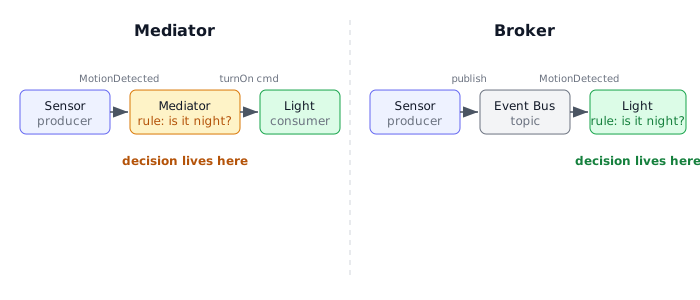
Trace one event through both topologies
Take a concrete home-automation requirement: when the front-door motion sensor fires, turn on the porch light — but only at night. The interesting question is not "does the light turn on" but where the "only at night" decision lives. That is exactly what the topology decides.
Mediator: the decision is central
| # | Component | Action |
|---|---|---|
| 1 | Motion sensor (producer) | Detects movement, emits MotionDetected{ time } to the mediator. It knows nothing about lights or night. |
| 2 | Mediator | Receives the event, applies the rule if isNight(time), and only then issues a TurnOnLight command. |
| 3 | Porch light (consumer) | Receives an explicit command and switches on. It is "dumb" — it never evaluates the rule. |
The night-check sits in one place. To later say "also only when nobody is home", you edit the mediator and nothing else.
Broker: the decision is at the edge
| # | Component | Action |
|---|---|---|
| 1 | Motion sensor (producer) | Publishes MotionDetected{ time } to the motion topic. Same event, no addressee. |
| 2 | Event bus | Fans the event out to every subscriber of motion — no logic, just delivery. |
| 3 | Porch light (consumer) | Receives the event and evaluates if isNight(time) itself, then switches on. The light is "smart". |
The night-check now lives inside the consumer. The upside: a new subscriber — say a security camera — can react to the very same MotionDetected stream without anyone changing the sensor or the light. The downside: if three consumers each need the night rule, that logic is now copied in three places, and no single component describes the whole behavior.
Choosing well: the selection layer
Mediator vs Broker
- Reach for Mediator when there is a real workflow — ordered, multi-step, needs transformation/aggregation, or must be auditable and changed as a unit (order fulfillment, payment orchestration, saga coordination). You are trading throughput and a single chokepoint for clarity and control.
- Reach for Broker when events are notifications that many independent parties react to, when throughput and independent scaling dominate, or when you expect to keep adding consumers over time (analytics, activity feeds, IoT telemetry fan-out). You are trading end-to-end visibility for scale and evolvability.
- Reach for Hybrid when most traffic is fire-and-forget fan-out but a handful of flows genuinely need orchestration — broker for the firehose, a mediator for those specific workflows.
EDA vs plain request/response
Don't default to events. Prefer synchronous request/response when the caller needs an immediate answer, when you want strong/read-your-write consistency, or when the interaction is a simple one-to-one call — an async event round-trip only adds latency and moving parts there. Prefer EDA when you want temporal decoupling (producer and consumer need not be up at the same time), fan-out to many/unknown consumers, resilience to consumer slowness via buffering, or the freedom to add reactions later without touching the source. A useful tell: if the producer needs the result to continue, that is a call; if it is simply announcing a fact, that is an event.
Pitfalls that bite in production
- Idempotency. Most brokers deliver at-least-once, so consumers will see duplicates. Make handlers idempotent — dedupe on a stable event ID, or design the effect so applying it twice is harmless ("set light on" is naturally idempotent; "increment counter" is not).
- Dead-letter handling. A poison event that always fails must not block the channel or loop forever. Route it to a dead-letter queue after N retries so the stream keeps flowing and the failure can be inspected.
- Correlation IDs. Because no single component owns the end-to-end flow (especially under Broker), stamp each event with a correlation ID and propagate it through every downstream event, so you can reconstruct one logical transaction across many async hops when debugging.
- Fat vs thin events. A thin event carries just an ID ("OrderPlaced #42") and forces consumers to call back for details — simple and small, but chatty and coupling. A fat event (event-carried state transfer) embeds the data consumers need, removing callbacks at the cost of larger payloads and stale-data risk. Choose deliberately per event; it is a real coupling and consistency decision, not a formatting detail.
- Watch the topology's blind spot. Under Mediator, the health signal is the mediator's own queue depth and error rate — it is the chokepoint, so it is also the first thing to saturate. Under Broker, no component owns the end-to-end flow, so alert on per-consumer-group lag and dead-letter-queue growth; nothing central will surface a silently-stalled consumer for you.
Takeaways
- EDA decouples "what happened" from "what to do about it." Producers emit facts; consumers react. That decoupling buys flexibility, temporal independence, and fan-out — and it is also the source of every operational complication below.
- The topology decides where your logic lives. The whole Mediator-vs-Broker choice comes down to one question: does the business decision sit in one central orchestrator, or is it distributed across the consumers at the edge?
- Pick Mediator when you need centralized control over an ordered, multi-step workflow — rich routing, transformation, auditability, and one place to change behavior — and you can accept that the mediator is a throughput bottleneck and a magnet for coupling.
- Pick Broker when you need scale and evolvability — no central chokepoint, and new consumers can join an existing event stream without touching anyone else — and you can accept that the flow logic is scattered and end-to-end tracing is harder.
- Pick Hybrid when the system is mostly high-volume fan-out with a few workflows that truly need orchestration: broker for the firehose, mediator for those flows.
- Don't reach for events at all when the caller needs an immediate answer or strong consistency — that is a synchronous request/response, and forcing it through a bus only adds latency and failure modes.
- Whatever you choose, engineer for the async reality: idempotent consumers, dead-letter queues, correlation IDs for tracing, and a deliberate fat-vs-thin event contract. These are not optional polish — they are what separates a demo from a system that survives duplicates, failures, and 3 a.m. debugging.
Source
Mediator and Broker EDA topologies and their trade-offs follow the canonical treatment in Mark Richards, Software Architecture Patterns (O'Reilly). The idempotency, dead-letter, correlation-ID, and event-carried-state-transfer (fat vs thin event) practices draw on Sam Newman, Building Microservices (2nd ed., O'Reilly), and Martin Fowler's writing on event-driven architectures. The home-automation MotionDetected walkthrough and step tables are original teaching material built on top of those sources.
🤖 Don't fully get this? Learn it with Claude
Stuck on The Architecture of the Event-Driven Architecture Pattern? Open Claude, copy a block below, and it'll teach you this exact concept — visually and interactively.
Build the mental picture, not memorization.
I just read a lesson on **The Architecture of the Event-Driven Architecture Pattern** (System Design) and want to truly understand it. Explain The Architecture of the Event-Driven Architecture Pattern from first principles using ONE vivid real-world analogy and a visual mental model — draw it as ASCII art or a clear step-by-step diagram — with a concrete example using real numbers. Then ask me one question to check I got the mental picture, and wait for my reply. If you're unsure or a claim isn't standard, say so and reason from first principles instead of guessing.
Socratic — adapts to where you're stuck.
Teach me **The Architecture of the Event-Driven Architecture Pattern** interactively. Ask me ONE guiding question at a time, wait for my answer, and adapt to my confusion — build the idea with me step by step instead of explaining it all at once. If you're unsure or a claim isn't standard, say so and reason from first principles instead of guessing.
Active recall exposes what you missed.
Quiz me on **The Architecture of the Event-Driven Architecture Pattern** with 5 questions, easy to tricky, ONE at a time. Tell me if each answer is right; at the end, explain clearly what I got wrong and why. If you're unsure or a claim isn't standard, say so and reason from first principles instead of guessing.
Intuition + hook + flashcards for long-term memory.
Help me remember **The Architecture of the Event-Driven Architecture Pattern** for the long term: give the one-sentence intuition, a memorable hook/mnemonic, a tiny worked example, and 3 active-recall flashcards (Q -> A). If you're unsure or a claim isn't standard, say so and reason from first principles instead of guessing.