Introduction to BFF
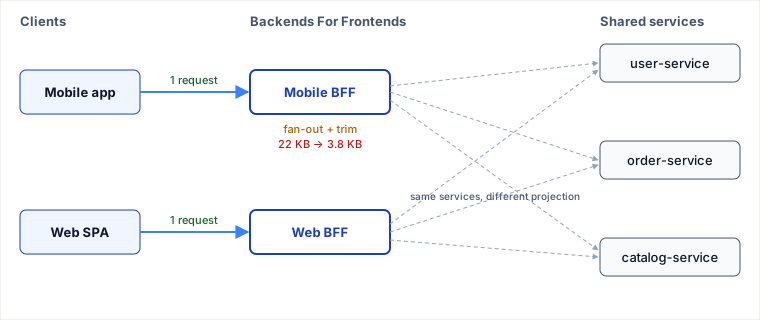
A Backend For Frontend (BFF) is a thin server-side facade owned by one client's team that fans out to the downstream microservices, then trims and reshapes their responses into exactly the fields that one client will render — so the client makes a single round trip and parses no data it will throw away.
The core move is a shift in ownership: instead of one general-purpose API shared by every client (the mobile app, the web SPA, the smart-TV app, a partner integration), you deploy one backend per client experience. Each BFF is free to speak its client's dialect — small payloads and battery-cheap round trips for mobile; rich, image-heavy objects for the desktop web — without any of them forcing a lowest-common-denominator contract on the others.
Worked example: the mobile home screen
A food-delivery app's mobile home screen needs three things: a greeting, the user's one active order, and three recommended restaurants. The data lives across three services. Watch what the Mobile BFF does with a single inbound request for user 8842.
| Step | Actor | Call / action | Payload |
|---|---|---|---|
| 1 | Mobile app | GET /mobile/home (one request, JWT identifies user 8842) | — |
| 2 | Mobile BFF | parallel fan-out to three services | — |
| 2a | → user-service | GET /users/8842 | { id, name:"Mathan", email, phone, savedAddresses[3], prefs{…} } ≈ 2.1 KB |
| 2b | → order-service | GET /orders?user=8842&status=active | [{ id:5567, restaurant:"Anjappar", status:"PREPARING", etaMin:12, items[4], priceBreakup{…} }] ≈ 3.4 KB |
| 2c | → catalog-service | GET /recommendations?user=8842 | 18 full restaurant objects, hi-res imagery ≈ 22 KB |
| 3 | Mobile BFF | merge + trim: keep name; order id/restaurant/status/etaMin; top 3 recs (name, rating, thumb) | — |
| 4 | BFF → app | one response ≈ 3.8 KB | see below |
The BFF absorbed ~27.5 KB of downstream JSON and three connections and handed the phone back 3.8 KB over one connection. It also hid the fan-out: if the phone had called the three services itself, a flaky mobile network would be paying three DNS/TLS/round-trip taxes instead of one.
The shaped response the phone actually receives:
{
  "greeting": "Hi Mathan",
  "activeOrder": {
    "id": 5567,
    "restaurant": "Anjappar",
    "status": "PREPARING",
    "etaMin": 12
  },
  "recommended": [
    { "name": "Sangeetha",        "rating": 4.5, "thumb": "/img/s.webp"  },
    { "name": "Saravana Bhavan", "rating": 4.4, "thumb": "/img/sb.webp" },
    { "name": "Murugan Idli",     "rating": 4.6, "thumb": "/img/mi.webp" }
  ]
}
The decisive detail: the Web BFF hits the same three services but projects them differently — it keeps the full savedAddresses book, all 18 recommendations, and full-resolution hero images, because the desktop home page renders them. Same sources, different projection, no negotiation between the two client teams.
Pitfalls
- Logic duplication and drift. Auth checks, pagination, retry policy, and error mapping get copy-pasted into every BFF. Six months later the Mobile BFF paginates at 20 and the Web BFF at 25, and nobody knows which is intentional. Push shared concerns into a library or a shared middleware layer — but resist folding the BFFs back into one service.
- The BFF becomes a distributed monolith. The moment two client teams share one "BFF," every change requires cross-team negotiation and coordinated deploys — you have re-created the general-purpose backend you were trying to escape. One BFF per client experience is the invariant; violating it forfeits the whole benefit.
- Tail latency dominates. A fan-out response is only as fast as its slowest downstream call. One sluggish catalog-service turns a 40 ms home screen into a 900 ms one. You need per-call timeouts, and a partial-response strategy (render the greeting and order even if recommendations time out) — not an all-or-nothing await.
- Schema coupling. If the BFF reaches deep into downstream response shapes, every internal refactor of order-service breaks the BFF and ripples to the client. Treat downstream payloads as contracts and map them at the BFF boundary.
- Ownership ambiguity. A BFF owned by a central platform team becomes a ticket-queue bottleneck — the frontend team waits weeks for a field. The pattern pays off only when the client team owns and deploys its own BFF.
Fault trace: one downstream degrades
The same mobile home screen, but now the recommendations service is slow: its p99 jumps from 50 ms to 2 s. A BFF that awaits all three fan-out calls without a deadline makes the user wait 2 s for a screen that can render useful data much sooner. The fix is a per-branch deadline plus a partial response.
| Branch | Latency | Deadline | Outcome |
|---|---|---|---|
| user-service | 40 ms | 80 ms | returns name |
| order-service | 60 ms | 80 ms | returns active order |
| recommendations | 2,000 ms | 80 ms | times out; BFF returns fallback (empty recs or cached) |
The client still sees greeting + active order in roughly 92 ms (30 ms WAN round trip + 2 ms gateway + max(40, 60) = 60 ms for the two critical branches + ~0.3 ms merge) instead of waiting 2 s — the recommendations branch, capped at an 80 ms deadline, is dropped to its fallback the moment the two critical branches resolve, so a deferrable branch never extends the critical path (an 80 ms recs wait would have pushed the screen to ~112 ms for data the user does not need to see first). The BFF must declare which branches are critical (an active order must not be silently dropped) and which are deferrable (recommendations can be empty or served from a stale cache). Without deadlines and partial responses, fan-out becomes a tail-latency multiplicative hazard.
Source grounding: The scatter-gather-with-deadline pattern is described in Sam Newman, Building Microservices (2nd ed.), and the tail-latency argument follows Dean & Barroso, "The Tail at Scale" (CACM 2013).
When to use it — and when not to
Reach for a BFF when you have two or more client types whose data needs genuinely diverge (mobile wants 3.8 KB, web wants 40 KB of the same entities); when over-/under-fetching is measurably hurting a client (mobile battery, cellular payload); and when you have frontend teams who want to own their own aggregation and ship independently.
Do not reach for one when you have a single client, or when every client needs identical data — you would be paying for extra services, deploys, and duplicated logic to solve a problem you do not have.
| Approach | You gain | It costs |
|---|---|---|
| BFF | Per-client payload shaping; client teams deploy independently; small mobile round trips | N backends to build/operate; duplicated cross-cutting logic; more deploy surface |
| Shared API Gateway | One edge to build and operate; central auth, rate-limiting, routing | No per-client shaping — clients get lowest-common-denominator payloads and must over-fetch or make extra calls |
| GraphQL | One endpoint; the client declares exactly which fields it wants — shaping without N backends | A resolver/schema layer to own; query-complexity, caching, and N+1 concerns; harder security surface |
Decide like this: choose a BFF when payload divergence is high and distinct client teams exist to own each one; prefer a shared API gateway when your clients are homogeneous and you just need one managed edge; prefer GraphQL when shaping needs are highly dynamic and unpredictable and you can afford to invest in a schema layer. These are not exclusive — a common real-world stack puts a GraphQL BFF behind a shared gateway that handles TLS, auth, and rate-limiting.
Takeaways
- A BFF is a projection layer: it fans out to shared services and hands each client exactly the shape that client renders — the value is in what it drops, not just what it aggregates.
- The load-bearing rule is one BFF per client experience, owned by that client's team. Share a BFF across clients and you rebuild the monolith.
- Fan-out means tail latency and partial-failure handling are first-class design work — timeouts and graceful degradation, not an afterthought.
- It is a point on a spectrum: API gateway (no shaping) → BFF (per-client shaping, server-defined) → GraphQL (per-request shaping, client-defined). Pick by how much your clients diverge and how much schema machinery you can own.
The BFF pattern originated at SoundCloud around 2012–2015, where Phil Calcado documented it in "The Back-end for Front-end Pattern (BFF)" (philcalcado.com, 2015); Sam Newman subsequently popularized and formalized it ("Backends For Frontends," samnewman.io, and in Building Microservices, O'Reilly). Trade-off framing draws on Chris Richardson's microservices.io API-gateway/BFF entries. Re-authored and deepened for this guide with a worked fan-out trace, a mechanism diagram, and the API-gateway vs. GraphQL selection criteria.
🤖 Don't fully get this? Learn it with Claude
Stuck on Introduction to BFF? Open Claude, copy a block below, and it'll teach you this exact concept — visually and interactively.
Build the mental picture, not memorization.
I just read a lesson on **Introduction to BFF** (System Design) and want to truly understand it. Explain Introduction to BFF from first principles using ONE vivid real-world analogy and a visual mental model — draw it as ASCII art or a clear step-by-step diagram — with a concrete example using real numbers. Then ask me one question to check I got the mental picture, and wait for my reply. If you're unsure or a claim isn't standard, say so and reason from first principles instead of guessing.
Socratic — adapts to where you're stuck.
Teach me **Introduction to BFF** interactively. Ask me ONE guiding question at a time, wait for my answer, and adapt to my confusion — build the idea with me step by step instead of explaining it all at once. If you're unsure or a claim isn't standard, say so and reason from first principles instead of guessing.
Active recall exposes what you missed.
Quiz me on **Introduction to BFF** with 5 questions, easy to tricky, ONE at a time. Tell me if each answer is right; at the end, explain clearly what I got wrong and why. If you're unsure or a claim isn't standard, say so and reason from first principles instead of guessing.
Intuition + hook + flashcards for long-term memory.
Help me remember **Introduction to BFF** for the long term: give the one-sentence intuition, a memorable hook/mnemonic, a tiny worked example, and 3 active-recall flashcards (Q -> A). If you're unsure or a claim isn't standard, say so and reason from first principles instead of guessing.