Serverless Architecture vs Traditional Serverbased
Serverless works because the cloud provider keeps your code dormant as a deployable artifact and only materializes a running execution environment when an event arrives — spinning up a sandboxed microVM, loading your runtime, running the handler, then freezing the environment so the next event can reuse it — so you are billed for CPU-milliseconds actually consumed instead of for a server sitting idle. Traditional server-based architecture inverts this: a process you provisioned runs continuously, holding memory and connections, ready to answer instantly, and you pay for that readiness whether one request arrives per hour or a thousand per second. The entire trade-off flows from that one difference: who owns the idle time.
The cold-start mechanism, traced
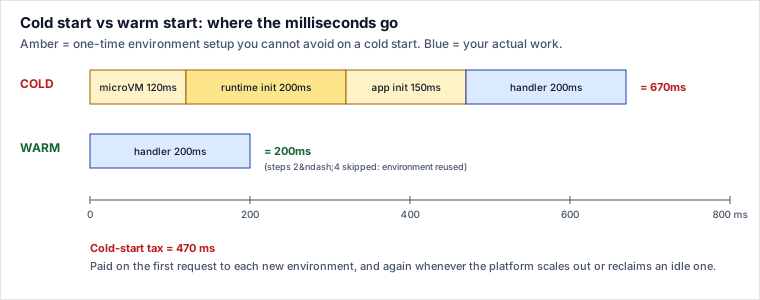
The word "serverless" hides a real container lifecycle. Here is exactly what happens when an S3 image-upload event hits a Lambda function whose environment is not already warm — a cold start:
- Event dispatch (~1–5 ms). The platform's invoke service receives the event and asks its fleet: is there an idle, initialized execution environment for this function version? On a cold start, the answer is no.
- Provision a sandbox (~50–150 ms; say 100 ms in this run). The platform boots a fresh micro-sandbox (AWS uses Firecracker microVMs) and mounts your deployment package. Larger packages and container images take longer to pull.
- Bootstrap the runtime (~50–400 ms; say 250 ms for a Node runtime with a mid-size bundle). The language runtime starts. Node.js and Python are fast; the JVM and .NET must start a VM and JIT, routinely adding 500 ms–several seconds.
- Run init code (~10–800 ms; say 120 ms here). Everything outside your handler runs once: top-level imports, SDK client construction, opening a DB connection pool, reading config. Fat dependency trees dominate here.
- Invoke the handler (the actual work). Only now does your
handler(event)run. For our resize job, say 200 ms. - Freeze, don't destroy. After returning the response the platform pauses the environment mid-memory and keeps it around (roughly 5–15 minutes of idleness, provider-tuned). The next event skips steps 2–4 entirely — a warm start that is just step 5.
So the cold-start penalty is steps 2–4 amortized to zero on warm invocations. In our trace that is 100 + 250 + 120 ≈ 470 ms of overhead paid only on the first request to a new environment — and paid again every time traffic scales out to a new concurrent instance, or after an idle gap lets the environment be reclaimed.
The per-invocation billing math, and the cost crossover
Lambda's bill (x86, us-east-1) is two line items: $0.20 per 1M requests plus $0.0000166667 per GB-second of wall-clock execution, memory rounded to what you configured. Take our resize function at 512 MB (= 0.5 GB) running 200 ms (= 0.2 s):
- Compute = 0.5 GB × 0.2 s = 0.1 GB-s × $0.0000166667 = $0.00000166667
- Request = $0.20 / 1,000,000 = $0.00000020
- Per invocation ≈ $0.00000187
Now compare that pay-per-use curve against one always-on t3.medium (2 vCPU / 4 GB) at ~$0.0416/hr ≈ $30/month, which happily serves this light workload at hundreds of req/s before saturating:
| Traffic / month | Avg rate | Serverless cost | 1× server cost | Winner |
|---|---|---|---|---|
| 100,000 | ~0.04 req/s | $0.19 | $30 | Serverless (158× cheaper) |
| 1,000,000 | ~0.4 req/s | $1.87 | $30 | Serverless |
| ~16,000,000 | ~6.1 req/s | ~$30 | $30 | Break-even |
| 100,000,000 | ~38 req/s | $187 | $30 | Server (6× cheaper) |
The crossover here is roughly 16M invocations/month (~6 req/s sustained). Below it, serverless is dramatically cheaper because you refuse to pay for idle. Above it — steady traffic that keeps a box busy — the server's flat cost amortizes per request while serverless keeps charging linearly. The honest comparison isn't "which is cheaper" but "how spiky and how sustained is my load," and you must add HA (a second server ~$60) and ops labor to the server column, and cold-start latency plus vendor pricing risk to the serverless column.
Why statelessness and concurrency limits force your architecture
Because each concurrent event gets its own frozen-then-thawed environment, two properties are non-negotiable:
- You cannot hold state in memory. A user's session, a counter, an in-progress upload — none of it survives past a single response reliably, and the very next request may land on a different instance. So you externalize everything: session and counters to DynamoDB or Redis, files to S3, coordination to a queue. The
/tmpscratch dir (512 MB default, up to 10 GB) may persist across warm reuse but is never guaranteed. This is why "serverless" and "stateless" are spoken in the same breath. - Concurrency is capped and shared. AWS gives an account a default of ~1,000 concurrent executions across all functions in a region. A traffic spike that needs 1,200 simultaneous instances gets throttled (429 /
TooManyRequestsException) and one noisy function can starve the others. You buy back isolation with reserved concurrency, and buy away cold starts with provisioned concurrency (pre-warmed instances you pay for hourly — which quietly re-introduces the always-on cost model you came to avoid).
Pitfalls a working engineer hits
- Database connection storms. 1,000 concurrent Lambdas each opening one Postgres connection = 1,000 connections against a
max_connectionsof ~100. The DB tips over. Fix with a proxy that pools on your behalf (RDS Proxy) or a connection-less store (DynamoDB). A traditional server opens a pool once and shares it — this problem doesn't exist there. - Cold starts on the wrong path. Fine for async image processing; painful on a synchronous, user-facing API — especially JVM/.NET, VPC-attached functions, or fat bundles. p50 looks great, p99 spikes to seconds.
- Hard platform limits. Lambda caps at 15-minute execution and 6 MB synchronous payloads; API Gateway in front adds a 29-second hard timeout. Long jobs and big responses simply don't fit — you must chunk, stream, or move to containers/Step Functions.
- Runaway recursion → runaway bill. A function that writes to the same S3 bucket that triggers it, or fans out without a stop condition, can invoke itself millions of times. There's no idle server to notice; you find out from the invoice. Set concurrency caps and budget alarms.
- Debugging and testing go distributed. No process to attach to, no local reproduction of the trigger fabric; you lean on structured logs and distributed tracing (X-Ray/OpenTelemetry). Local dev of an event-driven mesh is genuinely harder than
node server.js. - Vendor lock-in. Function signatures, event shapes, and the surrounding managed services (queues, auth, gateways) are provider-specific. Portability is real work.
When to use it, when not, and versus what
Reach for serverless when the load is spiky or unpredictable (bursty webhooks, cron jobs, occasional admin tasks), the work is event-driven and short (<15 min, stateless per request), you want to externalize ops, and idle time would otherwise dominate your bill. Concrete signals: a workload that is 0 req/s at night and 500 req/s at a launch spike; a glue function between two managed services; a startup that cannot staff an on-call ops rotation.
Avoid it when traffic is high and steady (you'd be past the cost crossover and paying a premium for elasticity you don't use), latency SLOs are tight and cold starts breach p99, jobs are long-running or need big in-memory state (ML inference on large models, video transcode of long files), or you require deep control over the OS, kernel, or specialized hardware.
Traditional always-on server (VM/EC2)
Gain: zero cold starts, full control, cheapest per request under sustained saturation, trivial connection pooling, easy local dev. Cost: you pay for idle 24/7, you own scaling (usually a load balancer + autoscaling group with minutes of lag), patching, and on-call. Choose the server when load is predictable and high enough to keep it busy; choose serverless when load is spiky and idle would dominate.
Containers on an orchestrator (Kubernetes / ECS / Cloud Run) — the middle ground
This is the option the original page omits, and it's usually the real alternative. You keep a small warm baseline (no cold starts on the hot path) but autoscale replicas on demand, run any language/binary, escape the 15-minute and payload limits, and stay portable across clouds. Cost: you now operate the orchestrator (or pay for a managed one) and you pay for the warm baseline even when idle. Choose containers when you want elasticity without cold-start tax or platform limits and can afford some ops; Cloud Run / scale-to-zero variants blur the line by adding serverless-style scaling to containers.
A senior engineer decides by plotting expected load on the cost/latency curve: idle-heavy and latency-tolerant → serverless; steady-and-hot → server; elastic-but-latency-sensitive or beyond-the-limits → containers. It's rarely all-or-nothing — the common production shape is a container/server core with serverless functions bolted on for the spiky, event-driven edges.
Takeaways
- The whole trade-off reduces to who pays for idle time: serverless pushes it to per-invocation billing; a server makes you pre-pay for readiness.
- A cold start is a real container lifecycle (provision microVM → init runtime → init code → invoke, then freeze); the ~470 ms tax is paid on the first hit to each new environment and vanishes on warm reuse.
- There is a computable cost crossover (~16M invocations/month for our 512 MB/200 ms function vs one $30 server); below it serverless wins, above it a saturated server is cheaper.
- Statelessness and shared concurrency limits aren't quirks — they force externalized state, connection proxies, and reserved/provisioned concurrency. Containers are usually the honest middle-ground alternative, not an either/or with always-on VMs.
Sources: AWS Lambda Developer Guide (execution environment lifecycle, INIT/INVOKE phases, concurrency & provisioned concurrency), AWS Lambda pricing (request and GB-second rates, us-east-1) and EC2 on-demand pricing; the Firecracker microVM paper (Agache et al., USENIX NSDI 2020) for the sandbox mechanism; Google Cloud Run and Kubernetes docs for the container middle-ground; and standard practitioner references (Berkeley "Cloud Programming Simplified: A Berkeley View on Serverless Computing," 2019). Re-authored/Deepened for this guide.
🤖 Don't fully get this? Learn it with Claude
Stuck on Serverless Architecture vs Traditional Serverbased? Open Claude, copy a block below, and it'll teach you this exact concept — visually and interactively.
Build the mental picture, not memorization.
I just read a lesson on **Serverless Architecture vs Traditional Serverbased** (System Design) and want to truly understand it. Explain Serverless Architecture vs Traditional Serverbased from first principles using ONE vivid real-world analogy and a visual mental model — draw it as ASCII art or a clear step-by-step diagram — with a concrete example using real numbers. Then ask me one question to check I got the mental picture, and wait for my reply. If you're unsure or a claim isn't standard, say so and reason from first principles instead of guessing.
Socratic — adapts to where you're stuck.
Teach me **Serverless Architecture vs Traditional Serverbased** interactively. Ask me ONE guiding question at a time, wait for my answer, and adapt to my confusion — build the idea with me step by step instead of explaining it all at once. If you're unsure or a claim isn't standard, say so and reason from first principles instead of guessing.
Active recall exposes what you missed.
Quiz me on **Serverless Architecture vs Traditional Serverbased** with 5 questions, easy to tricky, ONE at a time. Tell me if each answer is right; at the end, explain clearly what I got wrong and why. If you're unsure or a claim isn't standard, say so and reason from first principles instead of guessing.
Intuition + hook + flashcards for long-term memory.
Help me remember **Serverless Architecture vs Traditional Serverbased** for the long term: give the one-sentence intuition, a memorable hook/mnemonic, a tiny worked example, and 3 active-recall flashcards (Q -> A). If you're unsure or a claim isn't standard, say so and reason from first principles instead of guessing.