Hybrid Cloud Storage vs AllCloud Storage
Both models store the same bytes; they differ in where the authoritative copy lives relative to the compute that reads it — and every byte that crosses the on-prem↔cloud boundary is billed as egress and pays a full WAN round-trip. Hybrid keeps a hot working set on a local caching/tiering gateway and asynchronously pushes cold data to cloud object storage; all-cloud makes cloud object storage the single source of truth so every read from on-prem compute traverses that priced boundary. The entire trade-off collapses to one question: is your compute on the same side of the boundary as your data?
The mechanism, not the brochure
A hybrid deployment inserts a cache/tiering gateway (AWS Storage Gateway File/Cached-Volume mode, Azure File Sync with cloud tiering, NetApp Cloud Tiering — Azure's older gateway product, StorSimple, was retired in 2022) between local applications and a cloud object bucket. It runs a two-tier store:
- Hot tier — recently/frequently accessed blocks pinned on local SSD. Reads that hit here never touch the WAN: latency ~0.5–2 ms, cost $0.
- Cold tier — the full dataset in cloud object storage. A read that misses the local cache issues a GET across the WAN (~50–100 ms first byte) and is billed egress on the return path (~$0.09/GB on AWS to the internet).
Writes are acknowledged locally, then asynchronously replicated up to the bucket (ingress is free). That async step is the source of both its speed and its danger: the local ack means RPO > 0 — un-replicated writes are lost if the site dies. All-cloud removes the gateway entirely: the app talks object storage directly, so it inherits WAN latency and egress on every read unless you also move the compute into the same cloud region (where intra-region transfer is effectively free). That last clause is the whole game — co-locate compute with data and egress vanishes; separate them and it dominates the bill.
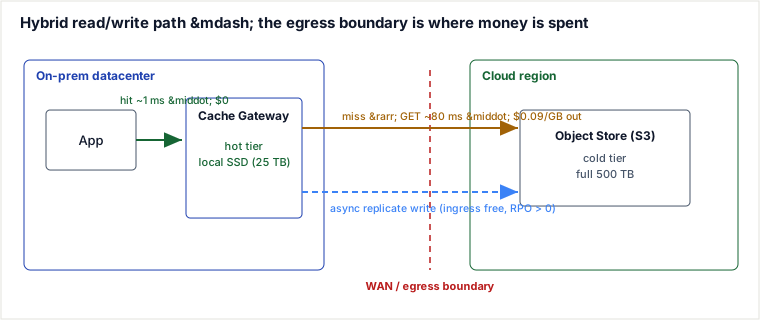
Worked example: 500 TB dataset, on-prem compute
An analytics team keeps 500 TB in cloud object storage (S3 Standard @ $0.023/GB-mo → ~$11,500/mo, paid by both models). The on-prem app issues 30 TB of reads/month against a hot working set of ~25 TB (90% of reads land in that set). Prices are representative AWS list rates; 1 TB = 1000 GB.
| Step | All-cloud (compute on-prem) | Hybrid (25 TB local cache) |
|---|---|---|
| 1. Read hits working set (27 TB) | 27,000 GB cross WAN → egress | Served from local SSD, 0 GB egress |
| 2. Read misses cold data (3 TB) | 3,000 GB cross WAN | 3,000 GB cross WAN (cache miss) |
| 3. Egress billed (GB × $0.09) | 30,000 × $0.09 = $2,700/mo | 3,000 × $0.09 = $270/mo |
| 4. Typical read latency | ~50–100 ms (WAN every read) | ~1–2 ms on 90% of reads |
| 5. Writes (async, ingress free) | local ack impossible; WAN-bound PUT | local ack ~1 ms, replicated later |
Hybrid cuts egress ~10× and read latency ~50× for this access pattern. But watch step 2: the moment a job scans the whole 500 TB (e.g., a full re-index), the cache is useless and you pay 500,000 GB × $0.09 = $45,000 in a single run — in either model. Egress is charged on the crossing, not on the tier.
The inversion: move the analytics compute into the same cloud region as the bucket and intra-region transfer drops to ~$0. All-cloud now costs $0 egress and beats hybrid outright — no gateway to run, no RPO gap. Hybrid only wins while the compute is stuck on-prem.
Pitfalls a working engineer hits
- Egress bill shock from cold scans. A backfill, full re-index, or a Spark job with a bad predicate that scans cold data pulls TBs across the boundary at $0.09/GB. The $45,000 rescan above lands with no warning. Meter reads by tier and alarm on egress, not just storage.
- Treating the local cache as durable. The gateway acks writes locally then replicates asynchronously. A site power loss or gateway crash before replication loses those writes — RPO > 0. Never point a system-of-record write path at a write-back cache without understanding the replication lag.
- Cold cache after failover / working-set drift. Reboot the gateway, fail over to a standby, or let the working set grow past local capacity, and hit rate craters. Every read becomes a WAN miss simultaneously: latency spikes 50× and egress spikes with it — exactly during an incident.
- Split-brain namespaces. Two gateways caching-and-writing the same bucket prefix will silently clobber each other on conflicting writes; object stores have no cross-gateway locking. Partition writers by prefix or use a single writer.
- All-cloud: the WAN is a hard dependency. An ISP or VPN/DirectConnect outage takes storage to zero for on-prem apps. No local copy = no read-only degraded mode.
- Data gravity / lock-in. Once 500 TB lives in one cloud, leaving costs the same egress — ~$45k just to copy it out once, before you pay the new home. The cost that made hybrid attractive is also what traps you in all-cloud.
When to use which — and the trade-off
Decide by the location of compute relative to the authoritative data, then by residency and elasticity.
Choose hybrid when: heavy, latency-sensitive compute is pinned on-prem and cannot move (existing datacenter capex, sub-millisecond local processing, factory/edge sites); regulation forces some data to stay resident on-prem; the hot working set is a small, stable fraction of the total so the local cache actually earns its keep; or the WAN link is the bottleneck for interactive reads. What you gain: local-read latency, residency control, ~10× egress reduction for cacheable patterns. What it costs: a second control plane to run and patch, orchestration/sync complexity, an RPO gap from async replication, and on-prem hardware capex.
Prefer all-cloud when: compute is (or can be) co-located in the same cloud region as the data, which zeroes out egress and deletes the entire hybrid rationale; workloads are spiky/elastic; there is no residency constraint; and you want to shed storage ops. What you gain: one simple control plane, elastic scale, no gateway. What it costs: a hard WAN dependency for any remaining on-prem reader, per-request latency for chatty workloads, and data-gravity lock-in.
Crisp rule: choose hybrid when compute is trapped on-prem or data is legally trapped there; choose all-cloud when you can put compute in the same region as the data. If you're doing hybrid purely for burst capacity, the honest middle option is cloud-bursting — keep the steady state on-prem and spin cloud compute up next to a replicated copy only during peaks, so the burst reads never cross the priced boundary.
Takeaways
- The bill and the latency are set by the on-prem↔cloud boundary crossing, not by which tier holds a byte — egress (~$0.09/GB) is charged per WAN read.
- Hybrid is a two-tier cache: hot on local SSD (fast, free), cold in the cloud (WAN + egress on miss), writes replicated asynchronously → RPO > 0.
- Co-locating compute with data zeroes egress and makes all-cloud strictly simpler; hybrid only wins while compute is pinned on-prem or data is residency-bound.
- Guard the two failure modes: cold scans that ignore the cache (bill shock) and the async-replication gap (data loss on site failure).
Sources: AWS Storage Gateway documentation (File & Cached-Volume modes) and Amazon S3 pricing/data-transfer pages; Azure File Sync and NetApp Cloud Tiering reference architectures; Google Cloud Storage and Anthos hybrid guidance; Martin Kleppmann, Designing Data-Intensive Applications (replication lag & RPO). Re-authored/Deepened for this guide.
🤖 Don't fully get this? Learn it with Claude
Stuck on Hybrid Cloud Storage vs AllCloud Storage? Open Claude, copy a block below, and it'll teach you this exact concept — visually and interactively.
Build the mental picture, not memorization.
I just read a lesson on **Hybrid Cloud Storage vs AllCloud Storage** (System Design) and want to truly understand it. Explain Hybrid Cloud Storage vs AllCloud Storage from first principles using ONE vivid real-world analogy and a visual mental model — draw it as ASCII art or a clear step-by-step diagram — with a concrete example using real numbers. Then ask me one question to check I got the mental picture, and wait for my reply. If you're unsure or a claim isn't standard, say so and reason from first principles instead of guessing.
Socratic — adapts to where you're stuck.
Teach me **Hybrid Cloud Storage vs AllCloud Storage** interactively. Ask me ONE guiding question at a time, wait for my answer, and adapt to my confusion — build the idea with me step by step instead of explaining it all at once. If you're unsure or a claim isn't standard, say so and reason from first principles instead of guessing.
Active recall exposes what you missed.
Quiz me on **Hybrid Cloud Storage vs AllCloud Storage** with 5 questions, easy to tricky, ONE at a time. Tell me if each answer is right; at the end, explain clearly what I got wrong and why. If you're unsure or a claim isn't standard, say so and reason from first principles instead of guessing.
Intuition + hook + flashcards for long-term memory.
Help me remember **Hybrid Cloud Storage vs AllCloud Storage** for the long term: give the one-sentence intuition, a memorable hook/mnemonic, a tiny worked example, and 3 active-recall flashcards (Q -> A). If you're unsure or a claim isn't standard, say so and reason from first principles instead of guessing.