Designing a Key-Value Store — Quorum, Vector Clocks & Anti-Entropy, Traced
The one problem a key-value store actually solves
A key-value store has a two-function API — get(key) and put(key, value) — and
that simplicity is the point: because there are no joins, no secondary indexes and no multi-key transactions to
preserve, the design is free to spread data across hundreds of machines. Everything hard about it comes from one
consequence of that freedom: the same key now lives on several machines, and they can disagree.
So this is not really a storage problem. It is a disagreement-management problem, and every component below is one specific answer to "what do we do when replicas differ?" Read it that way and the design stops being a list of exotic names (sloppy quorum, hinted handoff, Merkle tree) and becomes four decisions: where does a key live, how many copies, how do we read a fresh one, and how do copies get back in sync after a failure.
The scope worth agreeing on first
- Small values — say under 10 KB. Large blobs belong in object storage with the key-value store holding the pointer.
- Ability to store big data — the dataset does not fit on one machine, which is what forces partitioning.
- High availability and scalability — responds during failures, scales horizontally.
- Tunable consistency — the caller, not the database, decides how much staleness is acceptable.
That last one is the design's signature move, and it is worth being blunt about why: a store that hardcodes strong consistency cannot be highly available during a partition, and one that hardcodes eventual consistency cannot serve a balance check. Making W and R parameters pushes the choice to the only place that knows the answer — the caller.
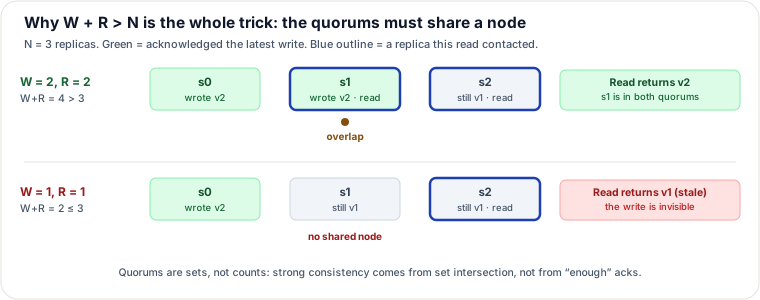
Consistency is set intersection, not a vote count
Define N = number of replicas, W = replicas that must acknowledge a write, R = replicas that must answer a read. A coordinator node acts as a proxy between the client and the replicas, collecting those acknowledgements.
The famous rule is W + R > N ⇒ strong consistency. The diagram above shows why, and it is worth stating precisely because the rule is so often repeated without its reason: if the write set has W members and the read set has R members out of N total, then W + R > N forces the two sets to share at least one node (pigeonhole). That shared node holds the latest write, so the read cannot miss it. The read still has to pick the newest of the R answers it gets — the overlap guarantees the fresh value is present among the responses, not that it arrives labelled.
One clarification that trips people up: W = 1 does not mean the data is written to only one server. It means the coordinator waits for only one acknowledgement before returning success. Replication to the other N−1 still happens — asynchronously, and possibly not at all if that node dies first. W is a latency knob, not a durability count.
Picking N, W, R — and what each choice costs
| Config | Optimizes | Consistency | Use when | The cost you accept |
|---|---|---|---|---|
| N=3, W=1, R=1 | Both read and write latency | Eventual only | Metrics, view counters, caches, session blobs | Reads can miss recent writes; conflicting versions accumulate |
| N=3, W=2, R=2 | Balance (the usual default) | Strong (4 > 3) | General-purpose store; user profiles, shopping carts | Every op waits for the 2nd-fastest replica — tail latency tracks the median, not the fastest |
| N=3, W=3, R=1 | Read latency | Strong | Read-heavy config/feature-flag data written rarely | A single slow or down replica blocks all writes — write availability = the weakest node |
| N=3, W=1, R=3 | Write latency | Strong | Write-heavy ingestion read by batch jobs | Reads block on the slowest replica; a down node stops reads |
Note the asymmetry hiding in rows 3 and 4: strong consistency is achievable at several W/R splits, but each puts the availability risk on a different operation. "W+R>N" alone does not tell you whether an outage breaks your writes or your reads. That is the actual interview question.
When a key-value store is the wrong answer
Reach for something else when you need queries you did not plan for (no secondary indexes —
you can only fetch by key, so every access pattern must be designed in advance as its own key), multi-key
atomicity (transferring money between two accounts is two keys, likely on two partitions), or
aggregation (there is no GROUP BY; you precompute or you stream). A relational database
with read replicas serves a surprising amount of "we need a KV store" traffic, and it answers questions you have not
thought of yet. Choose the KV store when the access pattern is genuinely known and the scale genuinely exceeds one
machine — not because it sounds more scalable.
Where a key lives: consistent hashing, and the two rules that matter
Servers are placed on a hash ring; a key is hashed onto the same ring and stored on the first server
found walking clockwise. This solves the two partitioning problems at once — data spreads evenly, and
adding or removing a node moves only the keys in the affected arc rather than remapping everything (the
hash % N catastrophe).
Two refinements carry real weight:
- Virtual nodes buy heterogeneity. Each physical server owns many ring positions, and the number of positions is proportional to its capacity — a machine with twice the RAM gets twice the virtual nodes and twice the keys. Without virtual nodes you cannot run a mixed fleet fairly.
- Replica selection must skip duplicates. Walk clockwise and take the first N servers — but with virtual nodes, the next N ring positions may belong to the same physical machine. Take only unique physical servers, otherwise "N=3" silently becomes two real copies and you lose a replica you believe you have. This is the kind of bug that stays invisible until the day it costs you data.
Because machines in one data center fail together — power, network, flood — replicas are placed in distinct data centers connected by high-speed links. This is what makes a full DC outage survivable rather than fatal.
When replicas disagree: versioning with vector clocks
Eventual consistency deliberately lets conflicting values into the system, then asks someone to reconcile them. To reconcile, you must first be able to tell which versions conflict — and wall-clock timestamps cannot tell you that, because clocks skew and "later timestamp" does not mean "knew about the earlier value".
A vector clock is a set of [server, counter] pairs carried with the value. On a write
handled by server Si: increment the counter if [Si, v] exists, else add
[Si, 1].
Trace: how a conflict forms and is detected
- A client writes D1; server Sx handles it →
D1([Sx, 1]). - A client reads D1, updates it, writes back via Sx →
D2([Sx, 2]). D2 descends from D1, so it simply overwrites it — no conflict. - A client reads D2, updates it, writes via Sy →
D3([Sx, 2], [Sy, 1]). - Concurrently, another client also reads D2, updates it, writes via Sz →
D4([Sx, 2], [Sz, 1]). - A client now reads and receives both D3 and D4. Neither dominates the other, so both are returned as
siblings. The client reconciles and writes the merge back via Sx →
D5([Sx, 3], [Sy, 1], [Sz, 1]), which now dominates both.
The test: version X is an ancestor of Y (no conflict, Y wins) if every counter in X is
≤ the corresponding counter in Y. They are siblings (a real conflict) if each has at least one counter
the other beats. So ([s0,1],[s1,1]) is an ancestor of ([s0,1],[s1,2]); but
([s0,1],[s1,2]) and ([s0,2],[s1,1]) conflict — each knows something the other does
not.
Two honest downsides
- Complexity moves to the client. The store can detect a conflict but cannot resolve it — only application logic knows whether two shopping carts should be unioned or whether the higher bid wins. Every caller must implement merge logic, and callers that ignore siblings silently lose writes.
- The clock grows. Each new coordinating server adds a pair. The mitigation is to cap the length and evict the oldest pairs, which makes the ancestor test occasionally wrong — you may report a conflict that is not one. Per the Dynamo paper, Amazon had not hit this in production, so it is an acceptable trade for most systems; it is worth knowing it is a trade rather than a solution.
The cheaper alternative, stated honestly: last-write-wins with a timestamp. It is simpler, needs no client merge logic, and silently discards one of two concurrent writes. That is the correct choice for overwrite-only data such as a cached profile field, and the wrong choice for anything additive like a cart or a counter, where the discarded write is a lost item.
Failure handling: detect, then survive, then repair
Detection — why gossip beats all-to-all
One server's opinion is not enough to mark another down; you want at least two independent sources. The naive approach, all-to-all multicasting, has every node heartbeat every other node — correct, but the message count grows as O(N²), so it collapses as the fleet grows.
Gossip protocol is the decentralized alternative: each node keeps a membership list of member IDs and heartbeat counters; each node periodically increments its own counter and sends its list to a few random nodes, which merge and re-propagate. If a member's counter has not advanced for longer than a threshold, it is marked offline and that verdict spreads. The result is O(N) messages per node per round and detection that degrades gracefully instead of melting down.
Surviving temporary failures — sloppy quorum and hinted handoff
Under a strict quorum, a downed replica can block reads and writes outright: if two of three replicas for a key are unreachable, W=2 simply fails. A sloppy quorum relaxes membership rather than the count — ignore the down nodes and take the first W healthy servers walking the ring for writes and first R healthy for reads. The count is preserved; the identity of the participants is not.
The stand-in that accepted a write it does not own keeps it with a hint recording the rightful owner. When the owner returns, the data is handed back — hinted handoff. Availability is preserved; the price is that during the window, a reader contacting only the "correct" replicas may not see the write, so a sloppy quorum does not deliver the W+R>N guarantee even when the arithmetic looks right. That is the subtlety worth naming out loud: sloppy quorum trades the consistency guarantee for uptime, and the arithmetic stops being a proof.
Repairing permanent failures — anti-entropy with Merkle trees
Hinted handoff assumes the node comes back. If a replica is permanently gone (or has silently drifted for weeks), you need anti-entropy: compare replicas and update each to the newest version. Comparing key by key would mean shipping the entire dataset, so replicas compare a Merkle tree instead — a tree where each leaf hashes a bucket of keys and each parent hashes its children.
- Split the key space into buckets (this bounds the tree's depth).
- Hash each key within a bucket.
- Compute one hash node per bucket.
- Build upward to a single root.
To compare, start at the roots. Equal roots mean identical data — one hash exchanged, done. If they differ, descend into the differing children only. Traffic becomes proportional to how much diverged, not to how much data exists. A realistic configuration is about one million buckets for one billion keys, so each bucket holds roughly 1,000 keys — the granularity knob: coarser buckets mean a smaller tree but more wasted re-sync per mismatch.
Inside one node: the write and read paths
The storage engine below is essentially Cassandra's, and it exists because random writes to disk are slow while sequential writes are fast.
Write path. (1) Append the write to a commit log on disk — sequential, and the reason a crash does not lose acknowledged writes. (2) Apply it to an in-memory table. (3) When memory fills past a threshold, flush to a sorted SSTable on disk (a sorted list of key-value pairs, written once and never modified in place).
Read path. Check memory first; on a hit, return. On a miss the problem is that the key could be in any of many SSTables, and checking each costs a disk seek. So consult a bloom filter per SSTable — a compact probabilistic structure that answers "definitely not here" or "possibly here". Only the "possibly" tables are read. False positives cost a wasted seek; false negatives cannot happen, which is exactly the asymmetry that makes the filter safe to trust as a skip signal.
The trade-off to state plainly: this design makes writes cheap (append-only) and pays on reads (potentially several SSTables plus background compaction to merge them). A B-tree engine does the opposite. Choose by workload shape, not by fashion — write-heavy ingestion wants the log-structured engine, read-heavy point lookups on stable data are often happier with a B-tree.
The architecture, assembled
- Clients call
get(key)/put(key, value). - Any node can act as coordinator for a request — a proxy to the replicas.
- Nodes sit on a consistent-hash ring; membership changes are automatic.
- Every node runs the same code and holds the same responsibilities: no leader, no special node, therefore no single point of failure.
That last property is the reason the design is decentralized at all, and it is also its main cost: with no leader there is nowhere to put a serialization point, which is precisely why you get quorums and vector clocks instead of simple transactions.
Which mechanism answers which failure
| Goal | Mechanism | What it costs |
|---|---|---|
| Store data too big for one node | Consistent hashing on a ring | No global queries; key design is permanent |
| High availability for reads/writes | Replication (N copies) + sloppy quorum | Storage ×N; replicas can disagree |
| Tunable consistency | Quorum W/R with W+R>N | Latency tracks the W-th or R-th fastest replica |
| Detect concurrent writes | Vector clocks | Client-side merge logic; clock growth |
| Detect node failure at scale | Gossip protocol | Detection is delayed, not instant |
| Survive a brief node outage | Hinted handoff | The W+R>N guarantee lapses during the window |
| Repair long-term divergence | Anti-entropy with Merkle trees | Background CPU/IO; bucket-granularity waste |
| Survive a data-center loss | Cross-DC replica placement | Cross-DC write latency and egress cost |
Pitfalls
- Believing W+R>N always holds. Under sloppy quorum the participants change, so the intersection proof no longer applies — you can read stale data with "strongly consistent" settings during a failure.
- Counting virtual nodes as replicas. Skipping the unique-physical-server check quietly reduces your real replication factor.
- Ignoring siblings. A client that always picks the first returned version turns conflict detection into silent data loss — strictly worse than last-write-wins, because you paid for vector clocks and still lost the write.
- W = N for durability. It does not buy durability, it buys a write outage on any single slow node. Durability comes from the commit log and replica placement.
- Assuming the read repairs itself. A quorum read may return divergent values; unless read repair or anti-entropy actually writes the winner back, the divergence persists for the next reader too.
Cost model — what dominates the bill
A key-value store's bill is shaped by replication factor multiplying everything. At N=3, one logical terabyte is three physical terabytes, three sets of writes to disk, and — if replicas span data centers — two cross-DC copies of every write leaving the region.
Rough BOTE for a modest store: 500 million keys × 2 KB average value = 1 TB logical, so 3 TB provisioned at N=3. On SSD-backed instance storage at roughly $0.10/GB-month that is about $300/month for storage — genuinely cheap. Now the other side: at 20,000 writes/second with N=3, the fleet absorbs 60,000 replica writes/second, and if one replica sits in another region at typical $0.02/GB egress, a 2 KB value replicated cross-region once is 20,000 × 2 KB = 40 MB/s → about 100 TB/month → roughly $2,000/month in egress alone, an order of magnitude above the storage line.
Dominant line item: cross-region replication egress, followed by the per-node compute/IOPS needed to absorb N× the logical write rate (compaction included — a log-structured engine rewrites data in the background, so provisioned IOPS must cover far more than the client write rate).
Levers to cut it: keep N=3 but place all three replicas in one region and accept a regional-outage risk you have explicitly priced; or replicate cross-region asynchronously and selectively, shipping only the keyspaces that need geographic durability. Reducing N to 2 halves the egress but makes W=2 equal to W=N — a single slow node then blocks every write, which is usually a worse trade than paying for the third replica.
Operability: the fingerprints of a sick key-value store
Each failure mode announces itself distinctly. Rising sibling counts on reads mean concurrent writes to the same keys are outrunning reconciliation — either genuine write contention or clients that read, think, and write back too slowly; the fix is usually a narrower key, not a bigger cluster. Hint queues growing without draining mean a node has been down long enough that hinted handoff has become a backlog; when hints expire before the node returns, those writes are only recoverable by anti-entropy, so a growing hint queue with an expiry policy is a silent data-loss timer. P99 writes tracking the slowest replica while P50 stays flat is the signature of W too close to N — one degraded disk is gating the quorum. Read latency climbing while write rate is flat points at SSTable count: compaction has fallen behind, so each read consults more files and more bloom filters. And Merkle repair transferring far more than the actual divergence means the buckets are too coarse.
The subtlest fingerprint is stale reads that appear only during a node outage — the signature of sloppy quorum silently suspending your consistency guarantee. It will not reproduce in a healthy cluster, which is why it gets misfiled as a client bug. Signals worth having: sibling-count histogram, hint-queue depth and hint age, SSTables-per-read, quorum-participant identity on stale-read complaints, and anti-entropy bytes transferred versus keys actually repaired.
Re-authored for this guide from the Alex Xu Vol. 1 chapter (with Dynamo/Cassandra/BigTable as the underlying sources); quorum-overlap diagram hand-authored as SVG. Assembles mechanisms this guide already covers individually — see Quorum, CAP Theorem, Consistent Hashing, Bloom Filters, Replication, and (Databases) B-Tree vs LSM-Tree Storage Engines.
🤖 Don't fully get this? Learn it with Claude
Stuck on Designing a Key-Value Store — Quorum, Vector Clocks & Anti-Entropy, Traced? Open Claude, copy a block below, and it'll teach you this exact concept — visually and interactively.
Build the mental picture, not memorization.
I just read a lesson on **Designing a Key-Value Store — Quorum, Vector Clocks & Anti-Entropy, Traced** (System Design) and want to truly understand it. Explain Designing a Key-Value Store — Quorum, Vector Clocks & Anti-Entropy, Traced from first principles using ONE vivid real-world analogy and a visual mental model — draw it as ASCII art or a clear step-by-step diagram — with a concrete example using real numbers. Then ask me one question to check I got the mental picture, and wait for my reply. If you're unsure or a claim isn't standard, say so and reason from first principles instead of guessing.
Socratic — adapts to where you're stuck.
Teach me **Designing a Key-Value Store — Quorum, Vector Clocks & Anti-Entropy, Traced** interactively. Ask me ONE guiding question at a time, wait for my answer, and adapt to my confusion — build the idea with me step by step instead of explaining it all at once. If you're unsure or a claim isn't standard, say so and reason from first principles instead of guessing.
Active recall exposes what you missed.
Quiz me on **Designing a Key-Value Store — Quorum, Vector Clocks & Anti-Entropy, Traced** with 5 questions, easy to tricky, ONE at a time. Tell me if each answer is right; at the end, explain clearly what I got wrong and why. If you're unsure or a claim isn't standard, say so and reason from first principles instead of guessing.
Intuition + hook + flashcards for long-term memory.
Help me remember **Designing a Key-Value Store — Quorum, Vector Clocks & Anti-Entropy, Traced** for the long term: give the one-sentence intuition, a memorable hook/mnemonic, a tiny worked example, and 3 active-recall flashcards (Q -> A). If you're unsure or a claim isn't standard, say so and reason from first principles instead of guessing.