Build the Equation
Mechanism
This is a per-row format then aggregate-into-one-string problem: each row of Terms is independently rendered into its own text fragment (sign + coefficient + variable part) with two CASE expressions, and then a single ordered string-aggregation pass glues every fragment together — in descending order of power, with no separator — before =0 is appended. The whole table collapses to exactly one row because the aggregation has no GROUP BY, so the engine treats the entire result set as one group.
The two CASE expressions
Every term must be printed as <sign><|factor|><variable-part>. Those three pieces are produced by two independent decisions:
- Sign depends only on the polarity of
factor: positive prints+, negative prints-. Because the problem guaranteesfactoris in[-100, 100]and cannot be zero, only two arms are ever reachable. - Variable part depends only on
power, which encodes how much ofX^<power>to suppress:power > 1keeps the fullX^p;power = 1drops the^1and prints bareX;power = 0drops theXentirely, leaving just the magnitude.
The coefficient itself is always ABS(factor) — the magnitude — because the sign has already been emitted separately. Splitting sign from magnitude is the trick that makes the descending concatenation read like real algebra (+1X^2-4X+2) instead of doubling up signs.
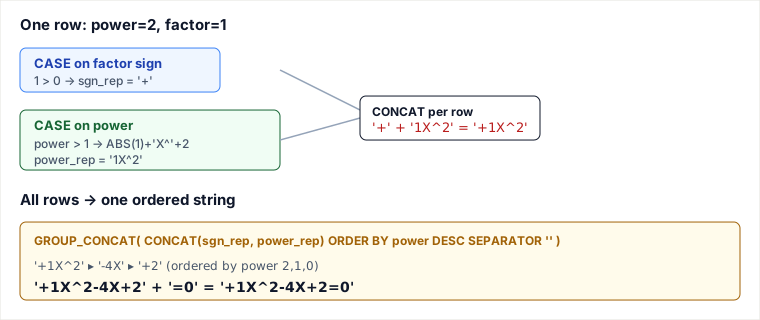
Worked example, traced
Take the three-row input (power, factor) = (2, 1), (1, -4), (0, 2). Trace each stage:
| power | factor | sgn_rep (CASE on sign) | power_rep (CASE on power) | per-row fragment |
|---|---|---|---|---|
| 2 | 1 | + | 1X^2 (power>1) | +1X^2 |
| 1 | -4 | - | 4X (power=1, drop ^1) | -4X |
| 0 | 2 | + | 2 (power=0, drop X) | +2 |
The aggregation orders fragments by power DESC → +1X^2, -4X, +2, joins them with an empty separator → +1X^2-4X+2, and the outer CONCAT(..., '=0') appends the right-hand side → final answer +1X^2-4X+2=0.
The query (cleaned up)
The version below removes two warts from the naive solution (explained next) but produces the identical correct output:
WITH eqn_reps AS (
    SELECT
        power,
        CASE WHEN factor > 0 THEN '+' ELSE '-' END AS sgn_rep,
        CASE
            WHEN power > 1 THEN CONCAT(ABS(factor), 'X^', power)
            WHEN power = 1 THEN CONCAT(ABS(factor), 'X')
            ELSE                ABS(factor)            -- power = 0
        END AS power_rep
    FROM Terms
)
SELECT CONCAT(
         GROUP_CONCAT(CONCAT(sgn_rep, power_rep)
                      ORDER BY power DESC SEPARATOR ''),
         '=0'
       ) AS equation
FROM eqn_reps;
Why the naive version is over-built
- The
rncolumn is dead weight. The original computesROW_NUMBER() OVER (ORDER BY power DESC) AS rnand a wholeordered_termsCTE around it, butrnis never referenced again. Ordering is re-stated insideGROUP_CONCAT(... ORDER BY power DESC), which is where it actually takes effect. A pre-sort in a subquery does not reliably survive into an aggregate — SQL set operations carry no inherent row order — so theROW_NUMBERand its CTE are pure overhead. Dropped here. - The sign
CASEhas an unreachableELSE ''arm. The schema guaranteesfactor≠ 0, so theWHEN factor < 0arm catches everything not caught by> 0. Collapsing toCASE WHEN factor > 0 THEN '+' ELSE '-' ENDis both shorter and states the invariant. (Had zero been possible, an empty sign would have produced malformed output like+1X^2 0— so the dead arm was also slightly misleading.)
The systems insight: string aggregation is not portable
GROUP_CONCAT is the single most engine-specific construct in this query. It is a MySQL/MariaDB-ism, and porting this exact SQL to another database will fail at parse time. The same "format-rows-then-fold-into-one-string" mechanism exists everywhere, but under different names and with different syntax for the two things that matter here — ordering inside the fold and choosing the separator:
| Engine | Function | Ordering & separator |
|---|---|---|
| MySQL / MariaDB | GROUP_CONCAT(x ORDER BY power DESC SEPARATOR '') | ORDER BY + SEPARATOR keyword inside the call |
| PostgreSQL | string_agg(x, '' ORDER BY power DESC) | separator is the 2nd arg; ORDER BY inside the call |
| SQL Server (2017+) | STRING_AGG(x, '') WITHIN GROUP (ORDER BY power DESC) | separator is 2nd arg; order in a WITHIN GROUP clause |
| Oracle | LISTAGG(x, '') WITHIN GROUP (ORDER BY power DESC) | like SQL Server; watch the 4000-byte VARCHAR2 cap |
| SQLite | group_concat(x, '') | no ORDER BY inside the call — must pre-sort in a subquery |
SQLite is the interesting outlier: its group_concat ignores ordering, so on SQLite the dead ROW_NUMBER/pre-sort the naive version wrote would suddenly become load-bearing-ish — though even then the only safe guarantee is to feed an already-ordered subquery. This is the broad lesson for a systems engineer: string aggregation is an ANSI-SQL gap, so any query that builds delimited text is implicitly tied to one engine. If portability matters, isolate the aggregation behind a generated query or do the final fold in application code.
Pitfalls
- Trusting subquery order to reach the aggregate. Ordering rows in a CTE and assuming
GROUP_CONCATwill honor it is the classic bug — most engines are free to reorder. The order clause must live inside the aggregate call (orWITHIN GROUP). The naivernCTE is a symptom of this misconception even though the query happens to also repeat the order inside the call. - Hitting the
group_concat_max_lenceiling. MySQL silently truncatesGROUP_CONCAToutput at 1024 bytes by default. A 100-term polynomial easily blows past that, producing a quietly cut-off equation with no error. Bump it withSET SESSION group_concat_max_len = 1000000;in production-scale data. - Number-to-string coercion of
power.CONCAT(ABS(factor), 'X^', power)relies on the engine implicitly casting the integerpowerto text. MySQL does this; some engines need an explicitCAST(power AS CHAR). Forgetting it is a silent porting failure. - Assuming a sign always precedes a term. If the spec allowed
factor = 0(it does not here) or a leading term with no sign, the bare+/-split would need rework. Lean on the stated invariants — that is exactly why the deadELSE ''arm should go.
Takeaways
- Format per row, fold once. Two independent
CASEexpressions render each term; one ordered, separator-aware aggregate with noGROUP BYcollapses the whole table into a single string. - Separate sign from magnitude. Emitting the sign character independently and concatenating
ABS(factor)is what lets descending concatenation read as valid algebra. - Put the order inside the aggregate. Row order is not carried by subqueries;
ORDER BY/WITHIN GROUPinside the aggregate is the only reliable control. A pre-sortingROW_NUMBERCTE is dead weight here. - String aggregation is engine-specific.
GROUP_CONCAT(MySQL) maps tostring_agg(Postgres),STRING_AGG(SQL Server),LISTAGG(Oracle), each with its own ordering/separator syntax and its own truncation traps — a portability boundary worth memorizing.
Re-authored and deepened for this guide. Problem from LeetCode 2118 "Build the Equation" (Hard). Engine-specific string-aggregation syntax verified against the MySQL 8 Reference Manual (GROUP_CONCAT, group_concat_max_len), the PostgreSQL 16 docs (string_agg), Microsoft SQL Server STRING_AGG documentation, Oracle LISTAGG documentation, and the SQLite group_concat reference. Fixes over the original: removed the unused ROW_NUMBER/rn CTE and collapsed the sign CASE's unreachable ELSE '' arm (factor is guaranteed non-zero); added the portability comparison and aggregate-ordering correctness note.
🤖 Don't fully get this? Learn it with Claude
Stuck on Build the Equation? Open Claude, copy a block below, and it'll teach you this exact concept — visually and interactively.
Build the mental picture, not memorization.
I just read a lesson on **Build the Equation** (Databases) and want to truly understand it. Explain Build the Equation from first principles using ONE vivid real-world analogy and a visual mental model — draw it as ASCII art or a clear step-by-step diagram — with a concrete example using real numbers. Then ask me one question to check I got the mental picture, and wait for my reply. If you're unsure or a claim isn't standard, say so and reason from first principles instead of guessing.
Socratic — adapts to where you're stuck.
Teach me **Build the Equation** interactively. Ask me ONE guiding question at a time, wait for my answer, and adapt to my confusion — build the idea with me step by step instead of explaining it all at once. If you're unsure or a claim isn't standard, say so and reason from first principles instead of guessing.
Active recall exposes what you missed.
Quiz me on **Build the Equation** with 5 questions, easy to tricky, ONE at a time. Tell me if each answer is right; at the end, explain clearly what I got wrong and why. If you're unsure or a claim isn't standard, say so and reason from first principles instead of guessing.
Intuition + hook + flashcards for long-term memory.
Help me remember **Build the Equation** for the long term: give the one-sentence intuition, a memorable hook/mnemonic, a tiny worked example, and 3 active-recall flashcards (Q -> A). If you're unsure or a claim isn't standard, say so and reason from first principles instead of guessing.