Customer Purchase Summary
A GROUP BY customer_id collapses every purchase row for one customer into a single output row, and the aggregate functions run over the set of grouped rows — COUNT(DISTINCT product) deduplicates while it counts, and GROUP_CONCAT(DISTINCT product ORDER BY product SEPARATOR ',') deduplicates, sorts, and stitches the surviving values into one comma-joined string, all inside the same grouping pass.
The problem
Given a purchases table where a customer can buy the same product more than once, produce one row per customer showing how many distinct products they bought and an alphabetised, comma-separated list of those product names.
-- purchases
 purchase_id | customer_id | product
-------------+-------------+----------
      1      |     101     | Mouse
      2      |     101     | Keyboard
      3      |     101     | Mouse      -- repeat
      4      |     102     | Monitor
      5      |     101     | Webcam
      6      |     102     | Monitor    -- repeat
The query (MySQL)
SELECT
    customer_id,
    COUNT(DISTINCT product) AS distinct_products,
    GROUP_CONCAT(DISTINCT product ORDER BY product SEPARATOR ',') AS product_list
FROM purchases
GROUP BY customer_id
ORDER BY customer_id;
The two aggregates are independent passes over the same group: one returns a number, the other returns a string. The DISTINCT, ORDER BY, and SEPARATOR clauses all live inside the GROUP_CONCAT parentheses — they shape that one aggregate's input, not the outer query.
Step-by-step trace for customer 101
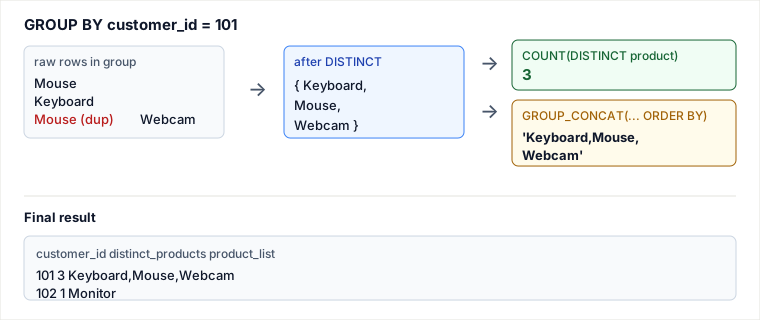
Customer 101 has four purchase rows: Mouse, Keyboard, Mouse, Webcam. Watch what each clause does to that multiset, in order.
| Step | Clause | Working set for 101 |
|---|---|---|
| 1 | Group's raw values | [Mouse, Keyboard, Mouse, Webcam] |
| 2 | DISTINCT — drop duplicate Mouse | {Keyboard, Mouse, Webcam} |
| 3 | ORDER BY product — sort alphabetically | [Keyboard, Mouse, Webcam] |
| 4 | SEPARATOR ',' — join | 'Keyboard,Mouse,Webcam' |
In parallel, COUNT(DISTINCT product) sees the same step-2 set {Keyboard, Mouse, Webcam} and returns 3 — not 4, because the duplicate Mouse was collapsed before counting.
Full output
Customer 102 bought Monitor twice; DISTINCT collapses it to one, so the count is 1 and the list is the single value.
| customer_id | distinct_products | product_list |
|---|---|---|
| 101 | 3 | Keyboard,Mouse,Webcam |
| 102 | 1 | Monitor |
Why the naive version is wrong
The instinctive write is COUNT(product) and a bare GROUP_CONCAT(product). Both fail on real data:
COUNT(product)counts rows, so customer 101 reports 4 (the repeatedMouseis counted twice). You wanted distinct products, so you needCOUNT(DISTINCT product).- Bare
GROUP_CONCAT(product)emitsMouse,Keyboard,Mouse,Webcam— duplicated and in arbitrary engine order. You must putDISTINCTandORDER BYinside the call to get a stable, deduplicated list.
Portability: this is MySQL-specific
That DISTINCT ... ORDER BY ... SEPARATOR form is MySQL/MariaDB syntax. The standard-SQL equivalent (PostgreSQL, modern SQL Server, Oracle) is STRING_AGG, and its grammar differs:
-- PostgreSQL
SELECT
    customer_id,
    COUNT(DISTINCT product) AS distinct_products,
    STRING_AGG(DISTINCT product, ',' ORDER BY product) AS product_list
FROM purchases
GROUP BY customer_id
ORDER BY customer_id;
The separator is a positional argument, not a SEPARATOR keyword. PostgreSQL allows DISTINCT together with ORDER BY only when the ORDER BY expression matches the aggregated expression — order by product while aggregating product is fine; order by some other column would raise "in an aggregate with DISTINCT, ORDER BY expressions must appear in argument list". SQL Server's STRING_AGG uses WITHIN GROUP (ORDER BY product) and has no DISTINCT support at all — you must pre-deduplicate in a subquery or CTE.
Pitfalls
- Silent truncation. MySQL caps
GROUP_CONCAToutput atgroup_concat_max_len(default 1024 bytes). A customer with thousands of products gets a truncated string with no error — the row still returns, just incomplete. Raise it withSET SESSION group_concat_max_len = 1000000;for wide aggregations. - NULLs vanish, not error.
GROUP_CONCATskips NULL products entirely, so a row with all-NULL products yieldsNULLfor the whole list, andCOUNT(DISTINCT product)also ignores NULLs — a customer with only NULL products counts 0. If absence matters,COALESCEfirst. - DISTINCT and ORDER BY are not free. Both force MySQL to materialise and sort each group's values; on large groups this spills to a temporary table on disk. It is a per-group sort, not a global one.
- Separator collisions. If a product name itself contains a comma ("Cable, USB-C"), a comma separator makes the result unparseable downstream. Pick a separator that cannot appear in the data (e.g. a tab or
'||'), or return JSON viaJSON_ARRAYAGG. - Don't double-aggregate. Wrapping
COUNTaroundGROUP_CONCATor vice-versa is a parse error — they are sibling aggregates over the same group, not nested.
Takeaways
COUNT(DISTINCT col)dedupes before counting; bareCOUNT(col)counts rows — they diverge the moment a value repeats.- Inside
GROUP_CONCAT, the order is fixed:DISTINCTdedupes, thenORDER BYsorts, thenSEPARATORjoins — all scoped to one group. - String aggregation is the least portable common aggregate: MySQL
GROUP_CONCATvs Postgres/standardSTRING_AGGvs SQL Server's no-DISTINCTWITHIN GROUP. Know which engine you target. - Watch the silent failure modes — length truncation and dropped NULLs return a wrong answer with no error.
Re-authored and deepened for this guide. Mechanism and clause-ordering semantics verified against the MySQL 8.0 Reference Manual (12.20 Aggregate Functions, GROUP_CONCAT and group_concat_max_len), the PostgreSQL 16 documentation (9.21 Aggregate Functions, STRING_AGG with DISTINCT/ORDER BY constraints), and the Microsoft SQL Server STRING_AGG / WITHIN GROUP reference. Worked example and failure modes authored for this page.
🤖 Don't fully get this? Learn it with Claude
Stuck on Customer Purchase Summary? Open Claude, copy a block below, and it'll teach you this exact concept — visually and interactively.
Build the mental picture, not memorization.
I just read a lesson on **Customer Purchase Summary** (Databases) and want to truly understand it. Explain Customer Purchase Summary from first principles using ONE vivid real-world analogy and a visual mental model — draw it as ASCII art or a clear step-by-step diagram — with a concrete example using real numbers. Then ask me one question to check I got the mental picture, and wait for my reply. If you're unsure or a claim isn't standard, say so and reason from first principles instead of guessing.
Socratic — adapts to where you're stuck.
Teach me **Customer Purchase Summary** interactively. Ask me ONE guiding question at a time, wait for my answer, and adapt to my confusion — build the idea with me step by step instead of explaining it all at once. If you're unsure or a claim isn't standard, say so and reason from first principles instead of guessing.
Active recall exposes what you missed.
Quiz me on **Customer Purchase Summary** with 5 questions, easy to tricky, ONE at a time. Tell me if each answer is right; at the end, explain clearly what I got wrong and why. If you're unsure or a claim isn't standard, say so and reason from first principles instead of guessing.
Intuition + hook + flashcards for long-term memory.
Help me remember **Customer Purchase Summary** for the long term: give the one-sentence intuition, a memorable hook/mnemonic, a tiny worked example, and 3 active-recall flashcards (Q -> A). If you're unsure or a claim isn't standard, say so and reason from first principles instead of guessing.