medium Repeated Values in Sequence
A value sits in the middle of a run of three-or-more identical values if and only if its immediate predecessor and immediate successor (by id order) both equal it — so LAG/LEAD let one pass over the table test that local three-window per row, and any qualifying run leaves at least one such interior row behind.
The mechanism, stated precisely
The task is “values appearing at least 3 times consecutively.” The clever reframing: don't try to measure run length. Instead notice a structural invariant about runs.
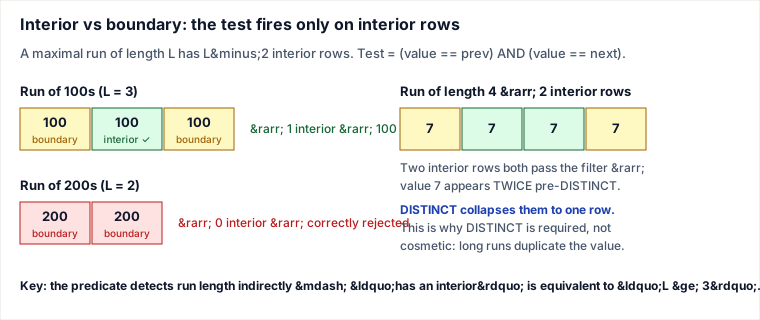
Invariant: a maximal run of length L (all the same value, contiguous by id) contains an interior element — one whose left neighbor and right neighbor are both inside the same run — exactly when L ≥ 3. The first and last members of a run are boundary elements; everything strictly between them is interior. A run of length 3 has exactly one interior element; a run of length 4 has two; length L has L−2.
So the per-row test value = prev_value AND value = next_value fires precisely on interior rows. Collapsing those with DISTINCT gives the set of values that have at least one run of length ≥ 3. That is the answer — no streak counting, no self-join, no recursion.
WITH Consecutive AS (
    SELECT value,
           LAG(value)  OVER (ORDER BY id) AS prev_value,
           LEAD(value) OVER (ORDER BY id) AS next_value
    FROM Sequence
)
SELECT DISTINCT value AS ConsecutiveNumbers
FROM Consecutive
WHERE value = prev_value
  AND value = next_value;
LAG(value) defaults to offset 1, so LAG(value) and LAG(value, 1) are identical; the explicit 1 is optional. The ORDER BY id inside the window is load-bearing — it defines what “previous” and “next” mean. Without it the neighbor relationship is undefined and results are nondeterministic.
Worked trace on the example
Input Sequence: ids 1–7 with values 100,100,100,200,100,200,200. The CTE computes prev_value and next_value per row by sliding the window in id order. Endpoints get NULL (no neighbor), which is the desired behavior — NULL never equals anything, so an endpoint can never be flagged as interior.
| id | value | prev_value | next_value | value = prev AND value = next? |
|---|---|---|---|---|
| 1 | 100 | NULL | 100 | no (NULL fails) |
| 2 | 100 | 100 | 100 | YES — interior of the 100-run |
| 3 | 100 | 100 | 200 | no (next differs) |
| 4 | 200 | 100 | 100 | no (it's a lone 200) |
| 5 | 100 | 200 | 200 | no (lone 100) |
| 6 | 200 | 100 | 200 | no |
| 7 | 200 | 200 | NULL | no (NULL fails) |
Exactly one row survives the filter: id 2, value 100 — the single interior element of the only run of length ≥ 3. DISTINCT is a no-op here (one row), but it is what keeps a longer run from emitting the value multiple times. Final output: a one-row table with 100.
Why this is the “gaps and islands” family
This problem is the simplest instance of a classic pattern called gaps and islands: a sequence partitions into islands (maximal runs of the same value) separated by gaps (value changes). Most questions in this family ask about island length — longest streak, runs of at least k, start/end of each run.
The general, reusable technique is the difference-of-row-numbers trick: number all rows, number rows within each value group, and subtract — the difference is constant within one island, so you can GROUP BY (value, diff) and use COUNT(*) to get exact run lengths.
-- General: exact run length, works for ANY threshold k
WITH islands AS (
    SELECT value,
           ROW_NUMBER() OVER (ORDER BY id)
         - ROW_NUMBER() OVER (PARTITION BY value ORDER BY id) AS grp
    FROM Sequence
)
SELECT DISTINCT value AS ConsecutiveNumbers
FROM islands
GROUP BY value, grp
HAVING COUNT(*) >= 3;
The LAG/LEAD solution is the special-case shortcut that works only because the threshold is exactly 3 and 3 = a window of width 3 you can peek at directly. For “at least 5 consecutive” the peek trick needs LAG(value,1),LAG(value,2),… or the general island grouping. Recognizing which one a question wants is the actual skill.
Pitfalls
- Omitting
ORDER BY idin the window. Without it, “previous” and “next” are undefined; the planner may use insertion or page order and silently give wrong, non-reproducible results. The ordering is the definition of consecutiveness, not decoration. - Assuming
idis gapless/contiguous. The neighbor byORDER BY idis the next row in sort order, notid+1. Rows 10,11,40 are still “consecutive” for this query. If the problem means “consecutive timestamps with no gap,” you must add a gap check —LAGalone won't catch it. - Dropping
DISTINCT. A run of length 4 has two interior rows, length 5 has three; each emits the value once. WithoutDISTINCTthe same value repeats in the output. It looks redundant on the 3-row example and bites on real data. - Forgetting
NULLsemantics at the edges. This one is a happy accident:100 = NULLisUNKNOWN, treated as false, so endpoints can't be interior. But the sameNULLlogic burns you ifvalueitself can beNULL— three consecutiveNULLs would not be flagged, becauseNULL = NULLisUNKNOWN. UseIS NOT DISTINCT FROM(Postgres) or null-safe equality if NULL values must count. - Naive self-join instead. A common first attempt joins the table to itself on
id = id+1andid = id+2. It breaks the moment ids have gaps (theid+1row may not exist) and is O(n) joins vs one O(n log n) window pass. The window approach is both correct under gaps and faster.
Takeaways
- Don't count run length when you only need a threshold — reframe “≥ 3 consecutive” as “has an interior element,” which a fixed
LAG+LEADwindow detects in one pass. - The invariant (run of length L has L−2 interiors) is why this is correct and why
DISTINCTis mandatory: long runs surface multiple interior rows for the same value. ORDER BYinside the window defines consecutiveness; neighbors are by sort position, not byidarithmetic — mind gaps andNULLs.- For any other threshold k, reach for the gaps-and-islands
ROW_NUMBER()difference trick; the peek-3 query is just its degenerate special case.
Re-authored and deepened for this guide. The interior-element invariant, the gaps-and-islands framing, and the difference-of-row-numbers generalization draw on Itzik Ben-Gan's treatment of gaps and islands in Microsoft SQL Server T-SQL Querying (Microsoft Press) and the SQL window-function chapter of Use The Index, Luke! (Markus Winand). Window-function NULL and ordering semantics per the PostgreSQL 16 documentation (§ 3.5, 4.2.8) and the SQL:2003 standard. Problem framing follows the LeetCode “consecutive numbers” family. Previous version was correct but omitted the invariant, the run-of-4 duplication note, and the gaps-and-islands generalization.
🤖 Don't fully get this? Learn it with Claude
Stuck on Repeated Values in Sequence? Open Claude, copy a block below, and it'll teach you this exact concept — visually and interactively.
Progressively stronger hints — you still solve it.
I'm working on the problem **Repeated Values in Sequence** (Databases). Give me a HINT LADDER: start with the tiniest nudge, then wait. Only reveal the next, stronger hint when I ask. Do NOT show the full solution unless I type 'show solution'. Keep me doing the thinking. If you're unsure or a claim isn't standard, say so and reason from first principles instead of guessing.
See the technique, not just code.
Explain the optimal approach to **Repeated Values in Sequence** with a VISUAL walkthrough: trace it on a small concrete example using ASCII art / a step-by-step diagram, narrate what changes each step, then give time & space complexity with a one-line derivation. If you're unsure or a claim isn't standard, say so and reason from first principles instead of guessing.
Catch bugs, edge cases, sub-optimality.
I'll paste my solution to **Repeated Values in Sequence**. Review it for correctness, missed edge cases, and time/space complexity, then coach me toward the optimal — don't just rewrite it. Ask me to paste my code now. If you're unsure or a claim isn't standard, say so and reason from first principles instead of guessing.
Lock in recognition with look-alikes.
Give me 2 problems that use the SAME underlying pattern as **Repeated Values in Sequence**. For each, let me attempt first, then review my answer and name the trigger signal that reveals the pattern. If you're unsure or a claim isn't standard, say so and reason from first principles instead of guessing.