Ad-Free Sessions
The mechanism
An ad belongs to a session when it shares the customer and its timestamp falls inside the session's inclusive [start_time, end_time] window; so you join Ads to Playback on customer_id with the timestamp between the bounds, collect every session_id that interval-overlap produces, and return the Playback rows whose id is not in that set. The whole query is an anti-join: keep the rows on the left that have no match on the right.
The problem
Table Playback — one row per viewing session (session_id is the primary key, NOT NULL); a session runs over the inclusive interval start_time .. end_time, and two sessions for the same customer never overlap. Table Ads records each ad shown to a customer at a single timestamp. Report every session that had no ad shown during it.
Worked example
Sample data:
| Playback | |||
|---|---|---|---|
| session_id | customer_id | start_time | end_time |
| 1 | 1 | 1 | 5 |
| 2 | 1 | 15 | 23 |
| 3 | 2 | 10 | 12 |
| 4 | 2 | 17 | 28 |
| 5 | 2 | 2 | 8 |
| Ads | ||
|---|---|---|
| ad_id | customer_id | timestamp |
| 1 | 1 | 5 |
| 2 | 2 | 17 |
| 3 | 2 | 20 |
Now test each ad against the sessions for its own customer:
| ad (cust @ ts) | candidate session | window | start ≤ ts ≤ end? | match |
|---|---|---|---|---|
| 1 @ 5 | 1 (cust 1) | [1, 5] | 1 ≤ 5 ≤ 5 | yes → session 1 |
| 1 @ 5 | 2 (cust 1) | [15, 23] | 15 ≤ 5 false | no |
| 2 @ 17 | 4 (cust 2) | [17, 28] | 17 ≤ 17 ≤ 28 | yes → session 4 |
| 2 @ 17 | 3 (cust 2) | [10, 12] | 17 ≤ 12 false | no |
| 2 @ 17 | 5 (cust 2) | [2, 8] | 17 ≤ 8 false | no |
| 3 @ 20 | 4 (cust 2) | [17, 28] | 17 ≤ 20 ≤ 28 | yes → session 4 (dup) |
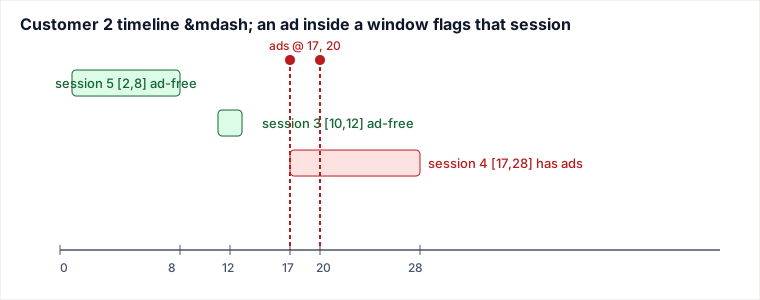
The subquery's distinct set of sessions-with-ads is {1, 4}. The outer query keeps every Playback.session_id not in that set: {2, 3, 5}. Note session 5's window [2, 8] contains no ad timestamp for customer 2 (their ads are at 17 and 20), so it survives.
The solution
Build the set of sessions that did get an ad, then subtract it:
SELECT session_id
FROM   Playback
WHERE  session_id NOT IN (
         SELECT DISTINCT P.session_id
         FROM   Playback P
         JOIN   Ads A ON A.customer_id = P.customer_id
         WHERE  A.timestamp BETWEEN P.start_time AND P.end_time
       );
BETWEEN is inclusive on both ends, which exactly matches "inclusive interval" in the spec — an ad fired at the same instant a session starts or ends still counts. The DISTINCT only tidies duplicates (session 4 matched two ads); it is not required for correctness because NOT IN tests membership, not multiplicity.
Pitfalls
The NOT IN + NULL footgun
This query is safe only because the subquery selects P.session_id, a primary key that is NOT NULL. The moment a subquery can emit a single NULL, NOT IN collapses to zero rows. The reason is three-valued logic: x NOT IN (a, b, NULL) expands to x <> a AND x <> b AND x <> NULL, and x <> NULL is UNKNOWN, never TRUE — so the whole AND can never be TRUE, only FALSE or UNKNOWN, and WHERE keeps neither. If someone later rewrites the subquery to select a nullable column (say A.customer_id after a LEFT JOIN), the page silently returns an empty result with no error.
Safer alternatives that ignore NULLs
NOT EXISTS is correlated and NULL-immune — it asks "does any matching ad row exist?" and a NULL row simply fails to match:
SELECT session_id
FROM   Playback P
WHERE  NOT EXISTS (
         SELECT 1 FROM Ads A
         WHERE  A.customer_id = P.customer_id
           AND  A.timestamp BETWEEN P.start_time AND P.end_time
       );
Or the anti-join via LEFT JOIN ... IS NULL, which keeps left rows whose join found nothing:
SELECT P.session_id
FROM   Playback P
LEFT JOIN Ads A
       ON A.customer_id = P.customer_id
      AND A.timestamp BETWEEN P.start_time AND P.end_time
WHERE  A.ad_id IS NULL;
Test the IS NULL on a column that is NOT NULL in matched rows (the right table's PK, A.ad_id) — otherwise a genuinely-null matched column would be mistaken for "no match."
Inclusive vs half-open intervals
The spec says inclusive, so BETWEEN is right. If you reflexively write A.timestamp > P.start_time AND A.timestamp < P.end_time (strict), you would wrongly call session 1 ad-free — its ad fired at timestamp = 5 = end_time, exactly the boundary. Always confirm whether the interval is inclusive [a,b] or half-open [a,b) before choosing your operators.
Why the naive version goes wrong
A tempting first cut joins on customer only and forgets the timestamp window:
-- WRONG: flags every session of any customer who ever saw an ad
SELECT session_id FROM Playback
WHERE customer_id NOT IN (SELECT customer_id FROM Ads);
Customer 2 saw ads at 17 and 20, so this excludes all of customer 2's sessions — including sessions 3 and 5, which contain no ad. "Ad-free" is a property of the session interval, not the customer; the predicate must pin each ad to a specific window with BETWEEN start_time AND end_time.
Takeaways
- This is an interval-overlap anti-join: a point (the ad timestamp) falls inside a session's inclusive window, and you return the sessions with no such point.
NOT IN (subquery)is correct here purely by accident of the schema — the projected column is aNOT NULLprimary key. Reach forNOT EXISTSorLEFT JOIN ... IS NULLas the default; they are immune to the NULL collapse and usually plan as efficiently.- Match your range operators to the interval semantics: inclusive bounds →
BETWEEN/≤; boundary timestamps are real edge cases that strict<silently drops. - Anchor an exclusion to the right grain — the session window, not the customer — or you over-exclude.
Based on LeetCode 1731 “Ad-Free Sessions” (problem statement and sample data). Three-valued-logic and NOT IN/NOT EXISTS behavior per the SQL standard and the PostgreSQL documentation on subquery expressions and NULL comparison. Re-authored and deepened for this guide: added the interval-overlap mechanism, a step-by-step ad-vs-window trace, a timeline diagram, the NOT IN + NULL footgun with NOT EXISTS / LEFT JOIN IS NULL alternatives, and the inclusive-interval edge case.
🤖 Don't fully get this? Learn it with Claude
Stuck on Ad-Free Sessions? Open Claude, copy a block below, and it'll teach you this exact concept — visually and interactively.
Build the mental picture, not memorization.
I just read a lesson on **Ad-Free Sessions** (Databases) and want to truly understand it. Explain Ad-Free Sessions from first principles using ONE vivid real-world analogy and a visual mental model — draw it as ASCII art or a clear step-by-step diagram — with a concrete example using real numbers. Then ask me one question to check I got the mental picture, and wait for my reply. If you're unsure or a claim isn't standard, say so and reason from first principles instead of guessing.
Socratic — adapts to where you're stuck.
Teach me **Ad-Free Sessions** interactively. Ask me ONE guiding question at a time, wait for my answer, and adapt to my confusion — build the idea with me step by step instead of explaining it all at once. If you're unsure or a claim isn't standard, say so and reason from first principles instead of guessing.
Active recall exposes what you missed.
Quiz me on **Ad-Free Sessions** with 5 questions, easy to tricky, ONE at a time. Tell me if each answer is right; at the end, explain clearly what I got wrong and why. If you're unsure or a claim isn't standard, say so and reason from first principles instead of guessing.
Intuition + hook + flashcards for long-term memory.
Help me remember **Ad-Free Sessions** for the long term: give the one-sentence intuition, a memorable hook/mnemonic, a tiny worked example, and 3 active-recall flashcards (Q -> A). If you're unsure or a claim isn't standard, say so and reason from first principles instead of guessing.