easy Main Office Assignment for Each Employee
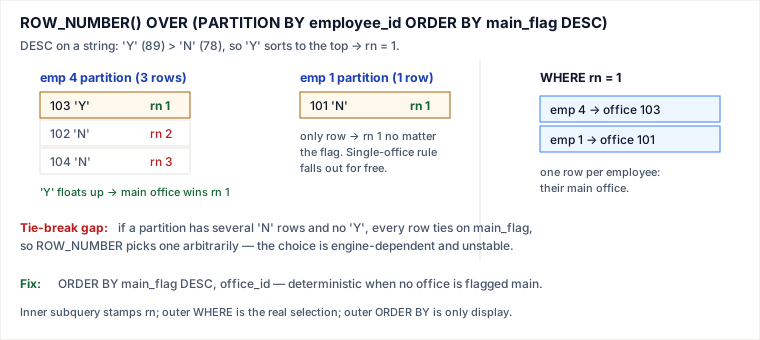
Number every office a person holds within their own partition, sorting main_flag descending so the lexical fact that 'Y' > 'N' floats the flagged main office to rank 1 — then keep only rank 1; a one-office person trivially has rank 1 because the partition has a single row, so the "single office is automatically main" rule needs no special case.
Problem
Table OfficeAssignment(employee_id, office_id, main_flag), where main_flag is an ENUM of 'Y' / 'N' and (employee_id, office_id) is the primary key. A person can be assigned to several offices but designates at most one as main ('Y'). If a person has exactly one office, that office is their main office no matter what its flag says. Report each employee with their one main office, ordered by employee_id.
The two insights the problem hinges on
This looks like it needs branching logic — "if multiple offices pick the 'Y'; else pick the only one" — but both branches collapse into a single ranking. Two facts make that work:
'Y' > 'N'lexically.main_flagis a string, soORDER BY main_flag DESCis a string comparison, not a flag comparison. In ASCII/Unicode and every common collation,'Y'(code 89) sorts after'N'(code 78), so descending puts'Y'first. The row that getsrn = 1in a multi-office partition is exactly the one flagged main. We are not telling the database what "main" means — we are exploiting that the sort order of the two literal strings already encodes it.- A one-office partition has nothing to break ties on.
ROW_NUMBER()hands out 1, 2, 3, … per partition. If the partition holds a single row, that row gets1regardless of whether its flag is'Y'or'N'. So employee 1 (office 101, flag'N') survives thern = 1filter without anyOR has-only-one-officeclause. The special case is not handled — it is absent, because the window function's per-partition counting already covers it.
The query
SELECT employee_id, office_id
FROM (
    SELECT employee_id, office_id,
           ROW_NUMBER() OVER (
               PARTITION BY employee_id
               ORDER BY main_flag DESC
           ) AS rn
    FROM OfficeAssignment
) AS ranked
WHERE rn = 1
ORDER BY employee_id;
It is one logical step, not two: the inner query stamps a rank; the outer WHERE rn = 1 is the actual selection of the main office; ORDER BY employee_id is only presentation. (You cannot filter on rn in the same SELECT that defines it — window functions are evaluated after WHERE — which is why the rank lives in a subquery / CTE and the filter wraps it.)
Traced on the sample data
The window function evaluates partition by partition. Inside each partition the rows are sorted by main_flag DESC, then numbered top-down.
| employee_id (partition) | rows after ORDER BY main_flag DESC | rn assigned | kept by rn = 1 |
|---|---|---|---|
| 1 | (101, 'N') | 101→1 | 101 — lone row, auto-main |
| 2 | (101, 'Y'), (102, 'N') | 101→1, 102→2 | 101 — the 'Y' row |
| 3 | (103, 'N') | 103→1 | 103 — lone row, auto-main |
| 4 | (103, 'Y'), (102, 'N'), (104, 'N') | 103→1, 102→2, 104→3 | 103 — the 'Y' row |
After the filter and ORDER BY employee_id:
employee_id | office_id
-----------+----------
    1      |   101
    2      |   101
    3      |   103
    4      |   103
Note employees 2 and 4 both resolve to office 103 vs 101 by flag, not by office number; employees 1 and 3 keep their only office despite it being flagged 'N'. The branch you would have hand-written never appears.
Why the naive approaches go wrong
Filtering on the flag directly
-- WRONG: drops every single-office employee whose flag is 'N'
SELECT employee_id, office_id
FROM OfficeAssignment
WHERE main_flag = 'Y';
This returns only employees 2 and 4. Employees 1 and 3 vanish because their lone office is flagged 'N' — yet the spec says a single office is the main one. The flag alone does not encode the rule; the rule is "the flagged office if one exists, otherwise the only office." Ranking captures both; a flat WHERE captures only the first half.
The non-deterministic tie-break in the ranking solution itself
If an employee has multiple offices and none is flagged 'Y' (e.g. two rows both 'N'), all rows in that partition tie on main_flag. ROW_NUMBER() still must assign distinct ranks, so it picks one row arbitrarily — the winner depends on the engine's physical row order and can change between runs, after a re-index, or across PostgreSQL / MySQL / SQL Server. The sample data never triggers this, so the bug hides. Add a deterministic secondary key:
ROW_NUMBER() OVER (
    PARTITION BY employee_id
    ORDER BY main_flag DESC, office_id
)
Now ties resolve to the lowest office_id — reproducible everywhere. (The original problem leaves this case undefined; in production you would clarify the rule rather than let the optimizer choose.)
Pitfalls
- Assuming
'Y' > 'N'is a logical fact. It is a collation fact about two strings. Under almost any collation it holds, but if someone changes the flag vocabulary (say'Main'/'Branch', where'B' < 'M'soDESCwould now float'Main'correctly, but'Primary'/'Secondary'would break it), the silent dependence on alphabetical order becomes a bug. Prefer an explicit key likeORDER BY (main_flag = 'Y') DESC(MySQL) orORDER BY CASE WHEN main_flag = 'Y' THEN 0 ELSE 1 ENDwhen the intent must be unmistakable. - Putting
WHERE rn = 1in the same query that computesrn. Window functions run afterWHERE, sornis not yet visible there — you get a "column rn does not exist" error. The rank must be materialized in a subquery or CTE first. - Reaching for
GROUP BY+MAX(main_flag).MAXpicks the largest flag string but cannot bring along the matchingoffice_idin standard SQL — you would need a correlated join back, which is more code and the same tie ambiguity. Window ranking carries the whole row along for free. - Forgetting the tie-break. As above: a partition of all-
'N'rows yields a non-deterministic pick. Always add a unique secondary sort key when the primary key can tie.
Takeaways
- Ranking turns "prefer X, else fall back" into one filter.
ROW_NUMBER() … WHERE rn = 1is the canonical "pick one row per group" idiom — and the fallback case (one-element group) is handled by counting, not by a special branch. - Know what your
ORDER BYis actually comparing. Here it is two literal strings, and the answer rides on'Y' > 'N'lexically. Make load-bearing comparisons explicit when the data's encoding could drift. - A tie in the
ORDER BYof a window function is a silent non-determinism bug. If the sort key is not unique within the partition, add a tiebreaker (here, office_id) so the result is reproducible across engines and runs. - The window function is evaluated after
WHERE/GROUP BYbut before the outerSELECT's filter — which forces the subquery/CTE wrapping pattern. The outerORDER BYis cosmetic, not part of the selection logic.
Based on the LeetCode-style "Main Office Assignment for Each Employee" practice problem. Ranking-then-filter idiom per the SQL standard (ISO/IEC 9075) window-function semantics; collation behavior of string comparison per PostgreSQL and MySQL documentation. Re-authored and deepened for this guide: the original asserted that DESC floats the main office but never explained the 'Y' > 'N' lexical mechanism or why the single-office case needs no branch, mislabeled the rank step's output as "Step 2," and left the non-deterministic all-'N' tie-break unflagged — all corrected here, with the deterministic ORDER BY main_flag DESC, office_id fix and a "why the naive flag filter is wrong" note added.
🤖 Don't fully get this? Learn it with Claude
Stuck on Main Office Assignment for Each Employee? Open Claude, copy a block below, and it'll teach you this exact concept — visually and interactively.
Progressively stronger hints — you still solve it.
I'm working on the problem **Main Office Assignment for Each Employee** (Databases). Give me a HINT LADDER: start with the tiniest nudge, then wait. Only reveal the next, stronger hint when I ask. Do NOT show the full solution unless I type 'show solution'. Keep me doing the thinking. If you're unsure or a claim isn't standard, say so and reason from first principles instead of guessing.
See the technique, not just code.
Explain the optimal approach to **Main Office Assignment for Each Employee** with a VISUAL walkthrough: trace it on a small concrete example using ASCII art / a step-by-step diagram, narrate what changes each step, then give time & space complexity with a one-line derivation. If you're unsure or a claim isn't standard, say so and reason from first principles instead of guessing.
Catch bugs, edge cases, sub-optimality.
I'll paste my solution to **Main Office Assignment for Each Employee**. Review it for correctness, missed edge cases, and time/space complexity, then coach me toward the optimal — don't just rewrite it. Ask me to paste my code now. If you're unsure or a claim isn't standard, say so and reason from first principles instead of guessing.
Lock in recognition with look-alikes.
Give me 2 problems that use the SAME underlying pattern as **Main Office Assignment for Each Employee**. For each, let me attempt first, then review my answer and name the trigger signal that reveals the pattern. If you're unsure or a claim isn't standard, say so and reason from first principles instead of guessing.