Find Interview Candidates
Two unrelated qualifications get computed in one pass and then OR'd together: a gaps-and-islands trick collapses each user's contest IDs into consecutive runs (subtracting a per-user row number from contest_id yields a constant only while IDs are contiguous), while a plain COUNT over the gold_medal column counts gold wins; a row surviving either branch is a candidate.
The problem (LeetCode 1378): a user is an interview candidate if they won any medal in 3+ consecutive contests, or won the gold medal in 3+ contests (consecutive or not). Contests have gap-free, consecutive IDs.
The two conditions are genuinely different
The single most common mistake here is treating these as one rule. They aren't. Condition 1 cares about position (a streak) and accepts any medal color. Condition 2 cares about count (total golds) and ignores position entirely. A user can satisfy one and fail the other — and in this dataset, the most interesting candidate qualifies only via the gold branch.
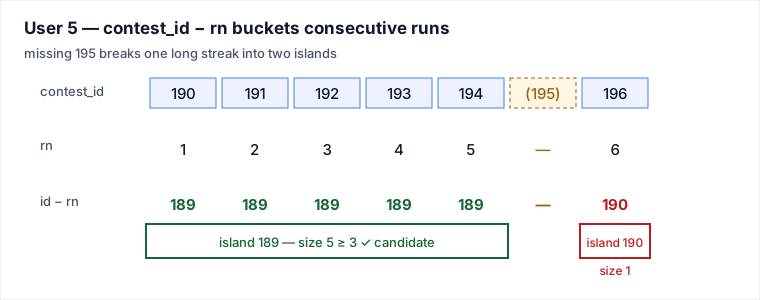
The mechanism: why contest_id − rn buckets a streak
Number a user's contests 1,2,3,… in ascending contest_id order with ROW_NUMBER(). Whenever the contests are consecutive, both the ID and the row number increase by exactly 1 per step, so their difference stays constant. The instant a gap appears, contest_id jumps but rn still only ticks by 1, so the difference jumps too — starting a new bucket. Grouping by that difference and keeping groups of size ≥ 3 finds every run of three or more consecutive contests.
The query
The one correctness fix versus the naive version: the medalist union must keep the medal color (or at least keep gold separable) — otherwise the gold-count branch can't be evaluated. Here the gold branch reads the Contests table directly, so the union only needs (user, contest_id) for the streak branch. Both branches are UNION'd (set union dedupes user IDs) and joined to Users.
WITH medalists AS (          -- one row per (user, contest), any medal
    SELECT gold_medal   AS user_id, contest_id FROM Contests
    UNION ALL
    SELECT silver_medal AS user_id, contest_id FROM Contests
    UNION ALL
    SELECT bronze_medal AS user_id, contest_id FROM Contests
),
numbered AS (
    SELECT user_id, contest_id,
           ROW_NUMBER() OVER (PARTITION BY user_id ORDER BY contest_id) AS rn
    FROM medalists
),
candidates AS (
    -- Condition 1: any medal in 3+ consecutive contests
    SELECT user_id
    FROM numbered
    GROUP BY user_id, contest_id - rn
    HAVING COUNT(*) >= 3

    UNION                    -- set union: dedupes user_ids across both rules

    -- Condition 2: gold medal in 3+ contests
    SELECT gold_medal AS user_id
    FROM Contests
    GROUP BY gold_medal
    HAVING COUNT(*) >= 3
)
SELECT u.name, u.mail
FROM candidates c
JOIN Users u ON u.user_id = c.user_id;
Why the naive version is wrong: if medalists aliases all three medal columns to a generic user and you then try to count golds from that union, you cannot — a row in the union no longer remembers whether it came from gold, silver, or bronze. The gold rule must read Contests.gold_medal directly. (Using UNION ALL for the final candidate combine instead of UNION is harmless here only because the outer query is JOIN + an implicit dedupe is not applied — to be safe, use UNION, or SELECT DISTINCT in the final projection.)
Worked example (the exact LeetCode 1378 data)
Contests (contest_id, gold, silver, bronze):
| contest_id | gold | silver | bronze |
|---|---|---|---|
| 190 | 1 | 5 | 2 |
| 191 | 2 | 3 | 5 |
| 192 | 5 | 2 | 3 |
| 193 | 1 | 3 | 5 |
| 194 | 4 | 5 | 2 |
| 195 | 4 | 2 | 1 |
| 196 | 1 | 5 | 2 |
After the union + ROW_NUMBER, each user's medal contests (sorted) and the resulting id − rn buckets:
| user | contests won (any medal) | id − rn buckets | streak ≥ 3? |
|---|---|---|---|
| 1 | 190, 193, 195, 196 | {189:[190]}, {191:[193]}, {192:[195,196]} | no (max run 2) |
| 2 | 190, 191, 192, 194, 195, 196 | {189:[190,191,192]}, {190:[194,195,196]} | yes (two runs of 3) |
| 3 | 191, 192, 193 | {190:[191,192,193]} | yes (run of 3) |
| 4 | 194, 195 | {193:[194,195]} | no |
| 5 | 190, 191, 192, 193, 194, 196 | {189:[190,191,192,193,194]}, {190:[196]} | yes (run of 5) |
Condition 1 (streak) candidates: {2, 3, 5}.
Now the gold branch — count of golds per user from the gold_medal column: contests 190,193,196 → user 1 (×3); 191 → user 2; 192 → user 5; 194,195 → user 4 (×2). So gold counts are {1:3, 2:1, 4:2, 5:1}.
Condition 2 (gold ≥ 3) candidates: {1}. User 1 is the payoff case: contests 190,193,195,196 contain no 3-in-a-row, so condition 1 rejects them — but they took gold three separate times (190, 193, 196), so condition 2 admits them. This is exactly why the two branches cannot be collapsed.
Union {2,3,5} ∪ {1} = {1, 2, 3, 5}. Joining to Users (1=Alice, 2=Bob, 3=Alex, 4=Donald, 5=Rocky) drops user 4 and yields:
| name | |
|---|---|
| Alice | alice@leetcode.com |
| Bob | bob@leetcode.com |
| Alex | alex@leetcode.com |
| Rocky | rocky@leetcode.com |
(Order is unspecified.)
Pitfalls
- Collapsing the two conditions. User 1 proves they're independent: no streak, but qualifies on gold count. A query that only does gaps-and-islands silently drops Alice and still returns a plausible-looking 3 rows — a bug that passes a careless eyeball check.
- Losing the medal color in the union. If you alias gold/silver/bronze into one anonymous
usercolumn and then try to count golds from that, you've thrown away the information you need. Count golds fromContests.gold_medaldirectly. - The gaps-and-islands trick assumes gap-free contest IDs. It works because the contest schedule has consecutive IDs, so a user's own gap (a contest they didn't medal in) is what breaks the run. If contest IDs themselves had holes,
id − rnwould mis-bucket. With non-contiguous keys you'd instead useLAG()+ a running sum of "is this a new run" flags, orROW_NUMBER()over a densely-ranked key. - Forgetting to dedupe the final candidate set. A user can hit both conditions;
UNION ALLwould then emit them twice and (without aDISTINCTon the projection) duplicate their name/mail. UseUNION, orSELECT DISTINCTat the end. - NULL medalists. If any medal slot can be NULL (no entrant), those rows enter the union as a NULL user and quietly drop on the join — usually fine, but be deliberate about it rather than surprised.
Takeaways
key − ROW_NUMBER()is the canonical gaps-and-islands tool: the difference is constant within a consecutive run and changes at every gap, soGROUP BYon it isolates runs.- When a problem says "OR", compute each branch independently and combine with
UNION; don't try to express two different shapes of condition in one aggregation. - Decide what each branch needs before you build the shared CTE — the gold branch needs medal color, so the streak union can't be the only source of truth.
- Verify by tracing the adversarial row (here, user 1) that satisfies the less-obvious branch, not the easy one.
Based on LeetCode 1378 "Find Interview Candidates" (Database, premium), using its canonical sample Contests and Users data. Gaps-and-islands technique as described in Itzik Ben-Gan, T-SQL Querying / Microsoft SQL Server High-Performance T-SQL Using Window Functions, and the long-standing SQL community treatment of islands via row-number differencing. Re-authored and deepened for this guide: the medal-color loss in the union was fixed so the gold branch is computable, every user's buckets were derived rather than asserted, and user 1's gold-only qualification (the case the original example silently mis-traced) is now the worked centerpiece.
🤖 Don't fully get this? Learn it with Claude
Stuck on Find Interview Candidates? Open Claude, copy a block below, and it'll teach you this exact concept — visually and interactively.
Build the mental picture, not memorization.
I just read a lesson on **Find Interview Candidates** (Databases) and want to truly understand it. Explain Find Interview Candidates from first principles using ONE vivid real-world analogy and a visual mental model — draw it as ASCII art or a clear step-by-step diagram — with a concrete example using real numbers. Then ask me one question to check I got the mental picture, and wait for my reply. If you're unsure or a claim isn't standard, say so and reason from first principles instead of guessing.
Socratic — adapts to where you're stuck.
Teach me **Find Interview Candidates** interactively. Ask me ONE guiding question at a time, wait for my answer, and adapt to my confusion — build the idea with me step by step instead of explaining it all at once. If you're unsure or a claim isn't standard, say so and reason from first principles instead of guessing.
Active recall exposes what you missed.
Quiz me on **Find Interview Candidates** with 5 questions, easy to tricky, ONE at a time. Tell me if each answer is right; at the end, explain clearly what I got wrong and why. If you're unsure or a claim isn't standard, say so and reason from first principles instead of guessing.
Intuition + hook + flashcards for long-term memory.
Help me remember **Find Interview Candidates** for the long term: give the one-sentence intuition, a memorable hook/mnemonic, a tiny worked example, and 3 active-recall flashcards (Q -> A). If you're unsure or a claim isn't standard, say so and reason from first principles instead of guessing.