Sellers With No Sales
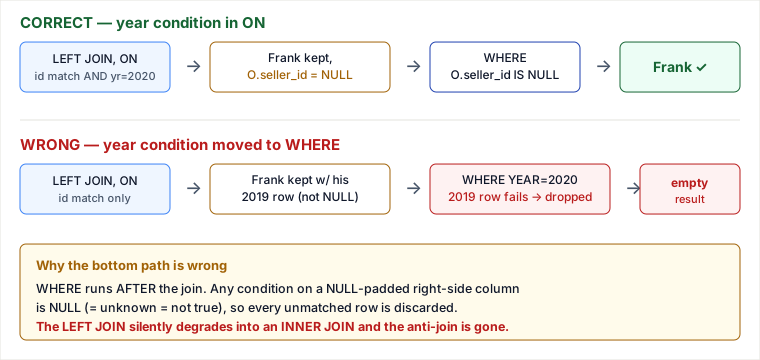
A LEFT JOIN keeps every seller and attaches their 2020 orders; the rows that come back with O.seller_id IS NULL are exactly the sellers for whom no matching 2020 order existed — that is the anti-join, and it only works because the year condition lives in the ON clause where it filters what counts as a match, not in WHERE where it would filter rows after the join has already happened.
The problem
Given Seller(seller_id, seller_name) and Orders(order_id, sale_date, order_cost, customer_id, seller_id), report the names of every seller who made no sale in 2020, ordered by seller_name ascending.
The phrase "made no sale" is the tell: you are looking for absence of a row. There is no column that says "this seller had no orders" — that fact only exists as a gap, and the canonical way to surface a gap in SQL is the LEFT-JOIN / IS NULL anti-join.
The data we will trace
Four sellers; the Orders table has 2019 and 2020 rows. Watch Frank: he sold in 2019 but not 2020.
| Seller | |
|---|---|
| seller_id | seller_name |
| 1 | Daniel |
| 2 | Elizabeth |
| 3 | Frank |
| 4 | William |
| order_id | seller_id | sale_date |
|---|---|---|
| 1 | 1 | 2020-03-01 |
| 2 | 2 | 2020-05-02 |
| 3 | 2 | 2020-06-03 |
| 4 | 3 | 2019-09-04 |
| 5 | 4 | 2020-01-25 |
Daniel, Elizabeth, William all have a 2020 order. Frank's only order is 2019-09-04. Expected answer: Frank.
The query
SELECT S.seller_name
FROM   Seller AS S
       LEFT JOIN Orders AS O
              ON  S.seller_id = O.seller_id
              AND YEAR(O.sale_date) = '2020'
WHERE  O.seller_id IS NULL
ORDER  BY S.seller_name;
Two conditions sit in ON: the join key and the year. WHERE does one thing only — keep the rows that failed to match.
Step-by-step trace
Step 1 — LEFT JOIN with both conditions in ON
For each seller, SQL looks for an Orders row where seller_id matches and the year is 2020. A seller with no such row still survives, padded with NULLs (that is what LEFT JOIN guarantees).
| S.seller_id | S.seller_name | O.seller_id | O.sale_date |
|---|---|---|---|
| 1 | Daniel | 1 | 2020-03-01 |
| 2 | Elizabeth | 2 | 2020-05-02 |
| 2 | Elizabeth | 2 | 2020-06-03 |
| 3 | Frank | NULL | NULL |
| 4 | William | 4 | 2020-01-25 |
Frank's 2019 order did not satisfy YEAR(O.sale_date)='2020', so it was never a match — Frank is kept as a NULL-padded row. That NULL is the signal we are about to read.
Step 2 — WHERE O.seller_id IS NULL
Keep only rows where the right side came back empty:
| S.seller_name | O.seller_id |
|---|---|
| Frank | NULL |
Step 3 — SELECT + ORDER BY
Project seller_name, sort ascending. One row remains:
| seller_name |
|---|
| Frank |
Why the naive version is wrong
The tempting "clean up" is to move the year into WHERE:
-- BROKEN: silently behaves like an INNER JOIN
SELECT S.seller_name
FROM   Seller AS S
       LEFT JOIN Orders AS O ON S.seller_id = O.seller_id
WHERE  YEAR(O.sale_date) = '2020'   -- ✖ wrong place
   AND O.seller_id IS NULL;          -- ✖ can never be satisfied
Trace it against Frank. The ON now matches only on id, so Frank joins to his real 2019 row — O.sale_date = 2019-09-04, not NULL. Then WHERE runs:
YEAR(O.sale_date)='2020'isYEAR('2019-09-04')='2020'→ false, so Frank's row is dropped — he never reaches the answer.- For any seller who genuinely had no orders at all, the LEFT JOIN pads with NULL, and
YEAR(NULL)='2020'evaluates to NULL (unknown), which is also not true → dropped.
So the two WHERE conditions are mutually exclusive: a row can't simultaneously have YEAR(sale_date)='2020' (needs a non-NULL date) and O.seller_id IS NULL. The query returns empty. The fix is mechanical: filters on the outer (right) table of a LEFT JOIN belong in ON, because ON decides what counts as a match before padding happens; only the IS NULL probe belongs in WHERE.
Pitfalls
- Year filter in WHERE. The headline bug above: moving any predicate on the right table to WHERE collapses the LEFT JOIN into an INNER JOIN and returns nothing (or wrong rows). Rule of thumb: right-table filters → ON; left-table filters → WHERE; the NULL probe → WHERE.
- Probing a NULLable join key.
WHERE O.seller_id IS NULLworks becauseseller_idis the join column and is non-null in real Orders rows, so NULL there can only mean "no match." If you instead testO.order_cost IS NULLand a real order legitimately had a NULL cost, you'd misclassify a matched seller as unmatched. Always probe the join key (or a NOT-NULL column). YEAR(sale_date)kills index usage. Wrapping the column in a function makes the predicate non-sargable — the planner can't use an index onsale_date. On large tables prefer a half-open range:O.sale_date >= '2020-01-01' AND O.sale_date < '2021-01-01', still inside theONclause.- NOT IN with NULLs. A common alternative —
WHERE seller_id NOT IN (SELECT seller_id FROM Orders WHERE YEAR(sale_date)='2020')— returns zero rows the moment the subquery yields a single NULL, becausex NOT IN (..., NULL)is never true.NOT EXISTSor this anti-join are NULL-safe;NOT INis a trap.
Takeaways
- "Find rows that have no match" = LEFT JOIN +
IS NULLon the join key. The NULL is the absence, made visible. - The placement rule is the whole lesson: filters on the LEFT-JOINed (right) table go in
ONso they shape what matches;WHEREruns after padding and treats every NULL as not-true, which would erase the unmatched rows you came for. - Always probe a non-nullable column (the join key) for
IS NULL, or you'll misclassify matched rows. - Prefer a date range over
YEAR(col)so the predicate stays sargable; preferNOT EXISTS/anti-join overNOT INto stay NULL-safe.
Based on LeetCode 1607 "Sellers With No Sales." Join semantics (ON vs WHERE for outer joins, NULL-padding) follow the SQL standard as documented in the PostgreSQL manual ("Joined Tables") and Markus Winand's SQL Performance Explained / use-the-index-luke.com on sargability. NULL-comparison and three-valued-logic behavior per the SQL:2016 standard. Re-authored and deepened for this guide to make the ON-vs-WHERE anti-join mechanism explicit, with a corrected broken-variant walkthrough and a side-by-side query-plan diagram.
🤖 Don't fully get this? Learn it with Claude
Stuck on Sellers With No Sales? Open Claude, copy a block below, and it'll teach you this exact concept — visually and interactively.
Build the mental picture, not memorization.
I just read a lesson on **Sellers With No Sales** (Databases) and want to truly understand it. Explain Sellers With No Sales from first principles using ONE vivid real-world analogy and a visual mental model — draw it as ASCII art or a clear step-by-step diagram — with a concrete example using real numbers. Then ask me one question to check I got the mental picture, and wait for my reply. If you're unsure or a claim isn't standard, say so and reason from first principles instead of guessing.
Socratic — adapts to where you're stuck.
Teach me **Sellers With No Sales** interactively. Ask me ONE guiding question at a time, wait for my answer, and adapt to my confusion — build the idea with me step by step instead of explaining it all at once. If you're unsure or a claim isn't standard, say so and reason from first principles instead of guessing.
Active recall exposes what you missed.
Quiz me on **Sellers With No Sales** with 5 questions, easy to tricky, ONE at a time. Tell me if each answer is right; at the end, explain clearly what I got wrong and why. If you're unsure or a claim isn't standard, say so and reason from first principles instead of guessing.
Intuition + hook + flashcards for long-term memory.
Help me remember **Sellers With No Sales** for the long term: give the one-sentence intuition, a memorable hook/mnemonic, a tiny worked example, and 3 active-recall flashcards (Q -> A). If you're unsure or a claim isn't standard, say so and reason from first principles instead of guessing.