medium Last Person to Fit in the Elevator
Because every weight is positive, the prefix sums taken in boarding order can only climb, never dip — so the running total is a monotonically non-decreasing sequence, and the single largest value that is still <= 800 belongs to exactly the last person the elevator can hold before it tips over capacity. That one fact is the whole problem: order by position, accumulate, then pick the biggest cumulative weight under the cap.
Problem in one breath
Table ElevatorQueue(person_id, name, weight, position). People board in position order (1 first). The car holds 800 kg. Return the name of the last person who fits before the cumulative weight would exceed 800. The first person always fits.
The query
WITH cumulative AS (
    SELECT name,
           weight,
           SUM(weight) OVER (ORDER BY position) AS total_weight
    FROM ElevatorQueue
)
SELECT name
FROM cumulative
WHERE total_weight <= 800
ORDER BY total_weight DESC
LIMIT 1;
Three moving parts, and each one earns its place:
SUM(weight) OVER (ORDER BY position)turns each row into a prefix sum — the total weight of everyone from position 1 up to and including this person.WHERE total_weight <= 800keeps only the prefixes that still fit.ORDER BY total_weight DESC LIMIT 1grabs the deepest surviving prefix — equivalently, the last person who fit.
Why "largest qualifying total" = "last person who fit"
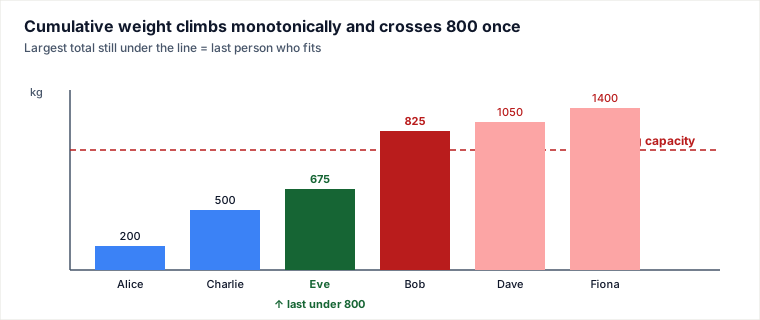
This is the step the naive write-up skips, and it is the actual idea. Sort the rows by position. The prefix sum at position k is w1 + w2 + ... + wk. Adding position k+1 adds w(k+1), which is > 0, so the sequence of totals is strictly increasing:
total(1) < total(2) < total(3) < ... < total(n)A strictly increasing sequence crosses the 800 line exactly once and never comes back. Everyone before the crossing has a total <= 800; everyone at or after it has a total > 800. So among the qualifying rows, the one with the maximum total is the row sitting immediately to the left of that crossing — and because the sequence is ordered by position, that row's position is the deepest into the queue. "Biggest total under the cap" and "furthest along the queue" are the same row. That is why ORDER BY total_weight DESC LIMIT 1 is allowed to forget about position entirely once the prefix sums exist.
If two weights could be zero or negative the monotonicity breaks and this trick is unsafe — see Pitfalls.
Worked trace
Input (shown in queue / position order, not person_id order):
| position | name | weight | total_weight (running) | <= 800? |
|---|---|---|---|---|
| 1 | Alice | 200 | 200 | yes |
| 2 | Charlie | 300 | 500 | yes |
| 3 | Eve | 175 | 675 | yes — last to fit |
| 4 | Bob | 150 | 825 | no (over 800) |
| 5 | Dave | 225 | 1050 | no |
| 6 | Fiona | 350 | 1400 | no |
The WHERE total_weight <= 800 survivors are Alice (200), Charlie (500), Eve (675). ORDER BY total_weight DESC LIMIT 1 picks the max of those, 675 → Eve. Bob is the person who breaks the cap (675 + 150 = 825), so Eve is the last one in.
The default window frame — the real conceptual content
SUM(weight) OVER (ORDER BY position) looks like it just "sums in order," but a window function always computes over a frame: a sliding subset of rows relative to the current row. When you write ORDER BY but omit an explicit frame, SQL substitutes a default, and the default is not "all preceding rows by row count." It is:
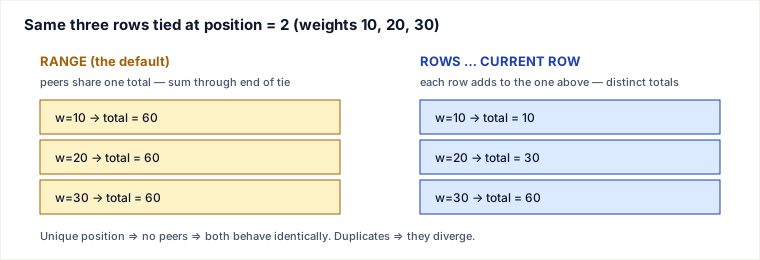
RANGE BETWEEN UNBOUNDED PRECEDING AND CURRENT ROWRead literally: sum every row from the start of the partition up to and including every row that is a peer of the current row in the ORDER BY. A peer is a row with the same position value. Here position is unique (the prompt guarantees 1..n), so each row is its own only peer and RANGE behaves identically to a row-by-row prefix sum. That is the only reason the query is correct as written.
The instant the ORDER BY column has duplicates, RANGE bites: all tied rows receive the same cumulative total — the sum through the end of the tie group — not a distinct partial sum each. If you actually wanted each row to add to its predecessor regardless of ties, you must say so explicitly:
SUM(weight) OVER (ORDER BY position
                  ROWS BETWEEN UNBOUNDED PRECEDING AND CURRENT ROW)
ROWS counts physical rows; RANGE counts value ranges and collapses peers. For monotonic-prefix problems like this elevator, reach for ROWS by habit so a future non-unique sort key cannot silently change your totals.
Pitfalls
- Forgetting the default frame is RANGE, not ROWS. Correct here only because
positionis unique. Copy this pattern onto a sort key with ties (e.g.ORDER BY order_datewith many rows per day) and every tied row gets the tie-group's grand total, silently corrupting your running balance. Default toROWS BETWEEN UNBOUNDED PRECEDING AND CURRENT ROW. - Ordering the outer query by the wrong column.
ORDER BY position DESC LIMIT 1after the filter does not work in general — it returns whoever happens to sit at the highest qualifying position, but with monotonic prefix sums the highest qualifying total and the highest qualifying position coincide, so it happens to match. Order bytotal_weight DESCto express the actual intent ("fullest elevator under the cap"). - Negative or zero weights. The whole "max qualifying total = last to fit" argument relies on strictly increasing prefixes. If weights can be ≤ 0 the prefix sum can dip back under 800 after crossing it, and
ORDER BY total_weight DESC LIMIT 1may return someone earlier than a later qualifying person. For physical weights this is fine; know the assumption. - No window functions available (old MySQL < 8.0). You'd fall back to a correlated subquery:
SUM(weight) over peers with position <= e.position. It is O(n²) and far slower; prefer the window function on any modern engine. - Empty result instead of a row. Not a risk here (the prompt guarantees person 1 fits), but if nobody fit,
LIMIT 1returns zero rows — fine for this grader, but wrap inCOALESCE/a sentinel if a caller expects exactly one row.
Takeaways
- Positive increments make prefix sums monotonic; that single property collapses "last to fit" into "max cumulative total ≤ cap," letting you drop the ordering column in the outer query.
SUM(...) OVER (ORDER BY x)with no frame clause meansRANGE UNBOUNDED PRECEDING AND CURRENT ROW— it merges peers. WriteROWSexplicitly unless your sort key is provably unique.- The window function builds the running total in one pass (O(n log n) for the sort); the filter +
ORDER BY total DESC LIMIT 1is just argmax over the survivors.
Re-authored and deepened for this guide. Window-frame semantics (default RANGE BETWEEN UNBOUNDED PRECEDING AND CURRENT ROW vs. explicit ROWS, and peer collapsing) follow the SQL:2003/2011 standard as implemented in PostgreSQL ("Window Function Calls," PostgreSQL docs §4.2.8 and §3.5) and MySQL 8.0 ("Window Function Frame Specification"). Problem and example values from the LeetCode-style "Last Person to Fit in the Elevator" prompt; running totals (Eve = 675) recomputed and verified against the example table.
🤖 Don't fully get this? Learn it with Claude
Stuck on Last Person to Fit in the Elevator? Open Claude, copy a block below, and it'll teach you this exact concept — visually and interactively.
Progressively stronger hints — you still solve it.
I'm working on the problem **Last Person to Fit in the Elevator** (Databases). Give me a HINT LADDER: start with the tiniest nudge, then wait. Only reveal the next, stronger hint when I ask. Do NOT show the full solution unless I type 'show solution'. Keep me doing the thinking. If you're unsure or a claim isn't standard, say so and reason from first principles instead of guessing.
See the technique, not just code.
Explain the optimal approach to **Last Person to Fit in the Elevator** with a VISUAL walkthrough: trace it on a small concrete example using ASCII art / a step-by-step diagram, narrate what changes each step, then give time & space complexity with a one-line derivation. If you're unsure or a claim isn't standard, say so and reason from first principles instead of guessing.
Catch bugs, edge cases, sub-optimality.
I'll paste my solution to **Last Person to Fit in the Elevator**. Review it for correctness, missed edge cases, and time/space complexity, then coach me toward the optimal — don't just rewrite it. Ask me to paste my code now. If you're unsure or a claim isn't standard, say so and reason from first principles instead of guessing.
Lock in recognition with look-alikes.
Give me 2 problems that use the SAME underlying pattern as **Last Person to Fit in the Elevator**. For each, let me attempt first, then review my answer and name the trigger signal that reveals the pattern. If you're unsure or a claim isn't standard, say so and reason from first principles instead of guessing.