Functions and Their Growth Rates
In algorithm analysis, functions like f(n) describe how the running time or space requirements of an algorithm change as the input size (n) increases. These functions help us predict how an algorithm behaves with larger inputs.
Understanding Growth with Simple Functions
Let’s look at a few basic functions and see how they grow as n increases. This comparison will help us understand why growth matters when analyzing algorithms.
1. Linear Growth: f(n) = n
For this function, as the input size n doubles, the output also doubles. The growth is proportional to the input.
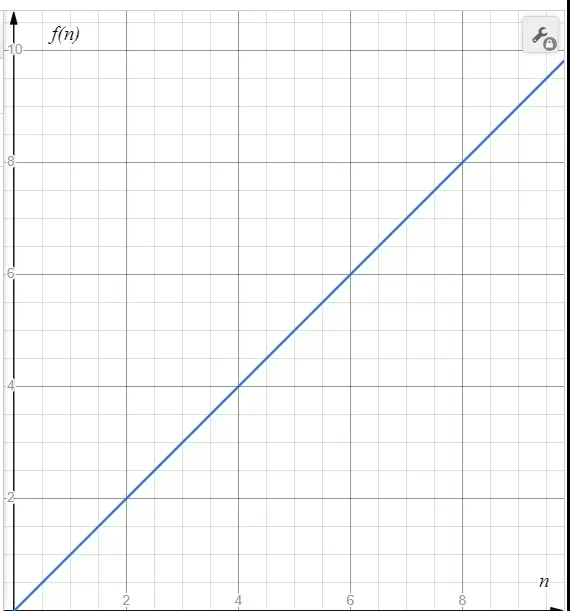
- Example: Searching through a list to find an element. If the list size increases, the number of steps needed increases by the same factor.
| n | f(n) = n |
|---|---|
| 1 | 1 |
| 10 | 10 |
| 100 | 100 |
| 1,000 | 1,000 |
- Implication: Linear growth is manageable. The algorithm scales well with input size, making it suitable for medium-sized problems.
2. Quadratic Growth: f(n) = n²
Here, as the input size n increases, the growth rate is much faster.
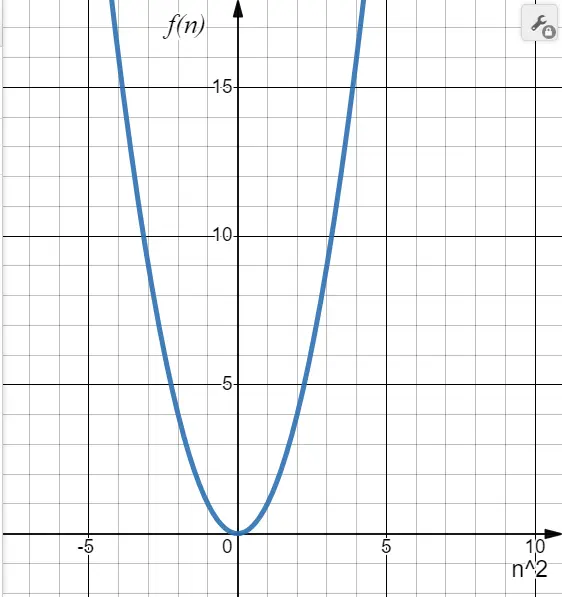
- Example: Consider an algorithm with nested loops where each loop runs
ntimes. For larger values ofn, the number of steps grows rapidly.
| n | f(n) = n² |
|---|---|
| 1 | 1 |
| 10 | 100 |
| 100 | 10,000 |
| 1,000 | 1,000,000 |
- Implication: Quadratic growth can quickly become impractical for large inputs. Algorithms with this growth rate are typically avoided for large datasets.
3. Exponential Growth: f(n) = 2ⁿ
The function grows extremely fast. This represents a very steep growth rate.
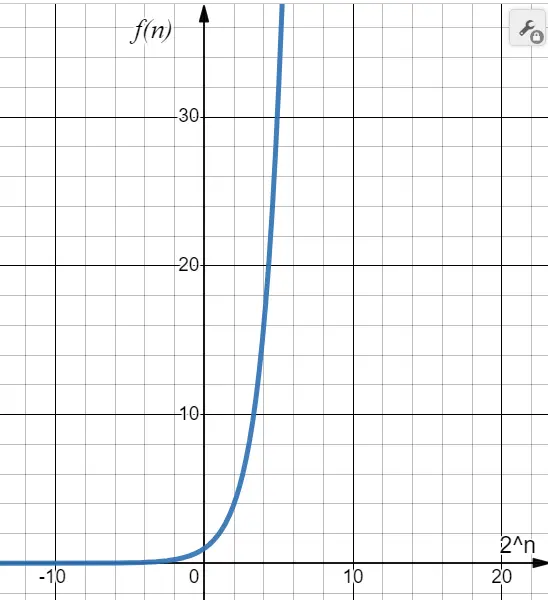
- Example: Some recursive algorithms, such as solving the traveling salesman problem using brute-force, have this growth pattern.
| n | f(n) = 2ⁿ |
|---|---|
| 1 | 2 |
| 10 | 1,024 |
| 20 | 1,048,576 |
| 30 | 1,073,741,824 |
- Implication: Exponential growth is not feasible for large input sizes. Such algorithms are used only for very small problems or when there’s no other choice.
Comparing Growth Rates
Let’s compare these three functions to see how their growth rates differ:
| n | f(n) = n | f(n) = n² | f(n) = 2ⁿ |
|---|---|---|---|
| 1 | 1 | 1 | 2 |
| 10 | 10 | 100 | 1,024 |
| 20 | 20 | 400 | 1,048,576 |
| 30 | 30 | 900 | 1,073,741,824 |
As seen in the table, while f(n) = n grows steadily, f(n) = n² becomes much larger for bigger inputs, and f(n) = 2ⁿ skyrockets quickly.
Why Does This Matter?
- Predicting Performance: By understanding how different functions grow, we can predict how well an algorithm will perform as input size increases.
- Choosing the Right Approach: Knowing the growth rate helps avoid algorithms that might become impractical for larger datasets.
🤖 Don't fully get this? Learn it with Claude
Stuck on Functions and Their Growth Rates? Open Claude, copy a block below, and it'll teach you this exact concept — visually and interactively.
Build the mental picture, not memorization.
I just read a lesson on **Functions and Their Growth Rates** (DSA) and want to truly understand it. Explain Functions and Their Growth Rates from first principles using ONE vivid real-world analogy and a visual mental model — draw it as ASCII art or a clear step-by-step diagram — with a concrete example using real numbers. Then ask me one question to check I got the mental picture, and wait for my reply. If you're unsure or a claim isn't standard, say so and reason from first principles instead of guessing.
Socratic — adapts to where you're stuck.
Teach me **Functions and Their Growth Rates** interactively. Ask me ONE guiding question at a time, wait for my answer, and adapt to my confusion — build the idea with me step by step instead of explaining it all at once. If you're unsure or a claim isn't standard, say so and reason from first principles instead of guessing.
Active recall exposes what you missed.
Quiz me on **Functions and Their Growth Rates** with 5 questions, easy to tricky, ONE at a time. Tell me if each answer is right; at the end, explain clearly what I got wrong and why. If you're unsure or a claim isn't standard, say so and reason from first principles instead of guessing.
Intuition + hook + flashcards for long-term memory.
Help me remember **Functions and Their Growth Rates** for the long term: give the one-sentence intuition, a memorable hook/mnemonic, a tiny worked example, and 3 active-recall flashcards (Q -> A). If you're unsure or a claim isn't standard, say so and reason from first principles instead of guessing.