Big-Omega Notation Ω-notation
Big-Omega Notation (Ω-notation)
Big-O tells you how bad an algorithm can get; Big-Omega (Ω) tells you how good it can never get better than. It is a lower bound on growth. If Big-O is the ceiling a function stays under, Ω is the floor it stays above. When we say an algorithm is Ω(n), we are promising that for large inputs it will do at least some constant multiple of n work — no clever trick will make it fundamentally cheaper than linear.
The key mental shift: O and Ω are about the same function’s growth, bounding it from two sides. They are not shorthand for “worst case” and “best case” — that is a common confusion we untangle below.
Precise definition
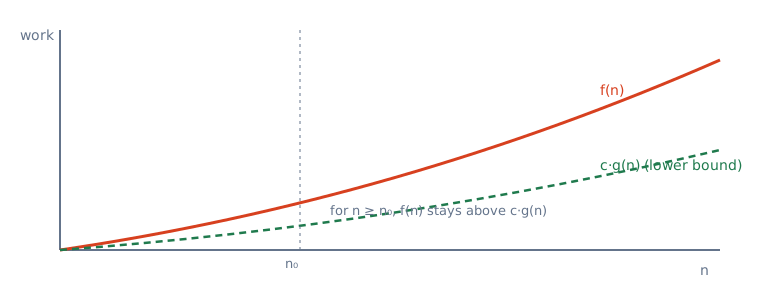
We say f(n) = Ω(g(n)) if there exist positive constants c and n0 such that:
0 ≤ c·g(n) ≤ f(n) for all n ≥ n0
Read literally: past some starting point n0, the function f(n) sits on or above the curve c·g(n). The constant c lets us ignore multiplicative factors; n0 lets us ignore small-n noise where cheaper terms might dominate.
Contrast the trio:
O(g)— upper bound:fgrows no faster thang.Ω(g)— lower bound:fgrows no slower thang.Θ(g)— tight bound:fis both O(g) and Ω(g); it grows exactly likeg.
So Θ is the intersection: f = Θ(g) iff f = O(g) and f = Ω(g).
Worked example: linear search, counted
Consider scanning an array of n items for a target, one comparison per element until found:
- Best case (target at index 0): 1 comparison, regardless of
n. - Worst case (target at the end, or absent): n comparisons.
Now bound the worst-case count function Tworst(n) = n. Is it Ω(n)? Pick c = 1, n0 = 1: then 1·n ≤ n holds for all n ≥ 1. Yes — the worst case is Ω(n). It is also O(n), so it is Θ(n).
But here is the subtlety interviewers love. The best-case count is Tbest(n) = 1. Is 1 = Ω(n)? We would need c·n ≤ 1 for all large n — impossible for any positive c, since c·n grows without bound. So the best case is not Ω(n); it is Ω(1). Every case, best or worst, has its own O and Ω bounds. That is why “Ω = best case” is wrong.
Concretely at n = 1000: worst case does 1000 comparisons (Ω(n) floor holds), best case does 1 (no linear floor possible).
Pitfalls and what an interviewer probes
- Confusing Ω with best case. Ω bounds a chosen function from below; you can talk about the Ω of the best case, the worst case, or the average. Bound and case are independent axes.
- Loose but true bounds. Every function is Ω(1) (it does at least constant work), and any O(n2) algorithm is trivially Ω(1). Saying “mergesort is Ω(1)” is technically true but useless. Interviewers want the tightest honest bound — ideally Θ.
- Claiming a lower bound for a whole problem vs an algorithm. “Comparison sorting is Ω(n log n)” is a statement about every possible algorithm for the problem, proved via decision trees — far stronger than bounding one implementation. Know which you are asserting.
- Direction of the inequality. Under pressure people flip
c·g(n) ≤ f(n). For Ω,gis underneath.
When it matters in practice
Ω earns its keep in two places. First, impossibility arguments: a lower bound proves no algorithm can beat a threshold, so you stop hunting for one. The Ω(n log n) barrier for comparison sorts is why practitioners reach for O(n) tricks like counting/radix sort only when keys are bounded integers — they sidestep the comparison model entirely.
Second, honest expectation-setting. If an operation is Ω(n), you know that caching, better constants, or SIMD will shave factors but never change the shape — you must reduce the input or change the algorithm class to win asymptotically.
Trade-off against neighbours: O alone can lull you (“it’s O(n2)” might actually always run in n2). Θ is what you usually want to report because it pins growth on both sides. Reach for a bare Ω when you can only honestly prove a floor — often the hardest and most valuable thing to establish about a problem.
Key takeaways
- Ω is a lower bound:
f = Ω(g)meansc·g(n) ≤ f(n)for alln ≥ n0—fgrows no slower thang. - Ω is not “best case.” Best, worst, and average each have their own O, Ω, and Θ; bound and case are separate axes.
- Θ = O and Ω together; report Θ when you can, and always give the tightest honest Ω, since Ω(1) is trivially true and unhelpful.
- Problem-level lower bounds (e.g. comparison sorting is Ω(n log n)) prove no algorithm can do better — a stronger, more useful claim than bounding one implementation.
🤖 Don't fully get this? Learn it with Claude
Stuck on Big-Omega Notation Ω-notation? Open Claude, copy a block below, and it'll teach you this exact concept — visually and interactively.
Build the mental picture, not memorization.
I just read a lesson on **Big-Omega Notation Ω-notation** (DSA) and want to truly understand it. Explain Big-Omega Notation Ω-notation from first principles using ONE vivid real-world analogy and a visual mental model — draw it as ASCII art or a clear step-by-step diagram — with a concrete example using real numbers. Then ask me one question to check I got the mental picture, and wait for my reply. If you're unsure or a claim isn't standard, say so and reason from first principles instead of guessing.
Socratic — adapts to where you're stuck.
Teach me **Big-Omega Notation Ω-notation** interactively. Ask me ONE guiding question at a time, wait for my answer, and adapt to my confusion — build the idea with me step by step instead of explaining it all at once. If you're unsure or a claim isn't standard, say so and reason from first principles instead of guessing.
Active recall exposes what you missed.
Quiz me on **Big-Omega Notation Ω-notation** with 5 questions, easy to tricky, ONE at a time. Tell me if each answer is right; at the end, explain clearly what I got wrong and why. If you're unsure or a claim isn't standard, say so and reason from first principles instead of guessing.
Intuition + hook + flashcards for long-term memory.
Help me remember **Big-Omega Notation Ω-notation** for the long term: give the one-sentence intuition, a memorable hook/mnemonic, a tiny worked example, and 3 active-recall flashcards (Q -> A). If you're unsure or a claim isn't standard, say so and reason from first principles instead of guessing.