Recursion Tree Method
Recursion Tree Method
When you write a recursive algorithm, its running time obeys a recurrence — a formula that defines the cost on an input of size n in terms of the cost on smaller inputs, plus whatever work the current call does itself. The recursion tree method is the most visual way to solve such a recurrence: you literally draw the tree of recursive calls, tag every node with the work it does (not counting its children), then add everything up. The genius of the technique is that it turns an intimidating self-referential equation into simple arithmetic — count the work per level, count the levels, and sum.
Think of it as unrolling the recursion by hand. The root is the original call. Its children are the sub-calls it spawns. Their children are the sub-sub-calls, and so on, until you hit the base case. The total time is nothing more than the sum of the work written on every node.
Precise definition
Given a recurrence T(n) = a·T(n/b) + f(n) (with a sub-calls each on inputs a factor b smaller, and f(n) non-recursive work), the recursion tree is built as follows:
- Root is labelled with
f(n)— the work the top call does outside its recursive calls. - The root has
achildren, each a subproblem of sizen/b, so each is labelledf(n/b). - Continue expanding until subproblem size reaches the base case (size 1), which occurs at depth roughly
logbn.
Then compute two quantities: the work at each level (number of nodes on the level × work per node) and the number of levels. T(n) is the sum of level-costs over all levels, including the bottom row of leaves (the base cases). The tree method is not a shortcut that hides the algebra — it is the algebra, drawn.
Worked example — merge sort: T(n) = 2T(n/2) + cn
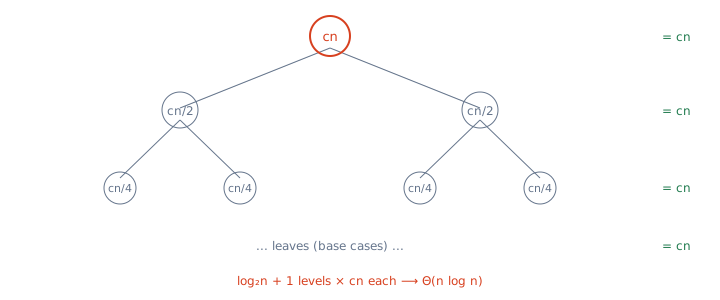
Merge sort splits an array in two, sorts each half, and merges in linear time. So a = 2, b = 2, f(n) = cn. Let us count with concrete numbers: n = 8 and c = 1.
- Level 0: 1 node of size 8 → work =
8. - Level 1: 2 nodes of size 4 →
2 × 4 = 8. - Level 2: 4 nodes of size 2 →
4 × 2 = 8. - Level 3: 8 leaves of size 1 →
8 × 1 = 8.
Every level costs exactly cn = 8 — because doubling the node count exactly cancels the halving of node size. The number of levels is log28 + 1 = 4. Total work = 8 × 4 = 32. In general T(n) = cn·(log2n + 1) = Θ(n log n). That is merge sort's running time in best, worst, and average case — the tree is identical regardless of input, which is exactly why merge sort has no bad cases.
The key insight: sum the level-costs as a geometric series
Not every tree has equal levels. Compare the level totals as you go down — they form a geometric series, and its ratio decides everything:
- Balanced (equal per level) — e.g. merge sort. Each of
log nlevels costs the same, givingΘ(f(n)·log n). - Root-heavy (decreasing) — e.g.
T(n) = 2T(n/2) + n2. Levelicosts2i·(n/2i)2 = n2/2i, halving each level. The series is dominated by the root:Θ(n2). - Leaf-heavy (increasing) — e.g.
T(n) = 4T(n/2) + n. Work grows down the tree, so theΘ(nlogba)leaves dominate:Θ(n2).
This is exactly the intuition behind the Master Theorem — its three cases are just "decreasing / equal / increasing series." The tree method is the honest derivation; the Master Theorem is the memorised shortcut.
Pitfalls and what an interviewer probes
- Forgetting the leaves. The bottom row is real work. In leaf-heavy trees it is the dominant term — counting only internal nodes gives the wrong answer.
- Miscounting the depth. Size-
n/bireaches 1 ati = logbn. For subtract-and-recur likeT(n)=T(n-1)+cthe depth isn, notlog n— a classic trap that turnsO(n)into a mistakenO(log n). - Node count vs. work per node. A level's cost is count × per-node work; conflating the two is the most common arithmetic slip.
- Treating it as proof. The tree gives you a guess; a rigorous answer uses the substitution method to verify the bound by induction. Interviewers love asking "how would you prove that?"
- Unbalanced splits.
T(n)=T(n/3)+T(2n/3)+cngives a lopsided tree — longest pathlog3/2n— yet still sums toΘ(n log n). Being able to reason about ragged trees signals real fluency.
When it matters in practice, and trade-offs
Reach for the recursion tree when the recurrence has an unusual f(n) (like n log n or n/log n) that the Master Theorem's clean cases do not cover, or when a split is uneven. It also builds the intuition that later lets you apply the Master Theorem instantly. Compared to neighbours: the Master Theorem is faster but only handles the aT(n/b)+f(n) shape with well-behaved f; the substitution method proves a bound rigorously but needs you to guess it first — the tree is the ideal guess-generator; Akra–Bazzi generalises to arbitrary unequal splits but is heavier machinery. Its one weakness: for messy or non-polynomial f(n), summing the series exactly can itself be hard, so the tree gives the shape of the answer while careful algebra nails the constant.
Key takeaways
- Draw the call tree, label each node with its own work
f(size), thenT(n) =sum over all levels including the leaf row. - Level cost = (number of nodes) × (work per node); the sequence of level costs is a geometric series whose ratio (decreasing / equal / increasing) picks the dominant term — root, all-levels, or leaves.
- Merge sort's tree has
log2n + 1levels each costingcn, soΘ(n log n)in best, worst, and average case. - Use the tree to guess the bound, the Master Theorem to shortcut the standard shape, and substitution to prove it — and always double-check depth and the leaf count.
🤖 Don't fully get this? Learn it with Claude
Stuck on Recursion Tree Method? Open Claude, copy a block below, and it'll teach you this exact concept — visually and interactively.
Build the mental picture, not memorization.
I just read a lesson on **Recursion Tree Method** (DSA) and want to truly understand it. Explain Recursion Tree Method from first principles using ONE vivid real-world analogy and a visual mental model — draw it as ASCII art or a clear step-by-step diagram — with a concrete example using real numbers. Then ask me one question to check I got the mental picture, and wait for my reply. If you're unsure or a claim isn't standard, say so and reason from first principles instead of guessing.
Socratic — adapts to where you're stuck.
Teach me **Recursion Tree Method** interactively. Ask me ONE guiding question at a time, wait for my answer, and adapt to my confusion — build the idea with me step by step instead of explaining it all at once. If you're unsure or a claim isn't standard, say so and reason from first principles instead of guessing.
Active recall exposes what you missed.
Quiz me on **Recursion Tree Method** with 5 questions, easy to tricky, ONE at a time. Tell me if each answer is right; at the end, explain clearly what I got wrong and why. If you're unsure or a claim isn't standard, say so and reason from first principles instead of guessing.
Intuition + hook + flashcards for long-term memory.
Help me remember **Recursion Tree Method** for the long term: give the one-sentence intuition, a memorable hook/mnemonic, a tiny worked example, and 3 active-recall flashcards (Q -> A). If you're unsure or a claim isn't standard, say so and reason from first principles instead of guessing.