Exponential Time and Space O2ⁿ
Exponential Time and Space O(2n)
Imagine you are standing at the entrance of a maze where every step forces a binary choice: go left or go right. To be sure you have explored everything, you must eventually walk down both branches of every fork. After the first fork there are 2 paths, after the second there are 4, after the third 8, after the tenth over a thousand. Each extra fork doubles the total work. That doubling-with-each-added-element is the signature of exponential growth, written O(2n).
The intuition to burn in: in polynomial time (like O(n2)) adding one more element adds a bit; in exponential time adding one more element multiplies the total. This is the difference between a cost that grows and a cost that explodes.
Precise definition
An algorithm runs in exponential time when its running time T(n) is bounded above by c · kn for some constants c > 0 and base k > 1. The canonical member is O(2n), but O(3n), O(1.6n), and similar all belong to the exponential family because the variable n sits in the exponent. Contrast this with polynomial time O(nk), where n sits in the base and the exponent is a constant.
A useful cousin is factorial time O(n!) (permutations of n items), which grows even faster than 2n. Both are colloquially called "exponential" in interviews, but strictly n! is super-exponential. Exponential space means the algorithm stores c · 2n units of data — for example, materializing all subsets of a set.
Best/worst/average: for many exponential algorithms the bound is tight in all three cases — the work is inherently a full enumeration. Where pruning applies (e.g. backtracking with early cutoffs), the worst case stays O(2n) while lucky inputs finish far sooner; the average depends entirely on how effective the pruning is.
Worked example: naive recursive Fibonacci
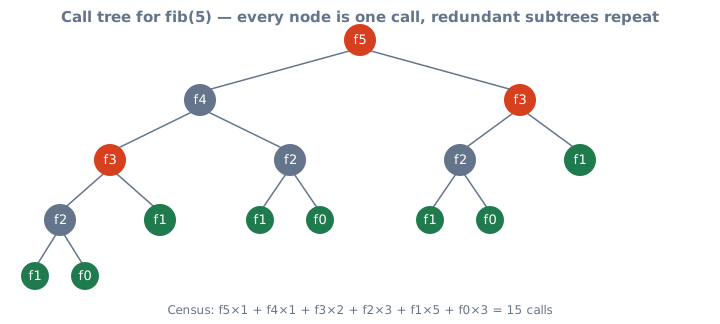
The cleanest place to see the doubling is the naive Fibonacci recurrence: fib(n) = fib(n-1) + fib(n-2), with fib(0)=0, fib(1)=1. Each call spawns two more calls, so the call tree branches by 2 at nearly every level. Let us literally count the calls to compute fib(5).
fib(5)callsfib(4)andfib(3)fib(4)callsfib(3)andfib(2)fib(3)callsfib(2)andfib(1)— and this wholefib(3)subtree is computed twice
Counting every node in the recursion tree, fib(5) makes 15 calls. The counts per n are: fib(2)=3, fib(3)=5, fib(4)=9, fib(5)=15, fib(6)=25, fib(7)=41 — the total calls for fib(n) equal 2·fib(n+1) − 1, and since fib itself grows like φn (φ ≈ 1.618), the number of calls is O(φn) ⊂ O(2n).
The damage is the repeated recomputation: fib(3) is recomputed 2 times, fib(2) 3 times, fib(1) 5 times. Memoizing those repeats collapses the whole thing to O(n) — one of the most important lessons in all of algorithms: exponential blowup is often redundant work in disguise.
Common pitfalls and what an interviewer probes
- Confusing
2nwithn2. These are wildly different.n2at n=50 is 2,500;2nat n=50 is over 1015. Interviewers watch for candidates who blur "exponent" and "power." - Missing that recursion depth is the exponent. The tell is a recursive function that makes two or more calls per invocation without memoization. If branching factor is
band depth isn, cost isO(bn). - Forgetting the space cost. The recursion stack for these is usually only
O(n)deep (one root-to-leaf path at a time), but if you store all subsets/paths, space becomesO(2n)too. Interviewers love the follow-up "and the space complexity?" - Not spotting the fix. The strongest signal you can send is: "this is exponential because of overlapping subproblems — memoization or DP makes it polynomial." Recognizing when a problem is genuinely exponential (no shared subproblems, e.g. generating all subsets) versus accidentally exponential (Fibonacci) is the real skill.
When it matters in practice + trade-offs
Genuinely exponential problems are everywhere in interviews and real systems: enumerating all 2n subsets (power set), the classic subset-sum / 0-1 knapsack by brute force, generating all combinations, the Travelling Salesman brute force at O(n!), and many NP-hard problems where no known polynomial algorithm exists.
The practical rule of thumb: exponential algorithms are only viable for tiny n. With modern hardware doing ~108–109 operations per second, 2n is fine up to roughly n ≈ 20–25, borderline to ~30, and hopeless beyond ~40. Compared to neighbours: O(n log n) scales to millions, O(n2) to tens of thousands (at n = 106 it's already 1012 ops), and O(n3) only to low thousands. Exponential is a cliff, not a slope.
The trade-off you offer interviewers: sometimes exponential is unavoidable (you truly must list every subset), and then you optimize constants or prune aggressively (branch-and-bound, backtracking). Other times you escape it with dynamic programming — 0-1 knapsack drops from O(2n) brute force to O(n·W) pseudo-polynomial DP. Knowing which situation you are in is the judgment that separates a passing answer from a great one.
Key takeaways
- Exponent, not base:
O(2n)means the variable is in the exponent, so each added element doubles the work — fundamentally different from and vastly worse than polynomialO(n2). - The tell is branching recursion: two-or-more recursive calls per invocation without memoization gives
O(bn); naive Fibonacci makes ~φncalls purely from recomputing overlapping subproblems. - Accidental vs genuine: overlapping subproblems (Fibonacci, knapsack) collapse to polynomial via memoization/DP; true enumeration (all
2nsubsets, permutations) is irreducibly exponential. - Only tiny n survives: exponential is practical up to about n ≈ 20–30; beyond ~40 it is intractable — always name the DP or pruning escape hatch if one exists.
🤖 Don't fully get this? Learn it with Claude
Stuck on Exponential Time and Space O2ⁿ? Open Claude, copy a block below, and it'll teach you this exact concept — visually and interactively.
Build the mental picture, not memorization.
I just read a lesson on **Exponential Time and Space O2ⁿ** (DSA) and want to truly understand it. Explain Exponential Time and Space O2ⁿ from first principles using ONE vivid real-world analogy and a visual mental model — draw it as ASCII art or a clear step-by-step diagram — with a concrete example using real numbers. Then ask me one question to check I got the mental picture, and wait for my reply. If you're unsure or a claim isn't standard, say so and reason from first principles instead of guessing.
Socratic — adapts to where you're stuck.
Teach me **Exponential Time and Space O2ⁿ** interactively. Ask me ONE guiding question at a time, wait for my answer, and adapt to my confusion — build the idea with me step by step instead of explaining it all at once. If you're unsure or a claim isn't standard, say so and reason from first principles instead of guessing.
Active recall exposes what you missed.
Quiz me on **Exponential Time and Space O2ⁿ** with 5 questions, easy to tricky, ONE at a time. Tell me if each answer is right; at the end, explain clearly what I got wrong and why. If you're unsure or a claim isn't standard, say so and reason from first principles instead of guessing.
Intuition + hook + flashcards for long-term memory.
Help me remember **Exponential Time and Space O2ⁿ** for the long term: give the one-sentence intuition, a memorable hook/mnemonic, a tiny worked example, and 3 active-recall flashcards (Q -> A). If you're unsure or a claim isn't standard, say so and reason from first principles instead of guessing.