Linearithmic Time On log n
Linearithmic Time: O(n log n)
Imagine you have to sort a shuffled deck of n cards. You could compare every card against every other card, but that is wasteful. A smarter idea: split the pile in half, sort each half, then merge the two sorted halves together. Splitting keeps halving the problem until each piece is trivially sorted, and merging stitches them back. The halving gives you a log n factor (how many times you can cut n in half before reaching 1), and each round of merging still has to touch all n items once. Multiply those two forces together and you get n × log n work. That product is what we call linearithmic time.
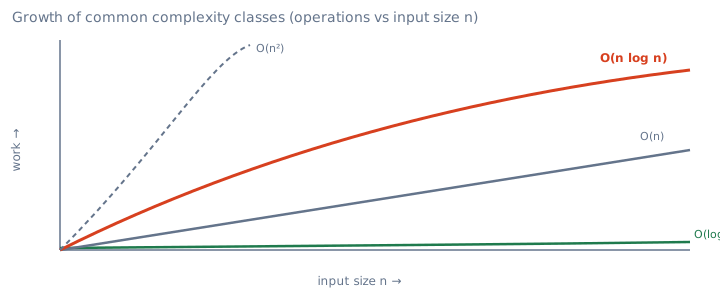
The mental picture: it is almost as cheap as looking at each item once (linear, O(n)), but with a small, slowly-growing multiplier bolted on. For a million items, log₂(n) ≈ 20 — so linearithmic is only about 20× more work than linear, not a million times more. That is why it feels “fast enough” in practice.
Precise definition
An algorithm runs in linearithmic time when its running time T(n) grows proportionally to n · log n — formally, T(n) = O(n log n). In big-O, the logarithm's base is irrelevant: log₂ n, log₁₀ n, and ln n differ only by a constant factor, which big-O absorbs. By convention we read it as base 2 because the recurring pattern is repeated halving.
The canonical way this arises is a divide-and-conquer recurrence:
T(n) = 2·T(n/2) + O(n)
Read it as: split into two halves, solve each (2·T(n/2)), then do linear O(n) work to combine. By the Master Theorem this solves to T(n) = O(n log n). The two ingredients you must always be able to point to are: (1) a log n number of levels from repeated division, and (2) O(n) work spread across each level.
Worked example: merge sort on 8 elements
Take n = 8 and count the real comparisons/moves. Merge sort recursively halves the array, so the number of levels is log₂ 8 = 3 (8 → 4 → 2 → 1). At every level, the total merging work touches all 8 elements exactly once — because the sub-arrays at a level partition the whole array.
- Level 1 (merge pairs of size 4 into size 8): ~8 element moves.
- Level 2 (merge four pieces of size 2 into fours): ~8 element moves total.
- Level 3 (merge eight singletons into pairs): ~8 element moves total.
Total ≈ 8 × 3 = 24 operations = n × log₂ n. Contrast the neighbours: a linear scan would be 8, and a quadratic O(n²) algorithm like bubble sort would be 8² = 64. For n = 1,000,000 the gap explodes: linearithmic ≈ 20,000,000 ops, quadratic ≈ 1,000,000,000,000 — a 50,000× difference. That is the entire reason we prefer O(n log n) sorts at scale.
Best / worst / average: merge sort is O(n log n) in all three cases — the halving structure is fixed regardless of input order. Quicksort is O(n log n) on average but degrades to O(n²) worst-case (bad pivots); heapsort is O(n log n) worst-case too. Comparison-based sorting cannot beat O(n log n) in the worst case — that is a proven lower bound.
Common pitfalls & what an interviewer probes
- Confusing O(n log n) with O(log n). A log-time algorithm does work at only one position per level (like binary search discarding half). Linearithmic does
O(n)work per level. Thenmultiplier is the whole difference. - Assuming every nested loop is O(n²). An interviewer will show a loop whose inner bound shrinks or doubles — e.g.
for i in 1..n: for j = 1; j < n; j *= 2. The inner loop runslog ntimes, so total isO(n log n), notO(n²). Watch how the inner counter changes. - Forgetting the “combine” cost. The recurrence is only linearithmic when the merge/partition step is
O(n). If combining wereO(n²),T(n)=2T(n/2)+O(n²)solves toO(n²)instead. - Space. Interviewers pair time with space: merge sort needs
O(n)auxiliary space; heapsort sorts inO(1)extra space. Same time class, different memory trade-off. - “Can you do better?” For comparison sorts, no — and you should be able to prove it: a comparison sort is a decision tree with one leaf per possible ordering, so it has
n!leaves; a binary tree withn!leaves has height at leastlog₂(n!) = Ω(n log n)(by Stirling's approximation,log₂(n!) ≈ n log₂ n). That height is the worst-case comparison count, hence theΩ(n log n)lower bound. But if you can exploit structure (integer keys, bounded range), counting/radix sort escape the comparison model and hitO(n)— a classic follow-up they want you to reach for.
When it matters in practice + trade-offs
Linearithmic time is the sweet spot for problems that provably cannot be linear. It shows up in: all efficient comparison sorts (merge, heap, introsort — the basis of most standard library sort() functions), building a balanced binary search tree by inserting n items, many divide-and-conquer results (closest pair of points, FFT), and the ubiquitous “sort first, then scan” pattern that turns an O(n²) brute force into O(n log n) — e.g. detecting duplicates, interval merging, or two-sum on a sorted array.
Trade-off framing versus neighbours: O(n) is strictly cheaper but often unattainable when ordering or global structure is required. O(n²) is simpler to code and can win for tiny n (constants matter — real sorts switch to insertion sort below ~16 elements). The practical rule: once n reaches the thousands, an O(n log n) solution dominates a quadratic one so decisively that finding one is usually the intended interview answer.
Key takeaways
O(n log n)= linear work repeated acrosslog nlevels of halving; recognise it from the recurrenceT(n) = 2T(n/2) + O(n).- The
logfactor grows glacially (~20 for a million), so linearithmic is only a small multiple of linear — and vastly better than quadratic at scale. - It is the proven lower bound for comparison-based sorting; merge/heapsort hit it in the worst case, quicksort on average.
- Interview reflex: if a brute force is
O(n²), ask whether sorting first or divide-and-conquer drops it toO(n log n).
🤖 Don't fully get this? Learn it with Claude
Stuck on Linearithmic Time On log n? Open Claude, copy a block below, and it'll teach you this exact concept — visually and interactively.
Build the mental picture, not memorization.
I just read a lesson on **Linearithmic Time On log n** (DSA) and want to truly understand it. Explain Linearithmic Time On log n from first principles using ONE vivid real-world analogy and a visual mental model — draw it as ASCII art or a clear step-by-step diagram — with a concrete example using real numbers. Then ask me one question to check I got the mental picture, and wait for my reply. If you're unsure or a claim isn't standard, say so and reason from first principles instead of guessing.
Socratic — adapts to where you're stuck.
Teach me **Linearithmic Time On log n** interactively. Ask me ONE guiding question at a time, wait for my answer, and adapt to my confusion — build the idea with me step by step instead of explaining it all at once. If you're unsure or a claim isn't standard, say so and reason from first principles instead of guessing.
Active recall exposes what you missed.
Quiz me on **Linearithmic Time On log n** with 5 questions, easy to tricky, ONE at a time. Tell me if each answer is right; at the end, explain clearly what I got wrong and why. If you're unsure or a claim isn't standard, say so and reason from first principles instead of guessing.
Intuition + hook + flashcards for long-term memory.
Help me remember **Linearithmic Time On log n** for the long term: give the one-sentence intuition, a memorable hook/mnemonic, a tiny worked example, and 3 active-recall flashcards (Q -> A). If you're unsure or a claim isn't standard, say so and reason from first principles instead of guessing.