Little-o and Little-omega Notations
Little-o and Little-omega Notations
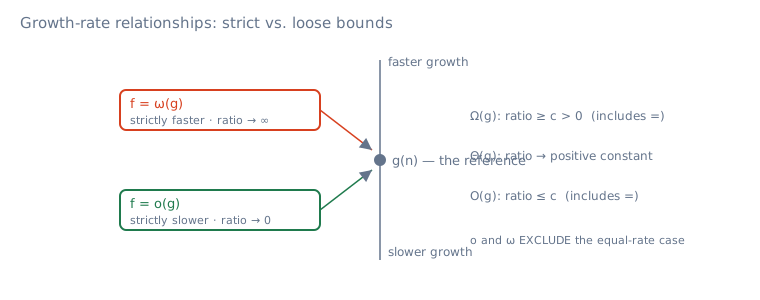
You already know Big-O (Ο) as an upper bound and Big-Ω as a lower bound on how a running time grows. Little-o (o) and little-omega (ω) are their strict cousins. The mental picture: Big-O is the ≤ of growth rates — f grows no faster than g, and is allowed to grow at exactly the same rate. Little-o is the < — f grows strictly slower than g, so much slower that g eventually dwarfs it no matter how you scale things. Symmetrically, Big-Ω is ≥ and little-omega is >: f grows strictly faster than g.
So n = O(n) is true but n = o(n) is false — a function is never strictly slower than itself. Meanwhile n = o(n2) is true: a linear algorithm doesn't just fail to beat a quadratic one, it becomes an ever-smaller fraction of it as input grows.
Precise definitions
The single most important difference from Big-O/Big-Ω is a flipped quantifier: it changes from “there exists a constant” to “for every constant.”
- Little-o:
f(n) = o(g(n))means that for every constantc > 0, there is ann0such that0 ≤ f(n) < c·g(n)for alln ≥ n0. (Big-O needed this for just one chosenc.) - Little-omega:
f(n) = ω(g(n))means that for every constantc > 0, there is ann0such that0 ≤ c·g(n) < f(n)for alln ≥ n0.
The clean, practical way to test them is with a limit ratio:
f = o(g)⇔limn→∞ f(n)/g(n) = 0(the gap widens without bound).f = ω(g)⇔limn→∞ f(n)/g(n) = ∞.
A tidy duality falls out: f = o(g) if and only if g = ω(f). And whereas f = Θ(g) means the ratio settles to a positive constant, o and ω describe the two ways it can fail to settle — collapsing to 0 or blowing up to ∞.
Worked example: prove 2n + 5 = o(n2)
Let f(n) = 2n + 5 and g(n) = n2. To satisfy little-o we must beat every c > 0, so let's take a deliberately tiny, adversarial one: c = 0.01. We need an n0 beyond which 2n + 5 < 0.01·n2.
Check concrete values of 2n + 5 against 0.01n2:
n = 100: left =205, right =0.01·10000 = 100. Left still bigger — not yet.n = 300: left =605, right =0.01·90000 = 900. Now right wins.
So for c = 0.01, choosing n0 = 300 works, and it keeps working for all larger n because the quadratic pulls away faster. The crucial part: pick any smaller c and you can always answer with a larger n0 — solving 2n + 5 < c·n2 gives roughly n > 2/c. Because an n0 exists for every c, the definition holds. The limit test confirms it in one line: limn→∞ (2n+5)/n2 = 0.
By the duality, this simultaneously proves n2 = ω(2n + 5): the quadratic grows strictly faster, its ratio to the linear term running off to infinity.
Pitfalls and what an interviewer probes
- The quantifier flip is the whole point. If you can only say “there exists a
c,” you have Big-O. Little-o demands it hold for allc, including absurdly small ones. Interviewers love asking whyn = O(n)butn ≠ o(n)— the ration/n = 1never reaches 0, failing at (say)c = 0.5. - “Same rate” is excluded on both sides. If
f = Θ(g), thenfis neithero(g)norω(g). Example:3n2 = O(n2)andΩ(n2), but noto(n2), because the ratio → 3, not 0. - Don't confuse the bound with the case. Little-o describes how one function relates to another; best/worst/average-case describes which input you're bounding. You can honestly say “binary search's worst case is
o(n)” —log ngrows strictly slower thann— but the tighter, information-bearing statement isΘ(log n). - Prefer Θ when you know it. Saying merely
o(n2)for an algorithm that is actuallyΘ(n log n)is technically true but throws away information. Little-o is a claim about a gap, not a tight characterization.
When it matters in practice
You rarely report an algorithm's cost as little-o — for reporting, tight Θ bounds are the currency. Little-o and little-omega earn their keep as tools inside proofs and reasoning:
- Dropping lower-order terms rigorously. The reason
Θ(n2 + n) = Θ(n2)is exactly thatn = o(n2): the smaller term is asymptotically negligible, so it can be absorbed. Little-o is the formal license for the “lower-order terms don't matter” move you make constantly. - Separating complexity classes. To prove one class is strictly inside another you show a strict gap:
log n = o(n),n = o(n log n),nk = o(2n)for any fixedk(every polynomial is strictly beaten by any exponential), and2n = o(n!). These strict separations justify why you fight to turn anω(n)algorithm into anO(n log n)one. - Amortized and probabilistic bounds. Statements like “the overhead is
o(1)per operation” precisely mean the per-op extra cost vanishes as the structure grows — a stronger, cleaner claim thanO(1).
Trade-off vs. neighbours: O/Ω give you slack (they permit equal rates), which makes them easy to state and safe when you're unsure of constants. o/ω give you a strict separation but say nothing about how big the gap is or when it kicks in — the crossover n0 can be enormous. And Θ is the most informative when you can prove it, pinning the rate exactly. Reach for little-o/little-omega precisely when the fact you need is “strictly less/greater,” not “how much.”
Key takeaways
- Strictness is the essence:
O/Ωallow equal growth rates (≤/≥);o/ωforbid it (</>). The definitional trigger is “for everyc > 0,” not “for somec.” - Limit test:
f = o(g)⇔f/g → 0;f = ω(g)⇔f/g → ∞;f = Θ(g)⇔ ratio → a positive constant. The duality:f = o(g)⇔g = ω(f). - If
f = Θ(g), thenfis neithero(g)norω(g)— equal-rate functions live in the gap between the two strict notations. - Use them as reasoning tools — to discard lower-order terms, separate complexity classes, and state vanishing overhead — while reporting algorithm costs with tight Θ bounds whenever you can prove them.
🤖 Don't fully get this? Learn it with Claude
Stuck on Little-o and Little-omega Notations? Open Claude, copy a block below, and it'll teach you this exact concept — visually and interactively.
Build the mental picture, not memorization.
I just read a lesson on **Little-o and Little-omega Notations** (DSA) and want to truly understand it. Explain Little-o and Little-omega Notations from first principles using ONE vivid real-world analogy and a visual mental model — draw it as ASCII art or a clear step-by-step diagram — with a concrete example using real numbers. Then ask me one question to check I got the mental picture, and wait for my reply. If you're unsure or a claim isn't standard, say so and reason from first principles instead of guessing.
Socratic — adapts to where you're stuck.
Teach me **Little-o and Little-omega Notations** interactively. Ask me ONE guiding question at a time, wait for my answer, and adapt to my confusion — build the idea with me step by step instead of explaining it all at once. If you're unsure or a claim isn't standard, say so and reason from first principles instead of guessing.
Active recall exposes what you missed.
Quiz me on **Little-o and Little-omega Notations** with 5 questions, easy to tricky, ONE at a time. Tell me if each answer is right; at the end, explain clearly what I got wrong and why. If you're unsure or a claim isn't standard, say so and reason from first principles instead of guessing.
Intuition + hook + flashcards for long-term memory.
Help me remember **Little-o and Little-omega Notations** for the long term: give the one-sentence intuition, a memorable hook/mnemonic, a tiny worked example, and 3 active-recall flashcards (Q -> A). If you're unsure or a claim isn't standard, say so and reason from first principles instead of guessing.