Understanding Space Complexity
Understanding Space Complexity
When we judge an algorithm we usually ask two questions: how much time does it take, and how much memory does it use? Space complexity answers the second. It describes how the amount of memory an algorithm needs grows as its input grows.
The intuition is the same as time complexity, but the resource is different. Instead of counting operations, you count cells of memory — variables, array slots, recursion frames, hash-table entries. If doubling the input roughly doubles the extra memory, that is linear space. If doubling the input leaves memory unchanged, that is constant space. We again strip away constants and focus on the dominant term, then wrap it in Big-O notation.
Precise definition
Space complexity is a function S(n) giving the maximum amount of memory an algorithm uses, measured against input size n, expressed asymptotically (Big-O). Two flavours matter, and interviewers care about the distinction:
- Total space = the input itself + everything extra the algorithm allocates.
- Auxiliary space = only the extra memory the algorithm allocates, excluding the input. This is what people almost always mean when they say "the space complexity".
Example: reading an array of n numbers already costs O(n) total space just to hold the input. An algorithm that scans it with two index variables uses O(1) auxiliary space — that O(1) is its interesting cost. We count in abstract memory units (one integer, one pointer, one stack frame = one unit); we do not care that a long is 8 bytes and an int is 4, because constant factors vanish in Big-O.
Worked example: counting the memory
Compare two ways to reverse an array of n elements. Count every named allocation.
Version A — build a new reversed array:
result= a fresh array of sizen→nunitsi, one loop index → 1 unit
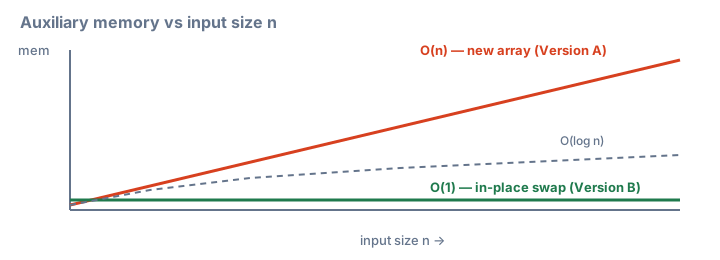
Extra memory = n + 1. Drop the constant → auxiliary space O(n). For n = 1000 elements you allocate ~1000 extra slots; for n = 2000, ~2000. It scales linearly.
Version B — reverse in place, swapping ends inward:
left,right→ 2 unitstempfor each swap → 1 unit (reused every iteration, never accumulates)
Extra memory = 3 units regardless of whether n is 10 or 10 million. Drop the constant → auxiliary space O(1). Both versions do the same O(n) work in time, but Version B is dramatically leaner in space — the classic time-equal, space-better trade you are expected to spot.
The trap interviewers probe: the recursion stack
The single most common space-complexity mistake is forgetting that recursion consumes memory. Each pending recursive call keeps a stack frame alive — its parameters, locals, and return address — until it returns. The maximum number of frames simultaneously on the stack is the auxiliary space, even if the function allocates nothing else.
- Linear recursion (e.g. naive factorial, or recursing one element at a time down a list of length n): depth n → O(n) stack space, not O(1).
- Binary recursion on a balanced tree/array (e.g. binary search, balanced merge sort splitting): depth ~log₂n → O(log n) stack space.
- Skewed / worst case: quicksort partitioning into 1 and n−1 recurses n deep → O(n) in the worst case, though O(log n) on average with good pivots. Always state the case.
A related trap: output does not count as auxiliary space by convention — if the problem requires returning an array of size n, that n is unavoidable and usually excluded when judging the algorithm's own overhead. But temporary scratch buffers do count. Be explicit about which you mean; a sharp interviewer will ask.
When it matters, and the trade-offs
In interviews, space complexity is where you earn the follow-up points after nailing the time bound. In production it decides whether your solution runs at all: memory is a hard ceiling (a process that exceeds RAM gets killed or thrashes to disk), whereas being slow merely makes you wait.
The recurring tension is time vs space:
- Memoization / caching / hash sets spend
O(n)space to cut repeated work — e.g. the two-sum hash-map solution tradesO(n)space to drop time fromO(n²)toO(n). - In-place algorithms spend more care (and sometimes time) to hold space at
O(1)— vital for huge datasets or embedded/systems contexts with tight memory. - Streaming processes input in one pass with
O(1)orO(log n)memory when the data is too large to hold at once.
Neighbouring classes to anchor your judgement: O(1) < O(log n) < O(n) < O(n log n) < O(n²). An O(n²)-space solution (e.g. a full DP table over pairs) is often the first draft; recognising you can compress it to two rows → O(n), or one running value → O(1), is exactly the optimisation that separates a strong answer from a passing one.
Key takeaways
- Space complexity counts memory growth, not operations — usually the auxiliary space (extra memory beyond the input), expressed in Big-O with constants dropped.
- Reuse is free, accumulation is not: a
tempreused each loop is O(1); a new array of size n is O(n). - Recursion is not free — the deepest stack depth is auxiliary space: O(n) for linear recursion, O(log n) for balanced binary recursion, and state best/worst/average when they differ.
- Space and time trade off: caching buys speed with memory; in-place and streaming buy memory with care. Choosing well is the judgement interviewers and real systems reward.
🤖 Don't fully get this? Learn it with Claude
Stuck on Understanding Space Complexity? Open Claude, copy a block below, and it'll teach you this exact concept — visually and interactively.
Build the mental picture, not memorization.
I just read a lesson on **Understanding Space Complexity** (DSA) and want to truly understand it. Explain Understanding Space Complexity from first principles using ONE vivid real-world analogy and a visual mental model — draw it as ASCII art or a clear step-by-step diagram — with a concrete example using real numbers. Then ask me one question to check I got the mental picture, and wait for my reply. If you're unsure or a claim isn't standard, say so and reason from first principles instead of guessing.
Socratic — adapts to where you're stuck.
Teach me **Understanding Space Complexity** interactively. Ask me ONE guiding question at a time, wait for my answer, and adapt to my confusion — build the idea with me step by step instead of explaining it all at once. If you're unsure or a claim isn't standard, say so and reason from first principles instead of guessing.
Active recall exposes what you missed.
Quiz me on **Understanding Space Complexity** with 5 questions, easy to tricky, ONE at a time. Tell me if each answer is right; at the end, explain clearly what I got wrong and why. If you're unsure or a claim isn't standard, say so and reason from first principles instead of guessing.
Intuition + hook + flashcards for long-term memory.
Help me remember **Understanding Space Complexity** for the long term: give the one-sentence intuition, a memorable hook/mnemonic, a tiny worked example, and 3 active-recall flashcards (Q -> A). If you're unsure or a claim isn't standard, say so and reason from first principles instead of guessing.