Overview of Asymptotic Analysis
Overview of Asymptotic Analysis
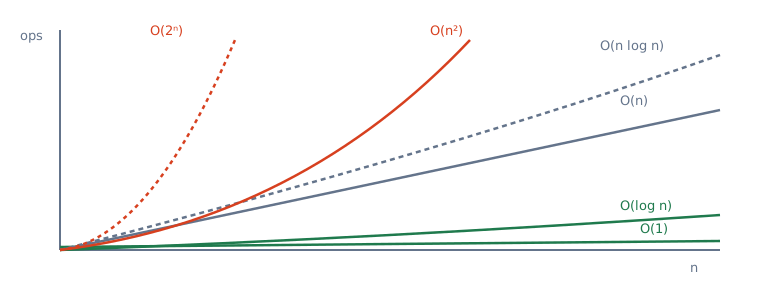
"Asymptotic" means one specific thing: behaviour as n heads to infinity. Asymptotic analysis deliberately throws away constants and low-order terms to expose the growth class underneath. Other pages give you the mechanics — the ∃c,n0 definition on Big-O Notation, the class catalogue on Functions and Their Growth Rates. This page examines the abstraction itself: a cleaner limit-based way to establish a bound, exactly why discarding the low-order terms is legitimate, and the cases where that discarding quietly betrays you.
The limit definition — asymptotics without guessing constants
Picking a constant c and threshold n0 to prove a bound is fiddly. There is a mechanical alternative: take the ratio of the two functions and send n to infinity. For T(n) and a candidate f(n), look at L = limn→∞ T(n)/f(n):
L = 0→Tgrows strictly slower thanf: writtenT ∈ o(f)(little-o).0 < L < ∞→ same growth class:T ∈ Θ(f)— a tight bound.L = ∞→Tgrows strictly faster:T ∈ ω(f)(little-omega).
The little-o/little-omega notations are the strict cousins of Big-O/Big-Omega (which allow equality). "n = o(n2)" says n is strictly below quadratic; "n2 = O(n2)" merely says it does not exceed it. The full side-by-side of O/Ω/Θ is on Comparing Asymptotic Notations.
Worked: for T(n) = 3n2 + 100n + 5000 against f(n) = n2: T/f = 3 + 100/n + 5000/n2 → 3 as n→∞. The limit is a finite non-zero constant, so T ∈ Θ(n2) — and the low-order terms vanished because (100n + 5000)/n2 → 0, i.e. they are o(n2). That is the whole justification for "drop them," made rigorous in one line.
When the abstraction leaks: constants and low-order terms you dropped
Asymptotics promise something about large n. Below the threshold where the dominant term takes over, the terms you discarded are not negligible — they are the cost. Take the same T(n) = 3n2 + 100n + 5000. When does the 3n2 term actually overtake the 100n + 5000 you threw away? Solve 3n2 = 100n + 5000: 3n2 − 100n − 5000 = 0 ⇒ n = (100 + √70000)/6 ≈ 60.8. So for every input below n ≈ 61, the "negligible" terms are the majority of the work (at n = 60, the linear-plus-constant part is 11,000 vs the quadratic's 10,800). The Θ(n2) label is a true statement about the tail that is actively misleading about the first 60 inputs.
The extreme case: galactic algorithms
Push "the constant is dropped" to its breaking point and you get galactic algorithms — algorithms with a genuinely better asymptotic class whose hidden constant is so vast that the crossover point exceeds any input that will ever exist. Matrix multiplication is the classic ladder:
- Naive triple loop —
O(n3). - Strassen —
O(n2.807), a real improvement with a manageable constant; production libraries actually switch to it for large matrices (crossover typically at a few hundred to ~1000 rows). - Coppersmith–Winograd and its successors —
O(n~2.37), asymptotically the best known, yet never used: the constant is astronomically large, so naive or Strassen wins for every matrix that fits in memory, in the world.
The lesson, and the judgment: an asymptotic bound is a claim about n → ∞. If the crossover n where the better class overtakes lies beyond your real inputs, the better complexity is worthless in practice. Asymptotic superiority is necessary, not sufficient — you must also check the crossover is reachable, which is exactly the empirical question handled on Measuring Efficiency.
Pitfalls unique to the asymptotic abstraction
- little-o vs Big-O.
ois strict (limit 0, grows genuinely slower);Oallows equality. Sayingn2 = o(n2)is false;n2 = O(n2)is true. - Amortized ≠ worst case. A dynamic array
pushisO(n)on the rare doubling butO(1)amortized over a sequence — the asymptotic average per operation, which is the honest figure when you do many. Saying "O(1)amortized" unprompted signals real depth. - "Asymptotically better" is not "faster." The galactic case is the proof: a lower exponent can lose on every real input.
- Assuming the limit always exists. For oscillating costs the ratio may not converge to a single
L; then you bound withO/Ωseparately rather than claimingΘ.
Key takeaways
- Asymptotic analysis studies behaviour as
n → ∞; the limit testlim T(n)/f(n)classifies it: 0 →o, finite non-zero →Θ, ∞ →ω. - Dropping low-order terms is justified because they are
o(dominant)— but only in the tail: for3n2+100n+5000the dropped terms dominate untiln ≈ 61. - Galactic algorithms show the abstraction's limit: a better class with an unreachable crossover (Coppersmith–Winograd's
O(n2.37)) is useless in practice. - Keep little-o (strict) distinct from Big-O (≤), and know amortized is an asymptotic average, not a worst case.
🤖 Don't fully get this? Learn it with Claude
Stuck on Overview of Asymptotic Analysis? Open Claude, copy a block below, and it'll teach you this exact concept — visually and interactively.
Build the mental picture, not memorization.
I just read a lesson on **Overview of Asymptotic Analysis** (DSA) and want to truly understand it. Explain Overview of Asymptotic Analysis from first principles using ONE vivid real-world analogy and a visual mental model — draw it as ASCII art or a clear step-by-step diagram — with a concrete example using real numbers. Then ask me one question to check I got the mental picture, and wait for my reply. If you're unsure or a claim isn't standard, say so and reason from first principles instead of guessing.
Socratic — adapts to where you're stuck.
Teach me **Overview of Asymptotic Analysis** interactively. Ask me ONE guiding question at a time, wait for my answer, and adapt to my confusion — build the idea with me step by step instead of explaining it all at once. If you're unsure or a claim isn't standard, say so and reason from first principles instead of guessing.
Active recall exposes what you missed.
Quiz me on **Overview of Asymptotic Analysis** with 5 questions, easy to tricky, ONE at a time. Tell me if each answer is right; at the end, explain clearly what I got wrong and why. If you're unsure or a claim isn't standard, say so and reason from first principles instead of guessing.
Intuition + hook + flashcards for long-term memory.
Help me remember **Overview of Asymptotic Analysis** for the long term: give the one-sentence intuition, a memorable hook/mnemonic, a tiny worked example, and 3 active-recall flashcards (Q -> A). If you're unsure or a claim isn't standard, say so and reason from first principles instead of guessing.