Trade-offs in Algorithm Design
Trade-offs in Algorithm Design
There is rarely a single "best" algorithm. There is a best algorithm for a given set of constraints. Almost every design decision spends one resource to save another: you burn extra memory to go faster, or you accept slower queries to keep updates cheap, or you give up a guaranteed answer for one that is usually right and much quicker. A trade-off is exactly this exchange rate. Interviewers care about trade-offs more than any single clever trick, because production systems live and die by the constraint you didn't optimise for. The skill being tested is not "which is fastest" but "which resource is scarce here, and what am I willing to pay to relieve it."
Precise definition
A trade-off is a design choice that improves one measurable cost while worsening another, such that no single choice dominates across all inputs and constraints. The recurring axes you balance are:
- Time vs space — store precomputed results (hash tables, memoisation, indexes) to cut running time.
- Preprocessing vs query — pay once to build a structure so that each later query is cheap (sorting before binary search, building a prefix-sum array).
- Worst case vs average case — a structure may be fast almost always but degrade on adversarial input (hashing, quicksort).
- Read cost vs write cost — data structures optimised for fast lookup often make insertion or deletion more expensive, and vice versa.
- Exactness vs speed — approximate or probabilistic answers (Bloom filters, randomised algorithms) trade a controlled error for large savings.
Crucially, a trade-off is only real when neither option strictly dominates. If choice A is better on every axis for every input, there is no trade-off — just a better algorithm.
Worked example: Two-Sum, counted operation by operation
Given an array and a target, find whether two elements sum to the target. Take arr = [3, 8, 2, 5, 9, 1, 7, 4] (n = 8), target = 12.
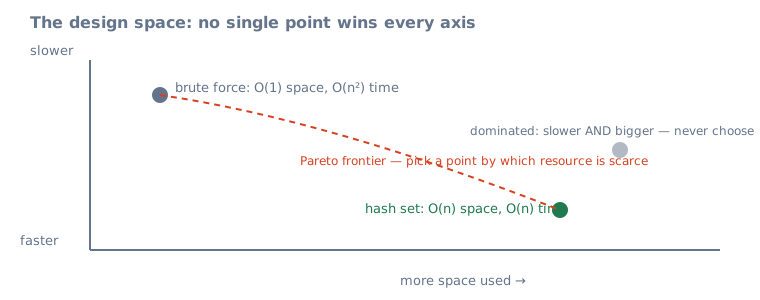
Approach A — brute force (favour space). Check every pair. The number of comparisons is exactly n(n-1)/2 = 8·7/2 = 28 in the worst case. Extra memory used: O(1) — just a couple of loop variables. Time: O(n2), and for n = 8 that is 28 operations.
Approach B — hash set (favour time). Walk the array once; for each element x check whether target − x was already seen, then insert x. Trace it: 3→need 9 (miss, store 3); 8→need 4 (miss, store 8); 2→need 10 (miss, store 2); 5→need 7 (miss, store 5); 9→need 3 (hit!). That is 5 lookups + 4 inserts = 9 hash operations versus 28 comparisons. Time: O(n). But it now holds up to n = 8 keys — O(n) extra space.
The trade is explicit: Approach B spent ~n words of memory to turn ~n2/2 work into ~n work. At n = 8 the gap is 28 vs 9; at n = 1,000,000 it is ~5·1011 vs ~106 — a factor of half a million. If memory were the binding constraint (an embedded device, or n so huge the hash table won't fit), Approach A wins despite being asymptotically slower.
Common pitfalls & what an interviewer probes
- Quoting only Big-O. Big-O hides constants and the space cost. "O(n) beats O(n2)" is meaningless if the O(n) solution needs memory you don't have. State the space cost out loud.
- Ignoring worst case. A hash-based solution is O(n) average but O(n2) worst case under adversarial keys; quicksort is O(n log n) average, O(n2) worst. Interviewers love asking "what breaks this?"
- Optimising the wrong axis. Candidates shave query time when the real bottleneck is write throughput or memory footprint. Always ask which operation dominates the workload.
- Missing that preprocessing must amortise. Sorting to enable binary search costs O(n log n) up front. It only pays off if you run many queries; for one lookup a linear scan is cheaper.
- Claiming a trade-off where none exists. If you can improve one axis for free, do it — that is just a better algorithm, not a trade.
A strong answer names the constraint, states both costs (best/worst/average), and justifies the choice: "I'll use the hash map — O(n) time, O(n) space — because n fits in memory and we run this query per request, so query latency dominates."
When it matters in practice & trade-offs vs neighbouring classes
The same reasoning drives real systems, not just interviews:
- Databases add an index (extra space + slower writes) to turn an O(n) table scan into an O(log n) lookup — worth it only when reads vastly outnumber writes.
- Caching / memoisation trades memory for time by storing computed answers; dynamic programming is exactly this trade formalised.
- Bloom filters answer set-membership in tiny constant space with a tunable false-positive rate — trading exactness for a huge space saving.
- Sorting choice: counting sort is O(n + k) time but needs O(k) space for the value range; comparison sorts are O(n log n) with O(1)–O(n) space and no range assumption.
Against neighbouring complexity classes, the trade is about how growth bends. Moving from O(n2) to O(n log n) usually costs some auxiliary space or preprocessing; moving from O(n) to O(1) often means precomputing a lookup table (space) or accepting an approximate answer (accuracy). The honest engineer measures the actual input size and workload mix rather than assuming the asymptotically superior class always wins — for small or one-shot inputs, the "worse" algorithm with tiny constants and zero setup frequently comes out ahead.
The hidden axis: cache locality as a constant factor
One more axis hides inside every trade-off above: Big-O's RAM model prices every memory access at O(1), but real CPUs fetch contiguous 64-byte cache lines, so array-style structures traverse far faster than pointer-chasing ones (linked lists, BSTs) at the same asymptotic cost. For practical sizes (roughly n ≤ 100,000) this constant factor often decides the winner outright — an O(n) block shift in an ArrayList can beat a LinkedList's "O(1)" splice, and databases choose B-Trees over BSTs for exactly this reason. The full mechanics — the cache-line and latency ladder, the ArrayList-vs-LinkedList benchmark, and the B-Tree 4KB-block design — live on the dedicated Cache Locality & the Memory Hierarchy in Practice page.
Key takeaways
- A trade-off is a real exchange only when neither option dominates on every axis; if one wins everywhere, it is simply the better algorithm.
- The core axes are time vs space, preprocessing vs query, worst vs average case, read vs write cost, and exactness vs speed — always state both sides.
- Two-Sum makes it concrete: brute force spends O(1) space for 28 comparisons at n=8; the hash set spends O(n) space to do it in 9 operations — pick by which resource is scarce.
- Interviewers reward naming the binding constraint and quoting best/worst/average costs, not reciting a single Big-O bound.
- Cache locality rules physical execution: contiguous arrays exploit 64-byte CPU cache lines and SIMD shifts, while linked lists suffer from pointer-chasing RAM stalls. B-Trees extend this caching principle to disk blocks (4KB sectors) by storing multiple keys in a single block, outperforming pointer-based BSTs in databases.
🤖 Don't fully get this? Learn it with Claude
Stuck on Trade-offs in Algorithm Design? Open Claude, copy a block below, and it'll teach you this exact concept — visually and interactively.
Build the mental picture, not memorization.
I just read a lesson on **Trade-offs in Algorithm Design** (DSA) and want to truly understand it. Explain Trade-offs in Algorithm Design from first principles using ONE vivid real-world analogy and a visual mental model — draw it as ASCII art or a clear step-by-step diagram — with a concrete example using real numbers. Then ask me one question to check I got the mental picture, and wait for my reply. If you're unsure or a claim isn't standard, say so and reason from first principles instead of guessing.
Socratic — adapts to where you're stuck.
Teach me **Trade-offs in Algorithm Design** interactively. Ask me ONE guiding question at a time, wait for my answer, and adapt to my confusion — build the idea with me step by step instead of explaining it all at once. If you're unsure or a claim isn't standard, say so and reason from first principles instead of guessing.
Active recall exposes what you missed.
Quiz me on **Trade-offs in Algorithm Design** with 5 questions, easy to tricky, ONE at a time. Tell me if each answer is right; at the end, explain clearly what I got wrong and why. If you're unsure or a claim isn't standard, say so and reason from first principles instead of guessing.
Intuition + hook + flashcards for long-term memory.
Help me remember **Trade-offs in Algorithm Design** for the long term: give the one-sentence intuition, a memorable hook/mnemonic, a tiny worked example, and 3 active-recall flashcards (Q -> A). If you're unsure or a claim isn't standard, say so and reason from first principles instead of guessing.