An Overview of Big-O
An Overview of Big-O
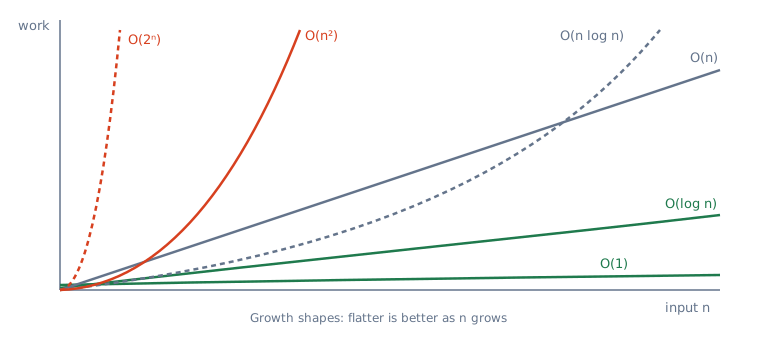
By the time you reach this page you can read a growth curve and write a bound. The question this page answers is the one that actually earns your salary: given a target Big-O, what do you build to hit it? Big-O is not trivia to recite — it is a decision tool that turns a performance requirement ("this lookup must stay fast at a billion keys") into a concrete data-structure and algorithm choice, before you write code. This is the bound-to-decision map.
If you need the growth classes themselves see Functions and Their Growth Rates; for the formal definition of O, Ω, Θ see Big-O Notation; to derive a bound from your own code see Understanding Time Complexity.
The cheat sheet: from required bound to the thing you build
| You need… | Reach for | and you accept… |
|---|---|---|
O(1) lookup by key | hash map / hash set | no ordering; O(n) worst case on collisions |
O(log n) lookup plus ordered scan / range / min-max | balanced BST (red-black, AVL) or skip list | a log-factor over the hash, more pointers |
O(log n) search on static data | sorted array + binary search | O(n) insert; must sort once up front |
| approximate membership, tiny memory | Bloom filter | a tunable false-positive rate |
the k largest of a stream of n | size-k min-heap, O(n log k) | nothing much — beats sorting all n |
to drop O(n2) pairwise work | sort-then-sweep, or a hash map | O(n log n) / extra O(n) space |
The skill is running this table in reverse under pressure: a colleague proposes a nested-loop pairwise scan (O(n2)) and you immediately ask "does a hash map collapse the inner loop to O(1), dropping us to O(n)?" — the single most common optimization in interviews and in real code.
The decision that most often comes back to bite: hash map vs balanced tree
Both store keyed data; the cheat sheet says hash for O(1), tree for O(log n)-with-order. Here is the judgment underneath, with the numbers at n = 1,000,000:
- Hash map — average lookup is
O(1), essentially 1 probe. But its worst case isO(n): if every key lands in one bucket (a pathological or adversarially crafted set of keys), a lookup degrades to scanning ~106 entries — a million-fold cliff from the average. It also gives you no order: no range queries, no in-order scan, no "next largest." - Balanced BST — every lookup is
O(log n) ≈ 20comparisons, guaranteed, worst case included, and you get ordered iteration and range queries for free.
The decision: hot-path point lookups on trusted input → hash map (that average O(1) is unbeatable). But choose the tree the moment you need ordered operations, a hard worst-case guarantee (latency SLOs), or resistance to adversarial input (a public endpoint where an attacker picks the keys). This is not academic: real hash-map implementations defend the cliff — Java 8's HashMap converts an over-full bucket into a red-black tree once it holds more than 8 collisions, precisely to cap the worst case at O(log n) instead of O(n).
The build-cost decision: does preprocessing pay off?
Binary search is O(log n) — but it demands a sorted array, an O(n log n) cost up front. When is that worth it versus just linearly scanning each query at O(n)? It depends entirely on how many queries you will run. For q queries over n items:
- Scan every time:
q · n. - Sort once, then binary-search:
n log n + q · log n.
Sorting wins when q·n > n log n + q·log n, i.e. q > n log n / (n − log n) ≈ log n for large n. At n = 106 that threshold is log2106 ≈ 20: if you will query the data more than ~20 times, pre-sort it; if it is a one-shot lookup, just scan. This is the general shape of every index decision — a build cost amortized over query volume — and stating the crossover, not just "indexes are faster," is what separates a design answer from a slogan.
Decision pitfalls
- Over-indexing. Choosing a balanced tree (
O(log n)) when you never need order and a hash (O(1)) would do is paying a log-factor for nothing. Match the structure to the operations you actually perform. - Ignoring the worst case on a public surface. Average
O(1)is the wrong guarantee when an adversary chooses the input; the worst case is the SLO. - Chasing an impossible class. If the answer depends on every element (a sum, a max, "does any element satisfy…"),
O(n)is the lower bound —O(n)is already optimal and hunting forO(log n)is wasted effort. Knowing when you have hit the floor is itself a decision.
Key takeaways
- Big-O is a design tool: a required bound maps to a concrete structure —
O(1)→hash,O(log n)+order→balanced tree, static search→sorted array, top-k→heap. - The recurring judgment is hash vs tree: hash for average
O(1)on trusted input; tree for ordered ops, worst-case guarantees, or adversarial resistance (a million-fold cliff atn = 106). - Preprocessing pays off by query volume: pre-sort for binary search once you will query more than ~
log ntimes (~20 at a million items). - Don't over-index, don't trust the average on a public surface, and recognize when
O(n)is already the optimal floor.
🤖 Don't fully get this? Learn it with Claude
Stuck on An Overview of Big-O? Open Claude, copy a block below, and it'll teach you this exact concept — visually and interactively.
Build the mental picture, not memorization.
I just read a lesson on **An Overview of Big-O** (DSA) and want to truly understand it. Explain An Overview of Big-O from first principles using ONE vivid real-world analogy and a visual mental model — draw it as ASCII art or a clear step-by-step diagram — with a concrete example using real numbers. Then ask me one question to check I got the mental picture, and wait for my reply. If you're unsure or a claim isn't standard, say so and reason from first principles instead of guessing.
Socratic — adapts to where you're stuck.
Teach me **An Overview of Big-O** interactively. Ask me ONE guiding question at a time, wait for my answer, and adapt to my confusion — build the idea with me step by step instead of explaining it all at once. If you're unsure or a claim isn't standard, say so and reason from first principles instead of guessing.
Active recall exposes what you missed.
Quiz me on **An Overview of Big-O** with 5 questions, easy to tricky, ONE at a time. Tell me if each answer is right; at the end, explain clearly what I got wrong and why. If you're unsure or a claim isn't standard, say so and reason from first principles instead of guessing.
Intuition + hook + flashcards for long-term memory.
Help me remember **An Overview of Big-O** for the long term: give the one-sentence intuition, a memorable hook/mnemonic, a tiny worked example, and 3 active-recall flashcards (Q -> A). If you're unsure or a claim isn't standard, say so and reason from first principles instead of guessing.