Understanding Data Structures
Understanding Data Structures
Imagine you have a pile of a thousand loose photographs. If you dump them in a shoebox, adding a new photo is trivial — you just toss it on top. But finding the one photo from your trip last spring means flipping through the entire box. Now imagine instead you slot every photo into a labeled album, one per numbered page. Finding page 738 is instant, but inserting a new photo between pages 300 and 301 forces you to shift every later photo down by one slot. Neither arrangement is "better" — each trades one kind of speed for another. That trade is the entire idea behind data structures.
A data structure is simply a deliberate arrangement of data in memory, chosen so that the operations you care about — searching, inserting, deleting, retrieving in order — are fast, while accepting that other operations you care about less will be slow. There is no universally best structure. There is only the best structure for the access pattern your problem demands.
A precise definition
A data structure is a way of organizing and storing data together with the set of operations defined on it, such that the operations have known, analyzable costs. Formally it has three parts:
- A logical model — how the data is conceptually related (a linear sequence, a hierarchy, a set of key-value pairs, a graph of connections).
- A physical layout — how that model is realized in memory. The same logical list can live in one contiguous block (an array) or as scattered nodes linked by pointers (a linked list). The layout is what determines real performance.
- An operation set with cost guarantees —
insert,delete,search,access, each with a time complexity expressed in Big-O, and a space cost.
We measure cost by counting the elementary operations (comparisons, pointer hops, element moves) as a function of the number of elements n, and we care about three regimes: the best case, the worst case (the guarantee), and the average case (typical behavior). Interviews and real systems live and die on the worst case.
A worked example: array vs. linked list, with the numbers
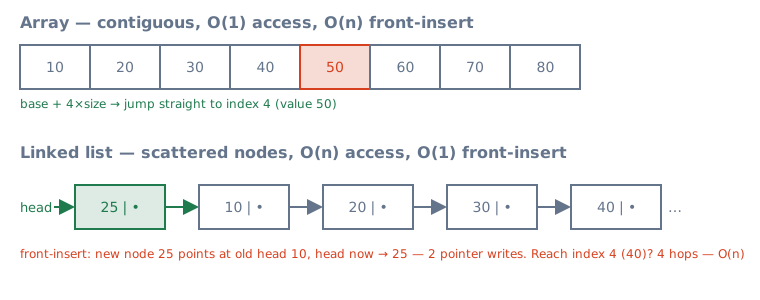
Let's make this concrete. Store 8 integers, then perform two operations, counting the actual work.
Setup: [10, 20, 30, 40, 50, 60, 70, 80], so n = 8.
Operation A — access the 5th element (index 4).
- Array: the element lives at
base_address + 4 × element_size. One multiply, one add, one memory read. Cost is constant, O(1), regardless of whethernis 8 or 8 million. This is random access, and it is the array's superpower. - Linked list: we must start at the head and follow
nextpointers: node1 → node2 → node3 → node4 → node5. That is 4 pointer hops to reach index 4. To reach the last element we'd take 7 hops. Access is O(n) — a linked list has no random access.
Operation B — insert value 25 at the front (index 0).
- Array: every existing element must slide right by one slot to make room: 80→slot8, 70→slot7, ... 10→slot1, then write 25 into slot0. That is 8 element moves. For a front-insert into an array of
nitems, the cost is n moves — O(n). - Linked list: create a new node holding 25, point its
nextat the old head, update head to the new node. That is 2 pointer writes and zero moves — O(1), whether the list has 8 or 8 million nodes.
So on the exact same data, the array wins access 4-hops-to-1 and the linked list wins front-insertion 8-moves-to-2. This single example is the whole lesson: the arrangement, not the data, decides the cost.
Common pitfalls and what an interviewer is really probing
- Confusing an abstract data type (ADT) with its implementation. A stack is an ADT — it promises LIFO order via
push/pop. It can be built on an array or a linked list. Interviewers probe this to see if you know that "which structure" and "which interface" are separate decisions. - Forgetting amortized cost. Appending to a dynamic array (Java
ArrayList, Go slice, Pythonlist) is usually O(1), but occasionally the array is full and must be copied to a block twice as large — an O(n) event. Because doublings are rare, the amortized cost per append is still O(1). Saying "append is always O(1)" without the word amortized is a classic miss. - Reciting Big-O while ignoring constants and memory. A hash map and a balanced tree both do lookups "fast," but a hash map is O(1) average / O(n) worst, while a tree is O(log n) guaranteed. On tiny
n, a linear scan of a contiguous array often beats both because it is cache-friendly and has no pointer overhead. Interviewers love to ask "what ifnis 10?" - Ignoring the worst case. Hash collisions, an already-sorted input to naive quicksort, a degenerate (unbalanced) BST — being unable to name the input that breaks your structure signals shallow understanding.
When it matters in practice, and the trade-offs
The choice of data structure is the highest-leverage decision in most programs — it fixes the complexity class before you write a single line of algorithm. Picking the right one can turn an O(n²) solution into O(n log n) or O(n), which is the difference between a request that returns in milliseconds and one that times out.
The recurring trade-offs cluster into a few axes:
- Access speed vs. modification speed. Contiguous arrays give O(1) indexed reads but O(n) middle inserts; linked structures flip this.
- Time vs. space. A hash map buys O(1) average lookup by spending extra memory on empty buckets; a bit-packed array saves memory but costs decode time.
- Average-case speed vs. worst-case guarantees. Hash map (O(1) avg, O(n) worst) vs. balanced BST (O(log n) guaranteed). A latency-sensitive system that cannot tolerate an occasional O(n) spike may prefer the tree's steady O(log n) even though it is slower on average.
- Ordering. Need elements in sorted order or range queries? A tree or skip list keeps order for free; a hash map throws ordering away entirely.
The professional habit is to start from the operation profile — "I do 1000 lookups per insert, order doesn't matter, worst case must stay bounded" — and let that profile select the structure, rather than reaching for a familiar one out of habit.
Key takeaways
- A data structure is a logical model plus a physical memory layout plus operations with known Big-O costs; the layout, not the data, determines real performance.
- There is no universally best structure — every one trades fast operations against slow ones (access vs. insert, time vs. space, average speed vs. worst-case guarantee).
- Always analyze best, worst, and average cases, and know the exact input that triggers your worst case; watch for amortized costs like dynamic-array resizing.
- Choose by starting from the operation profile of your problem — the mix and frequency of reads, writes, and ordering needs — and let that select the structure.
🤖 Don't fully get this? Learn it with Claude
Stuck on Understanding Data Structures? Open Claude, copy a block below, and it'll teach you this exact concept — visually and interactively.
Build the mental picture, not memorization.
I just read a lesson on **Understanding Data Structures** (DSA) and want to truly understand it. Explain Understanding Data Structures from first principles using ONE vivid real-world analogy and a visual mental model — draw it as ASCII art or a clear step-by-step diagram — with a concrete example using real numbers. Then ask me one question to check I got the mental picture, and wait for my reply. If you're unsure or a claim isn't standard, say so and reason from first principles instead of guessing.
Socratic — adapts to where you're stuck.
Teach me **Understanding Data Structures** interactively. Ask me ONE guiding question at a time, wait for my answer, and adapt to my confusion — build the idea with me step by step instead of explaining it all at once. If you're unsure or a claim isn't standard, say so and reason from first principles instead of guessing.
Active recall exposes what you missed.
Quiz me on **Understanding Data Structures** with 5 questions, easy to tricky, ONE at a time. Tell me if each answer is right; at the end, explain clearly what I got wrong and why. If you're unsure or a claim isn't standard, say so and reason from first principles instead of guessing.
Intuition + hook + flashcards for long-term memory.
Help me remember **Understanding Data Structures** for the long term: give the one-sentence intuition, a memorable hook/mnemonic, a tiny worked example, and 3 active-recall flashcards (Q -> A). If you're unsure or a claim isn't standard, say so and reason from first principles instead of guessing.