Analyzing Space Complexity of Algorithms
Analyzing Space Complexity of Algorithms
When you run an algorithm, it costs two things: time (how many operations) and space (how much memory). Space complexity answers a simple question: as the input grows, how does the memory the algorithm needs grow with it? Just like time complexity, we don't count exact bytes on your machine — we describe the shape of the growth using Big-O notation, so the answer stays true whether you run it on a laptop or a server.
The intuition: imagine you're sorting a stack of exam papers. If you can rearrange them on the same desk without needing a second table, your extra space is tiny and constant. But if for every paper you photocopy it onto a new sheet, you now need a second stack as big as the first — your extra space grows with the input. Space complexity is just a precise way of saying which of these you're doing.
Precise definition
The space complexity of an algorithm is the total memory it requires as a function of the input size n, expressed asymptotically (Big-O for an upper bound). It splits into two parts:
- Input space — the memory holding the input itself (e.g. the array you were handed). This is usually excluded when we care about the algorithm's own cost.
- Auxiliary space — the extra memory the algorithm allocates to do its work: temporary arrays, hash maps, and crucially the call stack for recursion.
In interviews and practice, when someone says "the space complexity," they almost always mean auxiliary space — the extra memory beyond the input. That is the number you control by design, so it is the one worth analyzing. Always state which you mean.
Worked example: counting the actual memory
Let's analyze two functions that both reverse an array of n integers, and count real allocations.
Version A — build a new reversed array:
- Allocate
result, a new array of sizen. That isninteger slots. - Loop and copy each element in. No other growing storage.
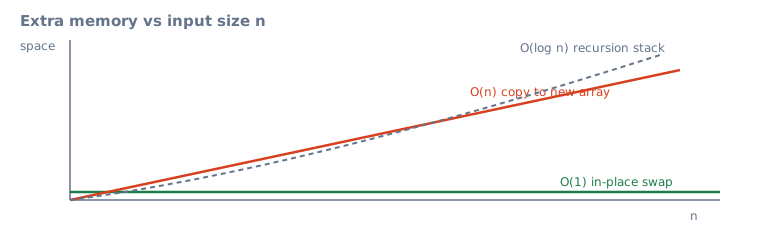
Auxiliary space = one array of size n + a loop counter (1 slot). Total extra = n + 1 slots. We drop the constant and the low-order term, giving O(n). For n = 1000 you allocate ~1000 extra slots; for n = 1,000,000 you allocate ~1,000,000. The extra memory scales linearly with input.
Version B — swap in place:
- Two index variables,
iandj(2 slots), and onetempfor the swap (1 slot). - Walk inward, swapping
a[i]witha[j]. No new array.
Auxiliary space = 3 slots, regardless of whether n is 10 or 10 million. That is O(1) — constant extra space. Same output, same O(n) time, but Version B uses dramatically less memory. This is the core lesson: two algorithms can agree on time and still differ sharply on space.
Recursion: the stack is memory too
The most-missed source of space is the call stack. Every pending recursive call keeps a stack frame alive — its parameters, locals, and return address — until it returns. So the space is the maximum depth of recursion, not the total number of calls.
- Binary search (recursive): each call halves the range, so the deepest chain is
log2nframes. Auxiliary space = O(log n), even though it does no explicit allocation. - Naive recursive factorial / linear recursion: depth
nframes stacked before any returns, so O(n) stack space — a real risk of stack overflow for largen. - Merge sort: O(n) for the merge buffers plus O(log n) stack depth = O(n) overall. Quicksort uses O(1) partitioning but O(log n) stack in the best/average case and O(n) stack in the worst case (already-sorted input with poor pivots).
A key distinction: recursion depth is often not the same as time. Binary search runs O(log n) time and O(log n) space; but a loop-based binary search is O(log n) time and O(1) space because it holds no frames.
Common pitfalls and what an interviewer probes
- Forgetting the recursion stack. Saying a recursive tree traversal is "O(1) space" is wrong — it is O(h), the tree height (O(log n) balanced, O(n) skewed). Interviewers love this.
- Confusing output space with auxiliary space. If the problem requires returning an array of size
n, that output is often not counted against you — but a scratch copy you made internally is. Be explicit about the boundary. - Ignoring hidden allocations. Slicing an array, building a hash set of all elements, string concatenation in a loop, or memoization tables all cost space. A DP solution with an
n×mtable is O(n·m) space unless you roll it to O(min(n,m)) by keeping only the last row. - Best vs worst vs average. State them when they differ. Quicksort stack: best/average O(log n), worst O(n). Hash-map approaches: average O(n), and O(n) worst too but with different constants.
- "Can you do it in-place?" This is a direct space-complexity challenge — the interviewer is asking you to reach O(1) auxiliary space, often trading a little time or clarity to get there.
When it matters and trade-offs
Space complexity becomes decisive when data is large relative to memory, on memory-constrained devices (embedded, mobile), or in systems processing streams that never fully fit in RAM. It also drives the classic time-space trade-off: you can often buy speed with memory, or save memory by spending time.
- Memoization / caching: spend O(n) space to cut exponential time to polynomial (e.g. Fibonacci from O(2n) time to O(n) time, O(n) space — then to O(1) space by keeping only two variables).
- Hash map lookups: "two-sum" in O(n) time uses O(n) space; the sort-and-two-pointer variant uses O(1) extra space but O(n log n) time. Neither is universally better — it depends on constraints.
- In-place algorithms minimize space but can complicate correctness and destroy the original input, which may itself be unacceptable.
Relative to neighboring classes: O(1) < O(log n) < O(n) < O(n log n) < O(n2). O(1) and O(log n) are "free" for practical purposes; O(n) is usually fine; O(n2) space (e.g. a full pairwise matrix) becomes a hard wall fast — 100,000 elements would need ~1010 slots, which is infeasible.
Key takeaways
- Space complexity = how auxiliary (extra) memory grows with input size, in Big-O; report auxiliary space and state clearly whether you're excluding input/output.
- Recursion costs space via the call stack — the cost is the maximum depth, so an allocation-free recursive function can still be O(log n) or O(n) in space.
- Time and space are independent axes: equal-time algorithms can differ from O(1) to O(n) space, and you can deliberately trade one for the other (memoization, in-place, hashing vs sorting).
- Always distinguish best/worst/average when they diverge (e.g. quicksort stack: O(log n) average, O(n) worst) and watch for hidden allocations in slices, hash sets, and DP tables.
🤖 Don't fully get this? Learn it with Claude
Stuck on Analyzing Space Complexity of Algorithms? Open Claude, copy a block below, and it'll teach you this exact concept — visually and interactively.
Build the mental picture, not memorization.
I just read a lesson on **Analyzing Space Complexity of Algorithms** (DSA) and want to truly understand it. Explain Analyzing Space Complexity of Algorithms from first principles using ONE vivid real-world analogy and a visual mental model — draw it as ASCII art or a clear step-by-step diagram — with a concrete example using real numbers. Then ask me one question to check I got the mental picture, and wait for my reply. If you're unsure or a claim isn't standard, say so and reason from first principles instead of guessing.
Socratic — adapts to where you're stuck.
Teach me **Analyzing Space Complexity of Algorithms** interactively. Ask me ONE guiding question at a time, wait for my answer, and adapt to my confusion — build the idea with me step by step instead of explaining it all at once. If you're unsure or a claim isn't standard, say so and reason from first principles instead of guessing.
Active recall exposes what you missed.
Quiz me on **Analyzing Space Complexity of Algorithms** with 5 questions, easy to tricky, ONE at a time. Tell me if each answer is right; at the end, explain clearly what I got wrong and why. If you're unsure or a claim isn't standard, say so and reason from first principles instead of guessing.
Intuition + hook + flashcards for long-term memory.
Help me remember **Analyzing Space Complexity of Algorithms** for the long term: give the one-sentence intuition, a memorable hook/mnemonic, a tiny worked example, and 3 active-recall flashcards (Q -> A). If you're unsure or a claim isn't standard, say so and reason from first principles instead of guessing.