Constant Space O1
Constant Space O(1)
Imagine you are asked to find the largest number in a list of a million values. You read them one at a time and keep a single sticky note that holds "the biggest I've seen so far." No matter whether the list has 10 numbers or 10 billion, you never need a second sticky note. Your extra memory is one fixed slot. That is the whole idea of constant space, written O(1): the amount of additional memory your algorithm uses does not grow as the input grows.
The key word is extra (or auxiliary) space, the scratch memory you allocate on top of the input. The input itself might be huge, but if your working memory is a fixed handful of variables, you are O(1) in space.
Precise definition
Let n be the size of the input. An algorithm uses O(1) auxiliary space if there exists a constant c (independent of n) such that the extra memory it allocates never exceeds c, for all input sizes. Formally, if S(n) is the auxiliary space used, then S(n) = O(1) means S(n) ≤ c for all n beyond some threshold.
Practically, O(1) space means a fixed number of variables: a few counters, pointers, indices, or accumulators, plus maybe a constant-size buffer. What it forbids is any structure whose size scales with n: a copy of the array, a hash set of seen elements, a recursion stack that grows with n, or an output that is proportional to the input. Note that O(1) does not mean "one byte" or "small", it means bounded by a constant, so 500 fixed variables is still O(1). What matters is that the count never depends on n.
Worked example: reversing an array in place
Reversing [10, 20, 30, 40, 50] (so n = 5) shows O(1) space concretely. The naive approach builds a new array of size n, which is O(n) space. The in-place two-pointer approach uses only three fixed variables regardless of n: left, right, and one temp for swapping.
- Init:
left = 0,right = 4. Extra slots allocated: 3 (left, right, temp). - Swap indices 0 and 4 →
[50,20,30,40,10]. Move toleft=1, right=3. - Swap indices 1 and 3 →
[50,40,30,20,10]. Move toleft=2, right=2. Pointers meet, stop.
We performed 2 swaps — ⌊n/2⌋ in general, and the middle element (index 2, value 30) is never touched — so time is O(n). But the extra memory stayed pinned at 3 variables. Try n = 1000: you do 500 swaps, yet you still allocate exactly 3 extra slots. Time grew; space did not. That decoupling, work scaling with n while memory stays flat, is the signature of an O(1)-space algorithm.
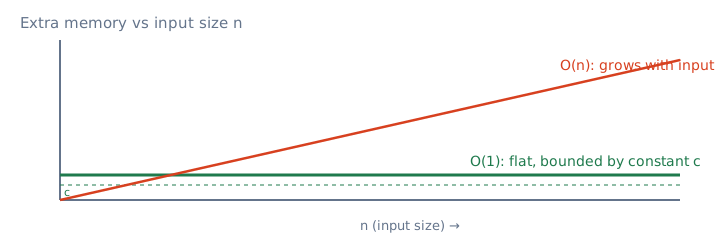
Step the debugger below through increasing values of n. Watch the O(1) curve stay pinned to the constant line while its O(n) and O(n2) neighbours climb away, this is the visual intuition worth burning in.
Common pitfalls and what an interviewer probes
- Confusing time with space. An algorithm can be O(n) time but O(1) space (the array reversal above), or O(1) time but O(n) space. They are independent axes. Interviewers love asking for the space complexity right after you give the time complexity to catch this.
- Forgetting the recursion stack. A recursive function that recurses to depth
nuses O(n) space on the call stack even if each frame is tiny. Recursive reversal is not O(1) space; the iterative two-pointer version is. Tail-call-free languages (like Python and Java) will not collapse that stack. - Counting the output. By convention we usually exclude the required input and output from auxiliary space. But if you allocate an intermediate copy or a
seenhash set, that counts, and it is often O(n). - "Sorting is free." An in-place sort like heapsort is O(1) auxiliary; but many quicksort implementations use O(log n) stack, and mergesort typically needs O(n). Know which one your language's library uses.
- Fixed-size structures that secretly depend on n. A boolean array of size 256 for ASCII is O(1). A count array of size
nis not. The probe: "does this structure's size depend on the input?"
When it matters, and trade-offs
O(1) space is precious in three settings: (1) huge or streaming data that cannot fit in RAM, where you must process one element at a time (running sum, running max, Boyer–Moore majority vote); (2) embedded / systems code with hard memory budgets; and (3) interviews, where "can you do it in constant space?" is the classic follow-up after a working solution.
The trade-off against neighbouring classes is usually space for time. Compared to O(n) space: two-sum solved with a hash set is O(n) time and O(n) space; solved by sorting first and using two pointers it is O(n log n) time but O(1) extra space. You often buy constant space by paying extra time (sorting, re-scanning) or by mutating the input in place. Compared to O(log n) space (typical of balanced-recursion algorithms like binary search's recursive form or quicksort's stack), O(1) is strictly leaner but sometimes forces an iterative rewrite. The honest rule: O(1) space is the gold standard when achievable cheaply, but do not contort an algorithm into constant space if it blows up the time complexity, an O(n) hash-set pass often beats an O(n log n) sort-to-save-space in real workloads.
Key takeaways
- O(1) space = auxiliary memory bounded by a constant, independent of input size
n; a fixed set of variables, not a growing structure. - It is orthogonal to time: the array-reversal example is O(n) time yet O(1) space; always state both axes.
- The usual killers of O(1) space are recursion depth, defensive copies, and hash sets/count arrays that scale with n, prefer iterative in-place two-pointer or running-accumulator patterns.
- Constant space is a time-vs-space trade: you often earn it by sorting or re-scanning; choose it when the memory win outweighs the added time.
🤖 Don't fully get this? Learn it with Claude
Stuck on Constant Space O1? Open Claude, copy a block below, and it'll teach you this exact concept — visually and interactively.
Build the mental picture, not memorization.
I just read a lesson on **Constant Space O1** (DSA) and want to truly understand it. Explain Constant Space O1 from first principles using ONE vivid real-world analogy and a visual mental model — draw it as ASCII art or a clear step-by-step diagram — with a concrete example using real numbers. Then ask me one question to check I got the mental picture, and wait for my reply. If you're unsure or a claim isn't standard, say so and reason from first principles instead of guessing.
Socratic — adapts to where you're stuck.
Teach me **Constant Space O1** interactively. Ask me ONE guiding question at a time, wait for my answer, and adapt to my confusion — build the idea with me step by step instead of explaining it all at once. If you're unsure or a claim isn't standard, say so and reason from first principles instead of guessing.
Active recall exposes what you missed.
Quiz me on **Constant Space O1** with 5 questions, easy to tricky, ONE at a time. Tell me if each answer is right; at the end, explain clearly what I got wrong and why. If you're unsure or a claim isn't standard, say so and reason from first principles instead of guessing.
Intuition + hook + flashcards for long-term memory.
Help me remember **Constant Space O1** for the long term: give the one-sentence intuition, a memorable hook/mnemonic, a tiny worked example, and 3 active-recall flashcards (Q -> A). If you're unsure or a claim isn't standard, say so and reason from first principles instead of guessing.