Recurrence Relation Method
Recurrence Relation Method
When a function calls itself, its running time is defined in terms of itself. That circularity is the whole difficulty: you can't just count a loop, because the "loop body" is another copy of the same problem on smaller input. The recurrence relation method is the technique for writing that self-reference down as an equation and then unrolling it into a closed-form Big-O. Think of it as reading a recursive function's cost the way the function actually runs: do a little work here, then spawn smaller versions of yourself, and add up everything across all the levels of that spawning.
Precise definition
A recurrence relation expresses T(n), the cost on input size n, using T evaluated at smaller sizes, plus the non-recursive work done at this call. The two ingredients are always:
- The recursive term — how many subproblems and how big. Written
a·T(n/b)(divide-and-conquer, e.g.2T(n/2)) orT(n-k)(decrease-and-conquer, e.g.T(n-1)). - The local work
f(n)— everything the call does outside the recursive calls: partitioning, merging, a single comparison, a loop. - A base case —
T(0)orT(1) = O(1), where recursion stops. Without it the equation has no anchor and no solution.
So a full recurrence looks like T(n) = 2T(n/2) + O(n) with T(1) = O(1). Solving it means finding a non-recursive formula for T(n) and reporting its growth rate.
Worked example: merge sort, counted exactly
Merge sort splits an array in half, sorts each half recursively, then merges. Merging n elements costs about n comparisons/moves, so:
T(n) = 2T(n/2) + n, T(1) = 0.
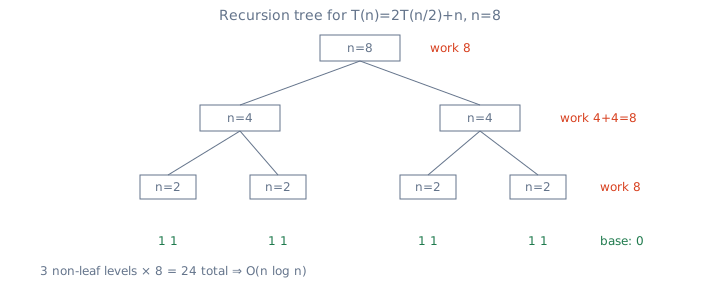
Solve by unrolling (repeated substitution). Take n = 8:
- Level 0: one problem of size 8 → merge work
= 8. - Level 1: two problems of size 4 → merge work
= 2×4 = 8. - Level 2: four problems of size 2 → merge work
= 4×2 = 8. - Level 3: eight problems of size 1 → base case, work
= 0.
Every non-leaf level does exactly n = 8 units of work. The number of levels is log₂8 = 3. Total = 8 × 3 = 24, and in general T(n) = n·log₂n, i.e. O(n log n). The pattern is the key insight: total cost = (work per level) × (number of levels), and the number of levels is how many times you divide n down to 1.
Three canonical shapes to recognise on sight
T(n) = T(n-1) + O(1)→ O(n). One shrinking call, constant local work: linear recursion (sum a list).nlevels, O(1) each.T(n) = T(n-1) + O(n)→ O(n²). Levels don, n-1, …, 1work — an arithmetic series summing ton(n+1)/2(e.g. naive quadratic selection).T(n) = 2T(n-1) + O(1)→ O(2ⁿ). Branching factor 2 with depthndoubles the node count each level (Towers of Hanoi, subset enumeration). Naive Fibonacci is the looser shapeT(n) = T(n-1) + T(n-2) + O(1)— bounded above by2T(n-1), but its tight growth isΘ(φⁿ) ≈ Θ(1.618ⁿ), not2ⁿ. Contrast this sharply with2T(n/2), which only haslog nlevels — halving the input is worlds apart from decrementing it.
For divide-and-conquer T(n)=aT(n/b)+O(n⁽), the Master Theorem is the shortcut: compare n⁽ against n^(log_b a). Larger exponent wins; a tie adds a log n factor. Merge sort is the tie case (log₂2 = 1 = c) → O(n log n).
Pitfalls interviewers probe
- Forgetting the base case makes the recurrence meaningless — and in code, an infinite recursion / stack overflow. They will ask "what stops it?"
- Miscounting local work. If each call does a linear scan, the term is
+O(n), not+O(1). Quicksort's partition isO(n); that single fact drives its whole analysis. - Confusing branch count with depth.
2T(n/2)and2T(n-1)both "call twice," but one isn log nand the other exponential. Interviewers love this trap. - Ignoring the recursion-stack space cost. Even an
O(n)-time linear recursion usesO(n)stack space; balanced divide-and-conquer usesO(log n)depth. - Unbalanced splits. Quicksort's worst case is a pivot that splits
n-1/0, givingT(n)=T(n-1)+O(n) = O(n²); balanced splits give theO(n log n)average. Same code, different recurrence.
When it matters + trade-offs
The recurrence method is how you predict an algorithm's class before coding it, and how you justify a design choice. Its practical payoff is seeing the boundary between complexity classes: memoising naive Fibonacci (T(n-1)+T(n-2)+O(1), tight Θ(φⁿ)) makes every subproblem compute once, collapsing exponential growth to O(n) — the entire point of dynamic programming is rewriting a bad recurrence into a good one. It also exposes the best/worst/average gap: quicksort is O(n log n) average but O(n²) worst, so we randomise the pivot to make the balanced recurrence overwhelmingly likely.
Trade-off vs neighbours: an O(n log n) divide-and-conquer sort beats an O(n²) one massively at scale, but the recursion carries constant-factor and O(log n) stack overhead — for tiny n, an O(n²) insertion sort with no call overhead actually wins, which is why real sort libraries switch to it below a threshold.
Key takeaways
- A recurrence = recursive term + local work + base case; solve it as (work per level) × (number of levels), which the recursion tree makes visible.
- Halving the input gives
log nlevels; decrementing givesnlevels — so2T(n/2)+nisO(n log n)but2T(n-1)isO(2ⁿ). Never confuse branch count with depth. - Use the Master Theorem as a shortcut for
aT(n/b)+O(n⁽): comparectolog_b a; the tie case adds alog nfactor. - Recurrences reveal the best/worst/average gap and the DP payoff — rewriting a branching recurrence into a linear one is the core optimisation move.
🤖 Don't fully get this? Learn it with Claude
Stuck on Recurrence Relation Method? Open Claude, copy a block below, and it'll teach you this exact concept — visually and interactively.
Build the mental picture, not memorization.
I just read a lesson on **Recurrence Relation Method** (DSA) and want to truly understand it. Explain Recurrence Relation Method from first principles using ONE vivid real-world analogy and a visual mental model — draw it as ASCII art or a clear step-by-step diagram — with a concrete example using real numbers. Then ask me one question to check I got the mental picture, and wait for my reply. If you're unsure or a claim isn't standard, say so and reason from first principles instead of guessing.
Socratic — adapts to where you're stuck.
Teach me **Recurrence Relation Method** interactively. Ask me ONE guiding question at a time, wait for my answer, and adapt to my confusion — build the idea with me step by step instead of explaining it all at once. If you're unsure or a claim isn't standard, say so and reason from first principles instead of guessing.
Active recall exposes what you missed.
Quiz me on **Recurrence Relation Method** with 5 questions, easy to tricky, ONE at a time. Tell me if each answer is right; at the end, explain clearly what I got wrong and why. If you're unsure or a claim isn't standard, say so and reason from first principles instead of guessing.
Intuition + hook + flashcards for long-term memory.
Help me remember **Recurrence Relation Method** for the long term: give the one-sentence intuition, a memorable hook/mnemonic, a tiny worked example, and 3 active-recall flashcards (Q -> A). If you're unsure or a claim isn't standard, say so and reason from first principles instead of guessing.