Sorting Algorithms
Sorting Algorithms
Sorting is the act of rearranging a collection so its elements follow a defined order — usually ascending numbers or lexicographic strings. It feels mundane, but it is the single most studied problem in computing, and for a systems-minded interviewer it is a lens onto everything else: recursion, invariants, memory layout, cache behaviour, and the difference between an algorithm's asymptotic cost and its real-world speed. The deep insight is that once data is sorted, dozens of other operations collapse from linear or quadratic work down to logarithmic: binary search, deduplication, finding the median, detecting duplicates, merging streams, range queries. So we do not sort for its own sake — we sort to make everything downstream cheap.
Precise definition
Given a sequence a0, a1, …, an-1 and a total order ≤ (a comparison that is reflexive, antisymmetric, transitive, and total — any two elements are comparable), a sorting algorithm produces a permutation of the input such that b0 ≤ b1 ≤ … ≤ bn-1. Two properties matter beyond correctness:
- Stability — equal keys keep their original relative order. Essential when you sort by one field then another (sort by name, then stably by age → names stay ordered within each age).
- In-place — uses only
O(1)orO(log n)extra memory beyond the input, rather than allocating a second array.
Comparison sorts only ask "is x ≤ y?". A classic decision-tree argument proves any comparison sort needs at least ⌈log2(n!)⌉ ≈ n log n comparisons in the worst case — so O(n log n) is a hard floor for that whole family. Non-comparison sorts (counting, radix, bucket) exploit the structure of keys and can beat it.
The core algorithms at a glance
- Bubble / Insertion / Selection — simple,
O(n2)average. Insertion sort is the standout:O(n)on nearly-sorted data, stable, in-place, and the workhorse real libraries switch to for tiny subarrays (~10–16 elements) because its low constant factor beats recursion overhead. - Merge sort —
O(n log n)in all cases (best = worst = average), stable, but needsO(n)scratch space. Divide in half, sort each half, merge. - Quicksort —
O(n log n)average,O(n2)worst case (already-sorted input with a naive pivot), in-place, not stable. Fastest in practice due to cache-friendly sequential access and tiny constants. - Heapsort —
O(n log n)worst case, in-place, not stable. Poor cache locality makes it slower in practice than quicksort, but its guaranteed bound makes it a safety net. - Counting / Radix —
O(n + k)/O(d·(n + b)). Linear time when keys are bounded integers; sidesteps then log nfloor entirely.
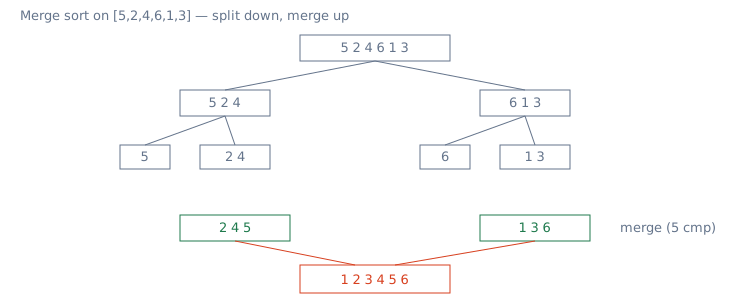
Worked example: merge sort on [5, 2, 4, 6, 1, 3], counting every operation
Merge sort splits until singletons, then merges sorted runs. Splitting [5,2,4,6,1,3] → [5,2,4] and [6,1,3], each again down to single elements. Now we merge back up:
- Merge [5]+[2] → compare 5 vs 2 (1 comparison) →
[2,5]. - Merge [2,5]+[4] → 2vs4 keep 2, 5vs4 keep 4, append 5 (2 comparisons) →
[2,4,5]. - Merge [6]+[1] → 1 comparison →
[1,6]. - Merge [1,6]+[3] → 1vs3 keep 1, 6vs3 keep 3, append 6 (2 comparisons) →
[1,3,6]. - Final merge [2,4,5]+[1,3,6] → 2vs1→1, 2vs3→2, 4vs3→3, 4vs6→4, 5vs6→5, append 6 (5 comparisons) →
[1,2,3,4,5,6].
Total: 11 comparisons. The theoretical lower bound is ⌈log2(6!)⌉ = ⌈9.49⌉ = 10, so merge sort is within one comparison of optimal here. Contrast bubble sort on the same input: it needs roughly n2/2 ≈ 15 comparisons and up to 15 swaps. As n grows the gap explodes — at n = 1,000,000, n log n ≈ 2×10⁷ versus n2 = 1012, a 50,000× difference.
Common pitfalls and what an interviewer probes
- "What's quicksort's worst case, and how do you avoid it?" —
O(n2)when the pivot is always the min/max, e.g. picking the first element on already-sorted data. Fix: randomized pivot or median-of-three, which makes the bad case astronomically unlikely. This is the most common quicksort gotcha. - Stability confusion — candidates claim quicksort or heapsort is stable. Neither is (partitioning and heap swaps reorder equal keys). Merge sort, insertion sort, and counting sort are stable.
- "Can you sort faster than
O(n log n)?" — Yes, but only by leaving the comparison model. If you can, name counting/radix sort and state the assumption: keys must be integers (or mappable) in a bounded range. - Recursion depth — naive quicksort can recurse
O(n)deep and blow the stack; recurse on the smaller partition and loop on the larger to cap depth atO(log n). - Space honesty — merge sort is not in-place; saying so signals rigour. "In-place merge" exists but is complex and slow.
When it matters in practice + trade-offs
Real standard libraries do not use one textbook algorithm — they use hybrids tuned to reality. Java's Arrays.sort for objects and Python's sorted both use Timsort: merge sort that detects pre-existing sorted "runs" (real data is often partially ordered) and falls back to insertion sort for small runs — stable, O(n) best case, O(n log n) worst. C++ std::sort and Go's slices.Sort use introsort: quicksort for speed, switching to heapsort once recursion gets too deep to guarantee the O(n log n) worst-case bound, plus insertion sort at the leaves.
Choosing between the neighbouring complexity classes:
- Need a hard worst-case guarantee (real-time, adversarial input)? Heapsort or merge sort — never plain quicksort.
- Need stability (multi-key sorts, preserving insertion order)? Merge sort / Timsort.
- Memory-constrained, want raw speed on random data? Quicksort / introsort — in-place and cache-friendly.
- Bounded integer keys (ages, byte values, IDs)? Counting or radix sort for linear
O(n)time — dropping fromn log ntonis the same kind of leap as sorting made possible for search. - Tiny arrays (n < ~16)? Insertion sort wins on constant factors — which is exactly why the big algorithms delegate to it.
Key takeaways
- Comparison sorts cannot beat
O(n log n)— it is a proven lower bound from thelog(n!)decision-tree argument; only non-comparison sorts (counting/radix) escape it, and only for bounded-range keys. - Know the trade-off triangle: merge sort gives stability + guaranteed
O(n log n)but costsO(n)space; quicksort is fastest and in-place but has anO(n2)worst case and no stability; heapsort guaranteesO(n log n)in-place but sacrifices cache locality and stability. - Production sorts are hybrids — Timsort (stable, run-aware) and introsort (quicksort + heapsort fallback + insertion-sort leaves) — because constant factors, partial order, and worst-case safety all matter beyond asymptotics.
- We sort mainly to make downstream operations cheap: search, dedup, median, and merges all drop to logarithmic or linear once order exists.
🤖 Don't fully get this? Learn it with Claude
Stuck on Sorting Algorithms? Open Claude, copy a block below, and it'll teach you this exact concept — visually and interactively.
Build the mental picture, not memorization.
I just read a lesson on **Sorting Algorithms** (DSA) and want to truly understand it. Explain Sorting Algorithms from first principles using ONE vivid real-world analogy and a visual mental model — draw it as ASCII art or a clear step-by-step diagram — with a concrete example using real numbers. Then ask me one question to check I got the mental picture, and wait for my reply. If you're unsure or a claim isn't standard, say so and reason from first principles instead of guessing.
Socratic — adapts to where you're stuck.
Teach me **Sorting Algorithms** interactively. Ask me ONE guiding question at a time, wait for my answer, and adapt to my confusion — build the idea with me step by step instead of explaining it all at once. If you're unsure or a claim isn't standard, say so and reason from first principles instead of guessing.
Active recall exposes what you missed.
Quiz me on **Sorting Algorithms** with 5 questions, easy to tricky, ONE at a time. Tell me if each answer is right; at the end, explain clearly what I got wrong and why. If you're unsure or a claim isn't standard, say so and reason from first principles instead of guessing.
Intuition + hook + flashcards for long-term memory.
Help me remember **Sorting Algorithms** for the long term: give the one-sentence intuition, a memorable hook/mnemonic, a tiny worked example, and 3 active-recall flashcards (Q -> A). If you're unsure or a claim isn't standard, say so and reason from first principles instead of guessing.