Big-Theta Notation Θ-notation
Big-Theta Notation (Θ-notation)
When we talk about how fast an algorithm runs, we don't count seconds — hardware, language, and compiler make seconds meaningless for comparing algorithms. Instead we count how the number of basic operations grows as the input size n grows. Big-Theta is the tool that pins that growth down from both sides: it says a running time grows exactly like some function, no faster and no slower, once n is large enough.
The intuition: Big-O gives an upper bound ("grows no faster than"), Big-Omega (Ω) gives a lower bound ("grows no slower than"), and Θ sandwiches the two together — it is a tight bound. Saying an algorithm is Θ(n2) is a stronger, more honest claim than saying it is O(n2): O(n2) would still be technically true of an O(n) algorithm, but Θ(n2) means it really does scale quadratically — double n, and work roughly quadruples.
Precise definition
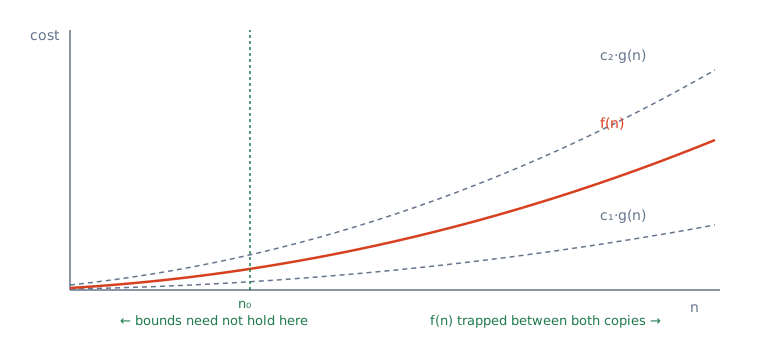
We say f(n) = Θ(g(n)) if there exist positive constants c1, c2, and a threshold n0 such that for all n ≥ n0:
0 ≤ c1·g(n) ≤ f(n) ≤ c2·g(n)
In words: beyond some input size n0, the actual cost f(n) is trapped between two scaled copies of g(n). The lower copy (c1·g) is the Ω part; the upper copy (c2·g) is the O part. So the classic identity is:
f(n) = Θ(g(n)) ⟺ f(n) = O(g(n)) and f(n) = Ω(g(n))
Two things this definition deliberately ignores: (1) constant factors — c1 and c2 absorb them, so 3n and 100n are both Θ(n); and (2) small inputs — the n ≥ n0 clause lets lower-order terms and startup quirks fall away. This is why we drop constants and keep only the dominant term: 5n2 + 30n + 7 is Θ(n2), because as n grows the n2 term dwarfs the rest.
Worked example: counting operations exactly
Take a function that sums every element of an array and then, separately, checks each pair once (a common inner-loop shape):
- Setup: initialise
total = 0andpairs = 0— 2 operations, constant. - First loop over
nelements: each iteration does 1 read + 1 add = 2 ops → 2n operations. - Nested loop comparing element
iwith every later elementj: the inner body runs(n−1) + (n−2) + … + 1 = n(n−1)/2times, at 1 op each → n(n−1)/2 = 0.5n2 − 0.5n operations.
Total: f(n) = 0.5n2 − 0.5n + 2n + 2 = 0.5n2 + 1.5n + 2.
Now bound it. Pick g(n) = n2. For the upper side, for n ≥ 1 we have 0.5n2 + 1.5n + 2 ≤ 0.5n2 + 1.5n2 + 2n2 = 4n2, so c2 = 4 works. For the lower side, 0.5n2 + 1.5n + 2 ≥ 0.5n2 always, so c1 = 0.5 works. With c1=0.5, c2=4, n0=1 the sandwich holds, so f(n) = Θ(n2). Concretely: at n=1000 the 0.5n2 term is 500,000 while the rest is only ~1,502 — the quadratic term is 99.7% of the work. That is what "Θ(n2)" is telling you.
Common pitfalls & what an interviewer probes
- Confusing Θ with O. Most people say "O(n2)" when they mean Θ. O is only an upper bound —
nis genuinely O(n2). An interviewer will ask "is that tight?" to see if you know the difference. If the bound is tight, Θ is the precise word. - Applying Θ to an algorithm whose best and worst cases differ. Θ describes a function, not automatically "the algorithm." Insertion sort is Θ(n) on already-sorted input (best case) but Θ(n2) on reversed input (worst case). You cannot write a single Θ for its overall running time because no one function bounds it from both sides across all inputs. You can say "worst case is Θ(n2), best case is Θ(n)." Interviewers love this trap.
- Best/worst/average vs Θ/O/Ω. These are two independent axes. "Best case" picks which input; Θ/O/Ω describe how tightly you bound the chosen case's function. You can give a Θ (tight) bound on the worst case, or a loose O bound on the average case.
- Dropping the wrong term. Keep the fastest-growing term, drop constants and lower terms — but only lower-order ones.
n2 + n log nis Θ(n2);n log nis not negligible againstnbut is againstn2. - Ignoring what
nis. For graph algorithms Θ(V + E) has two variables; collapsing to one is a classic error.
When it matters in practice & trade-offs
Θ tells you the shape of the scaling curve, which is what decides whether an algorithm survives at scale. Θ(n) vs Θ(n log n) vs Θ(n2) is the difference between an operation that stays fast at a billion elements and one that melts. Ordering of the common classes, best to worst: Θ(1) < Θ(log n) < Θ(n) < Θ(n log n) < Θ(n2) < Θ(2n) < Θ(n!).
But asymptotics hide the constants — and constants matter for the inputs you actually run. A Θ(n2) algorithm with a tiny constant can beat a Θ(n log n) one for small n; this is exactly why real sort libraries (e.g. Timsort, introsort) switch to insertion sort for small subarrays even though it is asymptotically worse. So the trade-off is: Θ predicts the winner as n → ∞, not necessarily at your n. Also, a lower Θ often costs memory (hash table for Θ(1) lookup) or code complexity — the judgment call is whether your input sizes and constraints justify it. Use Θ to reason about scaling; benchmark to settle the small-n, constant-factor fights.
Key takeaways
- Θ is a tight, two-sided bound:
f = Θ(g)meansf = O(g)andf = Ω(g)— it grows exactly likeg, up to constant factors and beyond somen0. - To prove it, find constants
c1, c2, n0withc1g(n) ≤ f(n) ≤ c2g(n); in practice, keep the dominant term and drop constants. - Θ describes a function, not always "the algorithm": when best and worst cases differ (insertion sort: Θ(n) best, Θ(n2) worst), state the case you mean — the case axis and the bound-tightness axis are independent.
- Θ predicts scaling as
n → ∞, not small-nperformance: constant factors and memory trade-offs still decide real-world speed, so reason with Θ but benchmark to finish the argument.
🤖 Don't fully get this? Learn it with Claude
Stuck on Big-Theta Notation Θ-notation? Open Claude, copy a block below, and it'll teach you this exact concept — visually and interactively.
Build the mental picture, not memorization.
I just read a lesson on **Big-Theta Notation Θ-notation** (DSA) and want to truly understand it. Explain Big-Theta Notation Θ-notation from first principles using ONE vivid real-world analogy and a visual mental model — draw it as ASCII art or a clear step-by-step diagram — with a concrete example using real numbers. Then ask me one question to check I got the mental picture, and wait for my reply. If you're unsure or a claim isn't standard, say so and reason from first principles instead of guessing.
Socratic — adapts to where you're stuck.
Teach me **Big-Theta Notation Θ-notation** interactively. Ask me ONE guiding question at a time, wait for my answer, and adapt to my confusion — build the idea with me step by step instead of explaining it all at once. If you're unsure or a claim isn't standard, say so and reason from first principles instead of guessing.
Active recall exposes what you missed.
Quiz me on **Big-Theta Notation Θ-notation** with 5 questions, easy to tricky, ONE at a time. Tell me if each answer is right; at the end, explain clearly what I got wrong and why. If you're unsure or a claim isn't standard, say so and reason from first principles instead of guessing.
Intuition + hook + flashcards for long-term memory.
Help me remember **Big-Theta Notation Θ-notation** for the long term: give the one-sentence intuition, a memorable hook/mnemonic, a tiny worked example, and 3 active-recall flashcards (Q -> A). If you're unsure or a claim isn't standard, say so and reason from first principles instead of guessing.