Comparing Asymptotic Notations
Comparing Asymptotic Notations
You already know the three big letters: O (Big-O, an upper bound), Ω (Big-Omega, a lower bound), and Θ (Big-Theta, a tight bound). This lesson is about the next skill interviewers actually test: given two functions or two notations, which one grows faster, and are they in the same class or not. Confusing "my algorithm is O(n2)" with "my algorithm is Θ(n2)" is one of the most common ways candidates lose credibility. Comparing is the tool that keeps you honest.
1. The plain-language intuition
Asymptotic notation describes how a cost function behaves as the input n heads toward infinity. Constants and low-order terms wash out, so 3n2 + 100n + 5 and n2 are treated as the same growth. Comparing two functions means asking a single question: as n gets huge, does one eventually and permanently dwarf the other, or do they stay locked together within a constant factor?
Think of it as a race with no finish line. We do not care who leads at n = 5. We care who is ahead once n is large enough and stays ahead forever after. A function that starts behind but has a steeper curve always wins the asymptotic race.
2. Precise definitions and the ordering
Let f(n) and g(n) be non-negative. The three notations are sets of functions:
f = O(g): there exist constantsc > 0andn0such thatf(n) ≤ c·g(n)for alln ≥ n0. (g is an upper bound on f — f grows no faster.)f = Ω(g): there existc > 0,n0withf(n) ≥ c·g(n)forn ≥ n0. (g is a lower bound — f grows no slower.)f = Θ(g): both hold at once —f = O(g)andf = Ω(g). (Same growth, tight.)
A clean way to compare two functions is the limit test. Let L = limn→∞ f(n)/g(n):
L = 0→ f grows strictly slower →f = O(g)but not Θ; equivalentlyf = o(g)(little-o).L = ∞→ f grows strictly faster →f = Ω(g)but not Θ; equivalentlyf = ω(g)(little-omega).0 < L < ∞→ same class →f = Θ(g).
The standard ranking of common classes, slowest-growing first:
1 < log n < √n < n < n log n < n2 < n3 < 2n < n! < nn
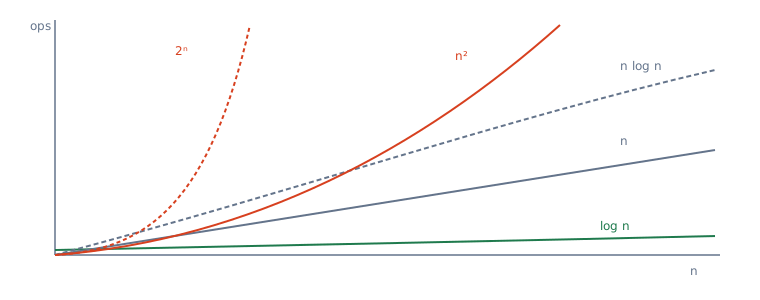
3. Worked example: comparing two real cost functions
Suppose algorithm A costs f(n) = 100n + 500 and algorithm B costs g(n) = 2n2. Which is asymptotically better, and where do they cross?
Cross-over by counting: set the operation counts equal, 100n + 500 = 2n2. At n = 10: A = 1500, B = 200 → B wins. At n = 50: A = 5500, B = 5000 → B still wins, barely. At n = 55: A = 6000, B = 6050 → A overtakes. From n ≥ 55 onward, A is permanently cheaper and the gap only widens: at n = 1000, A = 100,500 while B = 2,000,000 — B costs ~20× more.
Limit test confirms it: lim f/g = lim (100n + 500)/(2n2) = 0, so f = o(g) — A is strictly lower order. The verdict is asymptotic: f = O(g), g = Ω(f), and they are not Θ of each other. The lesson interviewers want you to internalize: B's smaller constant (2 vs 100) buys it an early lead, but a lower growth class always wins eventually. Constants decide the cross-over point; the exponent decides the war.
4. Pitfalls and what an interviewer probes
- O is an upper bound, not "the" running time. Every algorithm that is
Θ(n)is alsoO(n2)andO(2n)— all true, all loose. Interviewers ask "can you make that tighter?" to see if you reach for Θ. Saying Θ when you mean it signals rigor. - Best / worst / average are separate axes from O/Ω/Θ. They are commonly conflated but orthogonal. Quicksort is
Θ(n log n)average andΘ(n2)worst case. You can state a tight Θ bound for a specific case. "Ω = best case" is a myth — you can give an Ω bound on the worst case too. - Bases of logs do not matter (
log2n = log10n / log102, a constant factor), so we just writelog n. But the base of an exponent matters hugely:3nis notO(2n). - n log n vs n: a frequent trap.
lim (n log n)/n = lim log n = ∞, son log nis strictly worse than linear — not the same class. - Dropping the wrong term. In
n2 + n log nthe dominant term isn2; the sum is Θ(n2). Always keep the fastest-growing term only.
5. When comparison matters in practice + trade-offs
Asymptotics predict the future, not the present. For small or bounded n, constants and cache behavior dominate — which is exactly why real libraries pick the lower class only past a threshold:
- Sorting: introsort/Timsort fall back to insertion sort (
Θ(n2)) for tiny sub-arrays (n < ~16) because its small constants beatΘ(n log n)merge/quicksort below the cross-over. The asymptotically "worse" algorithm is genuinely faster there. - Neighbouring classes are worth a real jump: going from
Θ(n2)toΘ(n log n)turns a 10,000-element task from ~108 to ~105 ops — a 1000× win at scale. FromΘ(2n)toΘ(n2)is the difference between "never finishes" and "instant." - Trade-off honesty: a hash table is
Θ(1)average lookup butΘ(n)worst case; a balanced BST isΘ(log n)guaranteed. If worst-case latency matters (real-time systems), the "slower" average class is the right call. Comparing classes is only step one — comparing which case you actually face is step two.
Key takeaways
- Compare by growth, not by value at small n: use the limit
L = lim f/g—0means f is smaller-order (O, o),∞means larger-order (Ω, ω), and a finite positiveLmeans same class (Θ). - Constants set the cross-over point; the growth class wins the war. A smaller constant only buys an early lead, as
100n+500beating2n2only past n = 55 shows. - O / Ω / Θ are bounds; best / worst / average are cases — two independent axes. Always reach for the tight Θ on a named case, and never claim Ω means "best case."
- In practice, prefer the lower class past the cross-over, but let the required case and constants decide below it — which is why fast sorts fall back to insertion sort for tiny inputs.
🤖 Don't fully get this? Learn it with Claude
Stuck on Comparing Asymptotic Notations? Open Claude, copy a block below, and it'll teach you this exact concept — visually and interactively.
Build the mental picture, not memorization.
I just read a lesson on **Comparing Asymptotic Notations** (DSA) and want to truly understand it. Explain Comparing Asymptotic Notations from first principles using ONE vivid real-world analogy and a visual mental model — draw it as ASCII art or a clear step-by-step diagram — with a concrete example using real numbers. Then ask me one question to check I got the mental picture, and wait for my reply. If you're unsure or a claim isn't standard, say so and reason from first principles instead of guessing.
Socratic — adapts to where you're stuck.
Teach me **Comparing Asymptotic Notations** interactively. Ask me ONE guiding question at a time, wait for my answer, and adapt to my confusion — build the idea with me step by step instead of explaining it all at once. If you're unsure or a claim isn't standard, say so and reason from first principles instead of guessing.
Active recall exposes what you missed.
Quiz me on **Comparing Asymptotic Notations** with 5 questions, easy to tricky, ONE at a time. Tell me if each answer is right; at the end, explain clearly what I got wrong and why. If you're unsure or a claim isn't standard, say so and reason from first principles instead of guessing.
Intuition + hook + flashcards for long-term memory.
Help me remember **Comparing Asymptotic Notations** for the long term: give the one-sentence intuition, a memorable hook/mnemonic, a tiny worked example, and 3 active-recall flashcards (Q -> A). If you're unsure or a claim isn't standard, say so and reason from first principles instead of guessing.