Constant Time O1
Constant Time O(1)
The intuition: an operation is constant time when it takes the same amount of work no matter how big your data is. Whether your array holds 10 items or 10 billion, the operation costs the same fixed number of steps. It does not read the whole input; it jumps straight to the answer.
The classic picture: you have a wall of numbered mailboxes. To fetch the letter in box #4,782 you do not walk past every box counting — you go directly to that box. One motion. Add a million more boxes and fetching #4,782 still takes exactly one motion. That directness is what O(1) captures.
Precise definition
We say an operation runs in O(1) time if its running time is bounded above by a constant that does not depend on the input size n. Formally: there exists a constant c > 0 and a threshold n0 such that for all n ≥ n0, the number of steps T(n) ≤ c.
Two things people get wrong here:
- O(1) does not mean "one step" or "fast." It means a fixed number of steps — that could be 1 or 5,000. A routine doing 5,000 operations regardless of
nis stillO(1). Big-O hides constants deliberately; it describes growth, not raw speed. - The bound must hold as
ngrows. If the step count creeps up withn— even slowly — it is notO(1).
Worked example: counting the actual operations
Consider fetching the last element of an array and comparing two array lookups.
Task A — return the first element:
return arr[0]
Step count for n = 5: 1 index computation + 1 memory read + 1 return = 3 operations.
Step count for n = 5,000,000: 1 + 1 + 1 = 3 operations.
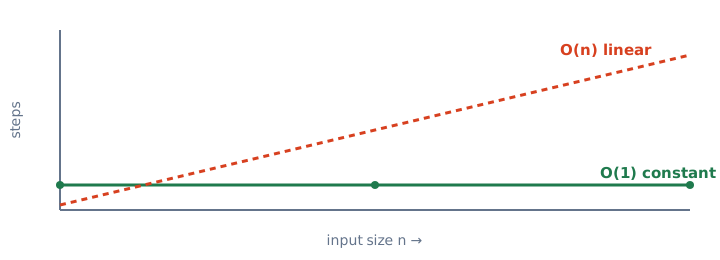
The count is identical — flat at 3 regardless of n. That flat line is O(1). (The constant is 3, but Big-O drops it: O(3) = O(1).)
Task B — sum every element: for i in 0..n: total += arr[i].
For n = 5 that is 5 additions; for n = 5,000,000 it is 5,000,000 additions. The count scales with n — that is O(n), linear, our contrast case.
Array indexing is O(1) because address = base + i × elementSize: one multiply, one add, one fetch — arithmetic that never grows with n.
Pitfalls an interviewer probes
- "Amortized O(1)" vs "worst-case O(1)." Appending to a dynamic array (Java
ArrayList, Goappend, Pythonlist) is amortizedO(1): most appends are one step, but occasionally the array is full and must copy allnelements — that one append isO(n). The arithmetic: with capacity doubling, the total copying done acrossnappends is1 + 2 + 4 + … + n < 2n(a geometric series), so the average is under 2 operations per append — that bounded average is exactly what "amortizedO(1)" means. Say "amortized" out loud; interviewers listen for it. - Hash map lookups.
get/puton a hash table are average-case O(1) but worst-case O(n) when every key collides into one bucket. Never claim an unqualifiedO(1)for hashing. - Hidden loops.
if x in myListlooks innocent but scans the list —O(n). Onlyx in mySet/myDictisO(1)average. - O(1) space. The same idea applies to memory: using a fixed number of variables regardless of
nisO(1)extra space. Interviewers often ask for an in-place,O(1)-space solution.
When it matters + trade-offs
O(1) is the gold standard for operations on a hot path — code that runs per request, per frame, or per event. A cache lookup, a hash-set membership test, or a stack push must be O(1) or the system does not scale. When traffic 10×s, an O(1) operation is unmoved while an O(n) one gets 10× slower.
But O(1) is rarely free. The trade-offs against neighbouring classes:
- vs O(log n): a hash map gives
O(1)average lookup but no ordering; a balanced tree givesO(log n)lookup yet keeps keys sorted and supports range queries. You buy speed with lost structure. - vs O(n): reaching
O(1)often costs extra memory (a hash index, a precomputed table) or a preprocessing step. The Two Sum pattern trades anO(n)hash map of space to turn anO(n²)scan intoO(n)withO(1)per-element lookups.
Rule of thumb: prefer O(1) on the operation that runs most often, and pay for it with memory or setup done once.
Key takeaways
O(1)means the step count is bounded by a constant independent ofn— a flat line as input grows, not necessarily "one step" or "fast."- Array indexing and hash lookups are the canonical examples; verify by counting operations and checking the count does not grow with
n. - Always qualify: amortized
O(1)(dynamic-array append) and average-caseO(1)(hashing, worst-caseO(n)) are what interviewers listen for. - Constant time usually costs extra memory or preprocessing; spend it on the hottest operation and trade away ordering (vs
O(log n)trees) when you do not need it.
🤖 Don't fully get this? Learn it with Claude
Stuck on Constant Time O1? Open Claude, copy a block below, and it'll teach you this exact concept — visually and interactively.
Build the mental picture, not memorization.
I just read a lesson on **Constant Time O1** (DSA) and want to truly understand it. Explain Constant Time O1 from first principles using ONE vivid real-world analogy and a visual mental model — draw it as ASCII art or a clear step-by-step diagram — with a concrete example using real numbers. Then ask me one question to check I got the mental picture, and wait for my reply. If you're unsure or a claim isn't standard, say so and reason from first principles instead of guessing.
Socratic — adapts to where you're stuck.
Teach me **Constant Time O1** interactively. Ask me ONE guiding question at a time, wait for my answer, and adapt to my confusion — build the idea with me step by step instead of explaining it all at once. If you're unsure or a claim isn't standard, say so and reason from first principles instead of guessing.
Active recall exposes what you missed.
Quiz me on **Constant Time O1** with 5 questions, easy to tricky, ONE at a time. Tell me if each answer is right; at the end, explain clearly what I got wrong and why. If you're unsure or a claim isn't standard, say so and reason from first principles instead of guessing.
Intuition + hook + flashcards for long-term memory.
Help me remember **Constant Time O1** for the long term: give the one-sentence intuition, a memorable hook/mnemonic, a tiny worked example, and 3 active-recall flashcards (Q -> A). If you're unsure or a claim isn't standard, say so and reason from first principles instead of guessing.