Binary Search Tree
Binary Search Tree
Imagine you keep your books on a shelf, but with one rule: for any book you place, every book to its left comes earlier in the alphabet and every book to its right comes later. To find a title you never scan the whole shelf — you glance at the middle book, decide "earlier" or "later", and throw away half the shelf. Repeat. That is the whole idea of a Binary Search Tree (BST): it takes the halving power of binary search on a sorted array and makes it work on a structure you can also insert into and delete from cheaply, without shifting everything over.
A plain sorted array gives fast lookup but slow insertion (you shove elements aside). A linked list gives fast insertion but slow lookup (you walk node by node). A BST is the negotiated middle: it keeps data ordered while letting each operation follow a single root-to-leaf path.
Precise definition
A BST is a binary tree — every node has at most two children, a left and a right — obeying the BST ordering invariant: for every node x,
- every key in
x's left subtree is less thanx.key, and - every key in
x's right subtree is greater thanx.key.
The word every is the trap most people miss: the rule is not just about immediate children, it applies to the entire subtree. A node can locally look fine yet globally violate the invariant. One clean consequence: an in-order traversal (left, node, right) visits keys in strictly ascending sorted order. That single property is how you verify, sort, and reason about a BST.
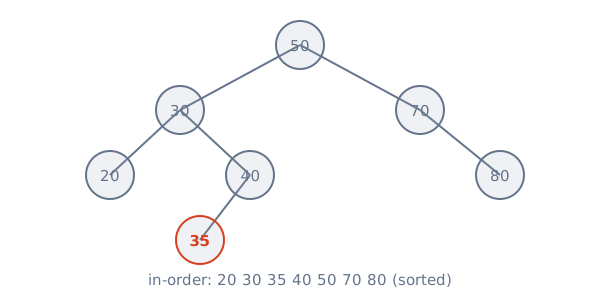
Worked example: searching for 35, then inserting it
Take the tree above (before the red node). Its keys are 50, 30, 70, 20, 40, 80. We search for 35, comparing at each step:
- At root
50: 35 < 50 → go left. (compare #1) - At
30: 35 > 30 → go right. (compare #2) - At
40: 35 < 40 → go left. (compare #3) - Left child of 40 is empty → 35 not found, after just 3 comparisons on a 6-node tree.
To insert 35 we follow the exact same path and place it where the search fell off the tree — as the left child of 40 (the red node). Insertion is "search, then attach at the null spot." Both operations cost O(h), where h is the height. Here h = 3, so ≤ 3 comparisons — versus scanning all 6 keys in an unsorted list.
Deletion has three cases. Deleting a leaf (e.g. 20): just detach it. Deleting a node with one child (e.g. 40 after adding 35): splice the child up in its place. Deleting a node with two children (e.g. 30): replace its key with its in-order successor — the smallest key in its right subtree — then delete that successor (which has at most one child). This preserves the sorted invariant.
Complexity — and the honest worst case
Every core operation (search, insert, delete, min, max, successor) walks one root-to-leaf path, so each is O(h). The catch is that h depends entirely on shape:
- Best / average case: a reasonably balanced tree has height
h ≈ log₂n, giving O(log n) operations. Inserting random keys yields expected height ≈2.99·log₂n (≈4.31·ln n), with the average search path even shorter at ≈1.39·log₂n (≈2·ln n) — logarithmic on average either way. - Worst case: insert already-sorted keys (10, 20, 30, 40, …) and every node hangs off the right. The tree degenerates into a linked list with
h = n, so operations become O(n). This is the killer weakness of the plain BST.
Because sorted or nearly-sorted input is common in practice, the plain BST's guarantee is fragile. That fragility is exactly why self-balancing variants exist.
Pitfalls and what an interviewer probes
- "Validate a BST" — the classic trap. Checking only
left < node < rightat each node is wrong: a deep descendant can violate the global rule. Correct approaches: carry a(min, max)range down the recursion, or do an in-order traversal and check it is strictly increasing. - Duplicates. The clean definition uses strict inequalities and no duplicates. If you must allow them, decide a consistent convention (e.g. equal keys go right, or store a count) — and say so out loud.
- Confusing BST with binary heap. A heap only guarantees parent-vs-child ordering and gives no sorted traversal or O(log n) search by key; a BST orders left-vs-right across whole subtrees. Different tools.
- Forgetting the two-children delete case, or forgetting to re-link the parent pointer after splicing — a very common source of bugs.
- Not raising balance. Strong candidates volunteer that a plain BST degrades to O(n) and name the fix before being asked.
When it matters in practice + trade-offs
You almost never ship a raw BST — you ship a self-balancing one: Red-Black trees (Java's TreeMap/TreeSet, C++ std::map, Linux kernel schedulers) and AVL trees (stricter balance, faster lookups, more rotations on write). Databases and filesystems use the disk-friendly cousin, the B-tree. All keep h = O(log n) guaranteed, dodging the degenerate case.
Trade-offs against neighbouring structures:
- vs. hash table: a hash map gives O(1) average lookup but no order. Choose a balanced BST when you need ordered operations hashing can't do cheaply: range queries ("all keys in [x, y]"), successor/predecessor, min/max, or sorted iteration. That ordering is the BST's reason to exist.
- vs. sorted array: array lookup is O(log n) too and is more cache-friendly, but insert/delete is O(n) due to shifting. BST insert/delete is O(log n) when balanced — pick the tree when the data changes often.
Key takeaways
- A BST keeps data ordered so every core operation follows one root-to-leaf path costing O(h); in-order traversal yields sorted keys.
- Balanced → O(log n); but sorted-input insertion degenerates it to a list at O(n) — the reason real code uses Red-Black/AVL/B-trees.
- Validate with a propagated
(min, max)range or an in-order check — never just local child comparisons. - Prefer a balanced BST over a hash table when you need ordering: range queries, successor/predecessor, min/max, or sorted traversal.
🤖 Don't fully get this? Learn it with Claude
Stuck on Binary Search Tree? Open Claude, copy a block below, and it'll teach you this exact concept — visually and interactively.
Build the mental picture, not memorization.
I just read a lesson on **Binary Search Tree** (DSA) and want to truly understand it. Explain Binary Search Tree from first principles using ONE vivid real-world analogy and a visual mental model — draw it as ASCII art or a clear step-by-step diagram — with a concrete example using real numbers. Then ask me one question to check I got the mental picture, and wait for my reply. If you're unsure or a claim isn't standard, say so and reason from first principles instead of guessing.
Socratic — adapts to where you're stuck.
Teach me **Binary Search Tree** interactively. Ask me ONE guiding question at a time, wait for my answer, and adapt to my confusion — build the idea with me step by step instead of explaining it all at once. If you're unsure or a claim isn't standard, say so and reason from first principles instead of guessing.
Active recall exposes what you missed.
Quiz me on **Binary Search Tree** with 5 questions, easy to tricky, ONE at a time. Tell me if each answer is right; at the end, explain clearly what I got wrong and why. If you're unsure or a claim isn't standard, say so and reason from first principles instead of guessing.
Intuition + hook + flashcards for long-term memory.
Help me remember **Binary Search Tree** for the long term: give the one-sentence intuition, a memorable hook/mnemonic, a tiny worked example, and 3 active-recall flashcards (Q -> A). If you're unsure or a claim isn't standard, say so and reason from first principles instead of guessing.