Quadratic Time On²
Quadratic Time O(n²)
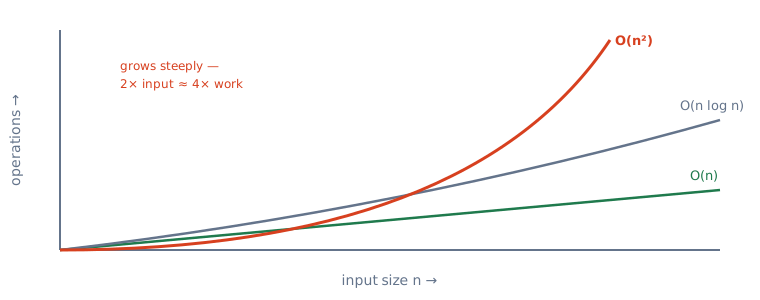
Imagine you walk into a room of n people and you want every person to shake hands with every other person. The first person shakes n−1 hands, the next shakes n−2 new hands, and so on. As the room grows, the number of handshakes doesn't just grow — it grows much faster than the room does. Double the guests and you roughly quadruple the handshakes. That runaway feeling — work exploding faster than the input — is the intuition behind quadratic time.
The tell-tale structural sign in code is a loop nested inside another loop, where both loops range over the same input of size n. For each of the n outer steps, you do n inner steps, giving you n × n = n² units of work.
Precise definition
An algorithm runs in quadratic time when its running time T(n) grows proportionally to the square of the input size: T(n) = O(n²). Formally, T(n) is O(n²) if there exist positive constants c and n₀ such that T(n) ≤ c·n² for all n ≥ n₀.
Big-O keeps only the dominant term and drops constant factors. So 3n² + 50n + 200 is still O(n²): once n is large, the n² term swamps everything else, and the leading 3 doesn't change the growth shape. This is why the handshake count — exactly n(n−1)/2 = ½n² − ½n — is O(n²) despite the ½ and the linear tail.
Quadratic sits above linear (O(n)) and log-linear (O(n log n)) but below cubic (O(n³)) and the exponential classes. It is the classic signature of brute-force pairwise comparison.
Worked example: counting operations in bubble sort
Let's sort the array [5, 1, 4, 2] (n = 4) with bubble sort and count the key operation — the comparison. Bubble sort makes n−1 passes; each pass walks the unsorted prefix comparing adjacent pairs.
- Pass 1 compares 3 pairs: (5,1)→swap, (5,4)→swap, (5,2)→swap →
[1,4,2,5] - Pass 2 compares 2 pairs: (1,4)→ok, (4,2)→swap →
[1,2,4,5] - Pass 3 compares 1 pair: (1,2)→ok →
[1,2,4,5]
Total comparisons = 3 + 2 + 1 = 6. In general that sum is (n−1) + (n−2) + … + 1 = n(n−1)/2. For n = 4 that is 4·3/2 = 6 — matching our count exactly. For n = 1000 it is 499,500 comparisons; bump the input to n = 2000 and it jumps to 1,999,000 — ~4× the work for 2× the data. That multiplier is the fingerprint of O(n²).
Best / worst / average. The comparison count above is fixed by the loop structure, so it is Θ(n²) in all cases. But an optimized bubble sort with an early-exit flag is O(n) in the best case (already-sorted input: one clean pass, zero swaps), while worst and average stay Θ(n²). Always name the case you mean.
Common pitfalls & what an interviewer probes
- Nested loops aren't automatically O(n²). What matters is how many times the inner body runs. If the inner loop is bounded by a constant, or iterates over a different, small set, it's not n². Interviewers love asking you to justify the bound, not just count braces.
- Two loops in sequence are O(n), not O(n²). Additive work (
for..; for..) gives n + n = O(n). Only nested (multiplicative) loops square it. Confusing+with×is a classic slip. - Hidden quadratics. Calling an O(n) operation inside an O(n) loop — e.g.
list.contains(), string concatenation in a loop, or repeatedarr.remove(0)— silently costs O(n²) even with a single visible loop. Probing for these is a favourite trap. - i < j triangular loops are still O(n²). Doing only
n(n−1)/2pairs feels cheaper, but halving is a constant factor — the class is unchanged. Expect the interviewer to reject “it's faster so it's O(n log n)”. - The real question: “Can you do better?” For pairwise problems the escape hatch is usually a hash set/map (trade space for time → O(n)) or sorting first (→ O(n log n)). Naming that pivot is what they're listening for.
When it matters & trade-offs vs neighbours
Quadratic algorithms are perfectly fine when n is small or bounded. For n ≤ a few thousand, an O(n²) pass finishes in microseconds-to-milliseconds, and a simple double loop is often more readable and cache-friendly than a clever alternative. Insertion sort (O(n²)) even beats O(n log n) sorts on tiny or nearly-sorted arrays, which is why real libraries switch to it for small partitions.
The danger is scale. At n = 1,000,000, O(n²) is ~10¹² operations — minutes to hours — while O(n log n) is ~2×10⁷ (sub-second) and O(n) is ~10⁶ (instant). The gap widens without bound, so a quadratic solution that passes small tests can fall off a cliff in production.
- vs O(n) / O(n log n): These usually cost extra memory (a hash map) or a preprocessing step (sorting). If n is large or growth is expected, pay that cost. If n is capped and small, quadratic's simplicity can win.
- vs O(n³): Cubic (e.g. naive matrix multiply, triple-nested loops) degrades even faster; the same “add a hash map / restructure” instincts often knock a dimension off.
Rule of thumb for interviews: if the input can exceed ~10⁴–10⁵, an O(n²) answer likely won't pass time limits — treat it as a correct baseline to then optimize, not the final answer.
Key takeaways
- Definition: work grows as the square of input — T(n) = O(n²); the fingerprint is doubling n roughly quadrupling the work.
- Structural sign: genuinely nested loops over the same n, or an O(n) operation hidden inside an O(n) loop — but always justify the bound, not just count loops.
- Escape hatches: a hash set/map trades space for O(n); sorting first gives O(n log n). Naming the pivot is the interview signal.
- Practicality: fine and even preferable for small/bounded n (insertion sort), disastrous at large n — use it as a correct baseline to optimize from.
🤖 Don't fully get this? Learn it with Claude
Stuck on Quadratic Time On²? Open Claude, copy a block below, and it'll teach you this exact concept — visually and interactively.
Build the mental picture, not memorization.
I just read a lesson on **Quadratic Time On²** (DSA) and want to truly understand it. Explain Quadratic Time On² from first principles using ONE vivid real-world analogy and a visual mental model — draw it as ASCII art or a clear step-by-step diagram — with a concrete example using real numbers. Then ask me one question to check I got the mental picture, and wait for my reply. If you're unsure or a claim isn't standard, say so and reason from first principles instead of guessing.
Socratic — adapts to where you're stuck.
Teach me **Quadratic Time On²** interactively. Ask me ONE guiding question at a time, wait for my answer, and adapt to my confusion — build the idea with me step by step instead of explaining it all at once. If you're unsure or a claim isn't standard, say so and reason from first principles instead of guessing.
Active recall exposes what you missed.
Quiz me on **Quadratic Time On²** with 5 questions, easy to tricky, ONE at a time. Tell me if each answer is right; at the end, explain clearly what I got wrong and why. If you're unsure or a claim isn't standard, say so and reason from first principles instead of guessing.
Intuition + hook + flashcards for long-term memory.
Help me remember **Quadratic Time On²** for the long term: give the one-sentence intuition, a memorable hook/mnemonic, a tiny worked example, and 3 active-recall flashcards (Q -> A). If you're unsure or a claim isn't standard, say so and reason from first principles instead of guessing.