Big-O Notation O-notation
Big-O Notation (O-notation)
Every other page in this topic uses Big-O; this is the page that takes its definition literally. Big-O is not a vibe about "fast" or "slow" — it is a precise mathematical statement about the existence of two witnesses, and once you can produce those witnesses you can prove a bound rather than assert it. That rigor is also what lets you spot the two misuses that quietly expose people who only pattern-match the notation.
The definition, read as a claim you must prove
Let T(n) be the operation count of an algorithm. We say T(n) = O(f(n)) if and only if:
there exist constants c > 0 and n0 ≥ 0 such that T(n) ≤ c·f(n) for all n ≥ n0.
Read it as an existence claim: to prove T(n) = O(f(n)) you must exhibit a specific c and n0 (the "witnesses") and show the inequality holds forever after. Two familiar rules are just consequences: constants drop (5n is O(n) — the witness c absorbs the 5) and lower-order terms drop (n2+3n+7 is O(n2)). The sibling notations Ω (lower bound) and Θ (tight bound) are compared side-by-side on Comparing Asymptotic Notations, and the equivalent limit-based test is on Overview of Asymptotic Analysis.
Proving a bound from first principles
Claim: T(n) = 3n2 + 5n + 100 is O(n2). Do not wave at it — find witnesses.
Pick c = 4. We need 3n2 + 5n + 100 ≤ 4n2, i.e. n2 ≥ 5n + 100, i.e. n2 − 5n − 100 ≥ 0. The positive root is n = (5 + √(25 + 400))/2 = (5 + √425)/2 ≈ 12.8, so the inequality holds for all n ≥ 13. Witnesses: c = 4, n0 = 13.
Verify the boundary (this is the step that makes it a proof, not a guess):
n = 13: LHS= 3(169) + 65 + 100 = 672; RHS= 4(169) = 676.672 ≤ 676✓.n = 12: LHS= 3(144) + 60 + 100 = 592; RHS= 4(144) = 576.592 ≤ 576is false — son0 = 13is exactly the threshold for thisc.
Witnesses are not unique: choose c = 5 and the inequality n2 ≥ &frac52n + 50 holds from a smaller n0. Any valid (c, n0) pair proves the bound; the definition only demands that some pair exists. The method for producing the count T(n) from real code in the first place is on Understanding Time Complexity.
The two misuses the definition exposes
Misuse 1: "Big-O means worst case." False, and the definition proves it. Big-O bounds a function; best / worst / average describe which input scenario produced that function. They are independent axes. Linear search's best case is O(1), its worst case is O(n) — both are Big-O statements, about different functions. You can equally write the Ω of the worst case. Keeping the notation (O/Ω/Θ) separate from the case (best/worst/average) is the single clearest signal that you understand what you are saying.
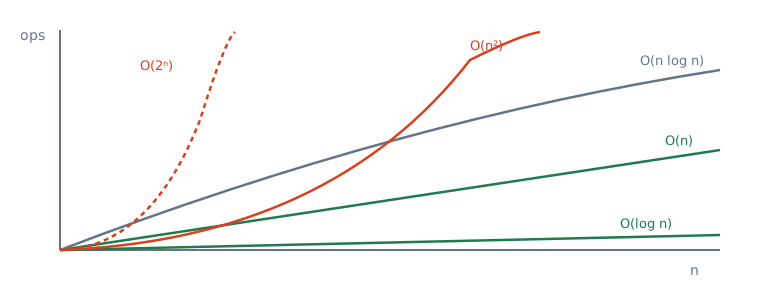
Misuse 2: conflating O with Θ. Because O is only an upper bound, a linear algorithm is honestly O(n), but also O(n2), and even O(n100) — every one is a true (if useless) upper bound. When you want to say "the growth is exactly linear," the correct symbol is Θ(n). Casual speech says "O" and means "Θ"; write what you mean.
When O vs Ω vs Θ actually changes the answer
The distinction is not pedantry — it depends on the question you are answering:
- Describing an algorithm or choosing a structure → you want
Θ, the true growth. "Mergesort isΘ(n log n)" is the useful statement; "mergesort isO(n2)" is true and worthless. - Proving optimality → you need
Ω, a bound on every possible algorithm. Comparison-based sorting has a lower bound ofΩ(n log n): a comparison sort is a decision tree withn!leaves (one per possible ordering), so its height — the worst-case number of comparisons — is at leastlog2(n!) = Θ(n log n). Forn = 20that floor islog2(20!) ≈ log2(2.4×10¹⁸) ≈ 61comparisons — no comparison sort can beat ~61 comparisons on 20 elements.
Now the two meet: mergesort's upper bound O(n log n) equals the problem's lower bound Ω(n log n), so mergesort is Θ(n log n) and provably optimal — not merely good, but impossible to beat asymptotically among comparison sorts. That conclusion is unreachable with O alone; it requires the Ω you would have skipped if you thought Big-O was the whole story.
Formal-notation pitfalls
- The "=" is an abuse of notation.
T(n) = O(f(n))really meansT(n) ∈ O(f(n))(membership in a set of functions). You never writeO(f(n)) = T(n). - Proving the wrong inequality. For
Oyou bound from above (T ≤ c·f); flipping it provesΩinstead. Watch the direction. - Giving a loose bound when asked for a tight one. "It's
O(n2)" for a linear scan is technically true and will still lose you the point — interviewers want the tightestΘ.
Key takeaways
- Big-O is an existence claim:
T(n) = O(f(n))iff somec > 0, n0makeT(n) ≤ c·f(n)for alln ≥ n0. Prove it by exhibiting witnesses (e.g.c = 4, n0 = 13for3n2+5n+100 = O(n2)). - Witnesses are not unique; any valid pair suffices.
- Keep the notation (
O/Ω/Θ) separate from the case (best/worst/average) — "Big-O = worst case" is false — and sayΘwhen you mean tight. Ωearns its keep in optimality proofs: comparison sort isΩ(n log n)(decision-tree heightlog2(n!)), which is why mergesort'sO(n log n)is provably the best possible.
🤖 Don't fully get this? Learn it with Claude
Stuck on Big-O Notation O-notation? Open Claude, copy a block below, and it'll teach you this exact concept — visually and interactively.
Build the mental picture, not memorization.
I just read a lesson on **Big-O Notation O-notation** (DSA) and want to truly understand it. Explain Big-O Notation O-notation from first principles using ONE vivid real-world analogy and a visual mental model — draw it as ASCII art or a clear step-by-step diagram — with a concrete example using real numbers. Then ask me one question to check I got the mental picture, and wait for my reply. If you're unsure or a claim isn't standard, say so and reason from first principles instead of guessing.
Socratic — adapts to where you're stuck.
Teach me **Big-O Notation O-notation** interactively. Ask me ONE guiding question at a time, wait for my answer, and adapt to my confusion — build the idea with me step by step instead of explaining it all at once. If you're unsure or a claim isn't standard, say so and reason from first principles instead of guessing.
Active recall exposes what you missed.
Quiz me on **Big-O Notation O-notation** with 5 questions, easy to tricky, ONE at a time. Tell me if each answer is right; at the end, explain clearly what I got wrong and why. If you're unsure or a claim isn't standard, say so and reason from first principles instead of guessing.
Intuition + hook + flashcards for long-term memory.
Help me remember **Big-O Notation O-notation** for the long term: give the one-sentence intuition, a memorable hook/mnemonic, a tiny worked example, and 3 active-recall flashcards (Q -> A). If you're unsure or a claim isn't standard, say so and reason from first principles instead of guessing.