The Problem Failure Propagation in Distributed Systems
Picture an ocean liner. The hull is breached and water pours in — but the ship does not sink at once, because it is divided into watertight compartments called bulkheads. Water floods one compartment; the others stay dry, buying time. Remove the bulkheads and a single breach floods the whole hull. The local failure propagates into a total one.
Distributed systems fail the same way. A system is many services calling each other, and one sick service can drag down every service that touches it. This is a cascading failure, and the mechanism is almost always the same: a shared, finite resource — usually a thread pool or connection pool — gets consumed by calls waiting on the slow dependency, leaving nothing for anyone else.
Why one slow service kills the whole system
The key insight is that a slow dependency is more dangerous than a dead one. A dependency that fails instantly frees your thread immediately. A dependency that hangs holds your thread hostage. To see how fast this compounds, use Little's Law: the number of requests in flight equals the arrival rate times the time each request spends in the system.
L = λ × W (in-flight concurrency = requests/sec × seconds-per-request)
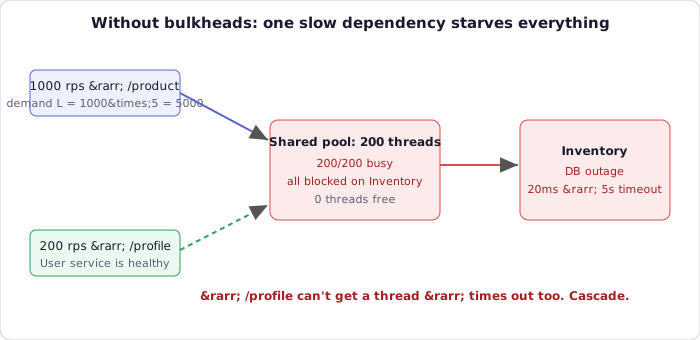
Consider a product-detail service that receives 1000 rps on /product, and each request calls the Inventory service, which normally responds in 20 ms. Concurrency in flight is 1000 × 0.02 = 20 — trivial. The same service also serves 200 rps on /profile, which calls a separate, healthy User service at 20 ms: 200 × 0.02 = 4 in flight. On a shared pool of 200 worker threads, total occupancy is ~24. Comfortable.
The worked failure
Now the Inventory database has an outage and Inventory calls stop returning. With no aggressive timeout, each /product call blocks for the full 5-second client timeout. Re-run Little's Law: the demand for concurrency becomes 1000 × 5 = 5000 in-flight requests. Your pool only has 200 threads, so within a fraction of a second all 200 are occupied and waiting on Inventory.
Here is the cruel part. The /profile traffic — 200 rps against a perfectly healthy User service — now arrives and finds zero free threads. Those requests queue, then time out. An endpoint that has nothing to do with Inventory has gone down, purely because it shared a thread pool with a sick neighbor. The breach flooded the whole hull.
The bulkhead pattern
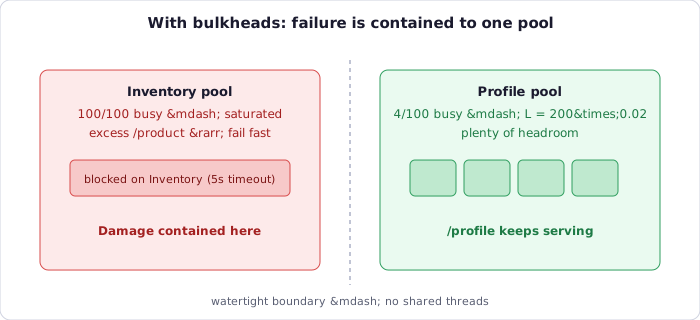
The fix mirrors the ship: partition the shared resource so no single dependency can consume all of it. Give Inventory-backed calls their own bounded pool (say 100 threads) and /profile its own pool (100 threads). When Inventory hangs, its pool fills to 100/100 and further /product requests are rejected immediately — they fail fast instead of piling up. The /profile pool is untouched, sitting at its natural 200 × 0.02 = 4 in flight, and keeps serving. The blast radius is now bounded to the one broken feature.
Choosing an implementation, and knowing when not to
There are two common ways to build a bulkhead, and they trade off differently.
- Thread-pool bulkhead — each dependency gets a dedicated pool, and calls run on those threads. Because the work is off the caller's thread, you can enforce a timeout and interrupt a hung call, giving true isolation even when the dependency blocks. The cost is real: extra threads mean context-switching and ~1 MB of stack each, a queue-handoff adds latency, and request-scoped context (thread-locals, tracing) does not cross the pool boundary for free.
- Semaphore bulkhead — just a counter that caps how many concurrent calls are allowed; the call runs on the caller's own thread. It is cheap, adds no threads, and preserves context. But it cannot enforce a timeout on a blocked call — if the dependency hangs, the calling thread hangs with it. It bounds concurrency, not time.
Rule of thumb: use a thread-pool bulkhead when the dependency is a network call that can hang and you need timeout-plus-isolation; use a semaphore when calls are fast and reliable (in-process or sub-millisecond) and you only want to cap concurrency without paying for threads.
When a bulkhead is not worth it. Bulkheads add real operational cost — you must size every pool, monitor its saturation, and a mis-sized pool causes its own incidents (too small rejects healthy traffic; too big fails to protect the host). Skip it when: (1) the service has a single downstream dependency and nothing else to protect — isolating a dependency from itself buys nothing, since if it dies you are down anyway; a tight timeout plus a circuit breaker is enough. (2) Traffic is low — at a handful of rps, thread exhaustion is not a credible risk, so a single aggressive timeout caps the blast radius without the complexity of partitioned pools.
Bulkhead vs. circuit breaker vs. both. A bulkhead is spatial isolation: it caps how much of your resources one dependency may consume, but every admitted request still tries and waits up to the timeout. A circuit breaker is temporal isolation: after the error rate crosses a threshold it stops calling the failing dependency entirely for a cool-down, failing fast and letting the dependency recover. Reach for a bulkhead when you must keep calling several dependencies but need to bound each one's footprint. Reach for a circuit breaker when repeatedly hammering a down dependency is wasteful or harmful (paying timeout latency on every request, or preventing a database from recovering). In production you usually want both: the bulkhead contains the blast radius, and the breaker trips when that bulkhead saturates or errors spike — the bulkhead stops the flooding, the breaker stops the bleeding.
Pitfalls
- No timeout is the root enabler. The 5000-in-flight explosion only happens because calls block for 5 seconds. An aggressive timeout is your first and cheapest bulkhead — it directly caps
Win Little's Law. - One shared pool for all dependencies defeats the entire pattern; a single slow dependency starves everything. Isolation only exists at the boundaries you actually draw.
- Mis-sized pools. Too large and the pool never protects the host (you still exhaust CPU/memory); too small and you reject healthy traffic under normal load. Size from measured concurrency (
λ×W) plus headroom, and alert on saturation. - Shrinking timeout budgets down a call chain. In a synchronous chain A→B→C, each hop's timeout must be smaller than its caller's, or the outermost timeout fires while inner calls are still blocking and holding threads.
- Retries amplify cascades. This is the most operationally dangerous one. A naive "retry 3×" turns 1000 rps into 3000 rps aimed at a dependency that is already failing, creating a retry storm that can push a recoverable slowdown into a self-sustaining (metastable) outage. Tame it with exponential backoff and jitter, a hard cap on attempts, and a retry budget (e.g. retries may be at most ~10% of total requests). Critically, retries must live inside the same bulkhead and timeout budget: a retry is just another in-flight call against the bounded pool, each attempt must respect the per-attempt timeout so total latency stays bounded, and you must not retry into an already-saturated bulkhead — let the circuit breaker fail fast instead.
Sources
Adapted and expanded from the ship-bulkhead framing of cascading failure, grounded in the standard resilience-patterns literature: Michael T. Nygard, Release It! Design and Deploy Production-Ready Software (2nd ed., Pragmatic Bookshelf) for the Bulkhead, Timeout, and Circuit Breaker stability patterns; the Netflix Hystrix documentation for the thread-pool vs. semaphore isolation trade-off and retry-storm behavior; and the concurrency reasoning follows Little's Law (L = λW).
🤖 Don't fully get this? Learn it with Claude
Stuck on The Problem Failure Propagation in Distributed Systems? Open Claude, copy a block below, and it'll teach you this exact concept — visually and interactively.
Build the mental picture, not memorization.
I just read a lesson on **The Problem Failure Propagation in Distributed Systems** (System Design) and want to truly understand it. Explain The Problem Failure Propagation in Distributed Systems from first principles using ONE vivid real-world analogy and a visual mental model — draw it as ASCII art or a clear step-by-step diagram — with a concrete example using real numbers. Then ask me one question to check I got the mental picture, and wait for my reply. If you're unsure or a claim isn't standard, say so and reason from first principles instead of guessing.
Socratic — adapts to where you're stuck.
Teach me **The Problem Failure Propagation in Distributed Systems** interactively. Ask me ONE guiding question at a time, wait for my answer, and adapt to my confusion — build the idea with me step by step instead of explaining it all at once. If you're unsure or a claim isn't standard, say so and reason from first principles instead of guessing.
Active recall exposes what you missed.
Quiz me on **The Problem Failure Propagation in Distributed Systems** with 5 questions, easy to tricky, ONE at a time. Tell me if each answer is right; at the end, explain clearly what I got wrong and why. If you're unsure or a claim isn't standard, say so and reason from first principles instead of guessing.
Intuition + hook + flashcards for long-term memory.
Help me remember **The Problem Failure Propagation in Distributed Systems** for the long term: give the one-sentence intuition, a memorable hook/mnemonic, a tiny worked example, and 3 active-recall flashcards (Q -> A). If you're unsure or a claim isn't standard, say so and reason from first principles instead of guessing.