Bulkhead Pattern An Example
The Bulkhead pattern takes its name from ship design: a hull is divided into watertight compartments so that a breach in one does not flood the whole vessel. Applied to software, it partitions the resources a service uses to talk to its dependencies, so that one slow or failing dependency cannot exhaust the resources needed by the others.
We will build the canonical example: an Order Service that must call two downstream services on every order — an Inventory Service (high traffic, prone to slowdowns) and a Shipping Service (lower traffic, usually healthy). The failure we want to prevent is cascading resource exhaustion: a spike or stall in Inventory tying up every thread the Order Service owns, so that even a perfectly healthy Shipping call can no longer be made.
Why one shared pool is dangerous
If both dependencies are called from a single thread pool, the pool is a shared, finite resource. When Inventory stalls, its calls occupy threads for a long time. Because arriving work never releases those threads, the pool drains, and the next Shipping call has nowhere to run — it queues behind the stuck Inventory work or is rejected outright. Shipping is healthy, yet it fails, purely because it shared a resource with a sick neighbour. That is the cascade a bulkhead severs.
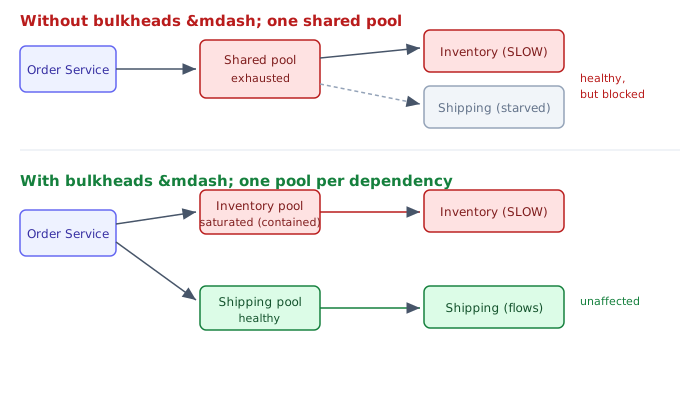
Laying the groundwork: one pool per dependency
The bulkhead is created by giving each dependency its own ExecutorService. Java's Executors.newFixedThreadPool(n) builds a pool of n worker threads backed by an unbounded queue — we will replace that queue with a bounded one shortly, because an unbounded queue quietly defeats the pattern.
ExecutorService inventoryExecutor = Executors.newFixedThreadPool(100);
ExecutorService shippingExecutor  = Executors.newFixedThreadPool(50);
The sizes are not arbitrary: give each pool a thread budget proportional to the load and latency it must absorb. Inventory takes the larger allotment (100) because it carries more traffic; Shipping gets 50. The key invariant is that these two budgets are disjoint — a thread stuck in Inventory can never be one that Shipping needed.
The naive version, and what it hides
The simplest use of the two pools is fire-and-forget: submit each call as a task and move on.
public void createOrder(Order order) {
    inventoryExecutor.submit(() -> inventoryService.checkAndUpdateInventory(order));
    shippingExecutor.submit(() -> scheduleShipping(order));
}
This already gives us isolation: a stalled Inventory call ties up only inventoryExecutor threads. But it hides three things. First, the caller learns nothing — there is no result and no confirmation. Second, there is no timeout, so a task can occupy its thread indefinitely and eventually saturate its own pool. Third — a point worth stating plainly — in this fire-and-forget form checkAndUpdateInventory(order) and scheduleShipping(order) are used purely as statement expressions: whatever they return is discarded, so their return types are irrelevant here.
Transparency note. The next version needs those results back, so it treats checkAndUpdateInventory(order) as returning a boolean (did the reservation succeed?) and scheduleShipping(order) as returning a TrackingId. That is a plausible and likely-intended evolution — a call whose value was previously thrown away can certainly return one — but it is a new assumption. The original snippet never established these return types, and the code below only compiles if the real signatures match boolean checkAndUpdateInventory(Order) and TrackingId scheduleShipping(Order).
The robust version: results, timeouts, and a bounded wait
To get results back and bound how long the caller waits, we submit both tasks first — so they run concurrently on their separate pools — then collect each result through Future.get(timeout).
public OrderResult createOrder(Order order) {
    // Submit both up front: they now run in parallel on disjoint pools.
    Future<Boolean>    reserved = inventoryExecutor.submit(
                                    () -> inventoryService.checkAndUpdateInventory(order));
    Future<TrackingId> shipment = shippingExecutor.submit(
                                    () -> shippingService.scheduleShipping(order));

    try {
        boolean ok    = reserved.get(500, MILLISECONDS);  // waits UP TO 500ms
        TrackingId id = shipment.get(500, MILLISECONDS);  // then UP TO another 500ms
        return OrderResult.confirmed(id, ok);
    } catch (TimeoutException e) {
        // Released on the FIRST dependency to blow its own budget.
        return OrderResult.degraded(order);
    } catch (ExecutionException | InterruptedException e) {
        return OrderResult.failed(order);
    }
}
Watch the budget carefully. It is tempting to comment this as “caller waits ≤500ms, not 30s.” That is not a hard bound. The two get(500ms) calls are sequential, and each has its own independent 500 ms budget. If both dependencies are slow at once, the caller can spend up to ~500 ms blocked on reserved.get and then up to another ~500 ms on shipment.get — a worst-case caller-visible latency approaching ~1000 ms before the method returns. The ≤500 ms figure only holds when at most one dependency stalls at a time.
If you genuinely need a hard end-to-end bound, share one deadline across both waits so the second get only ever gets the time the first left unused:
long deadline = System.nanoTime() + MILLISECONDS.toNanos(500);
try {
    boolean ok    = reserved.get(remainingMillis(deadline), MILLISECONDS);
    TrackingId id = shipment.get(remainingMillis(deadline), MILLISECONDS);
    return OrderResult.confirmed(id, ok);
} catch (TimeoutException e) {
    return OrderResult.degraded(order);
}

static long remainingMillis(long deadlineNanos) {
    return Math.max(0, (deadlineNanos - System.nanoTime()) / 1_000_000);
}
Now the sum of the two waits can never exceed the original 500 ms — the caller is released within a true, shared budget regardless of how many dependencies are slow.
Tracing saturation: why the bounded queue matters
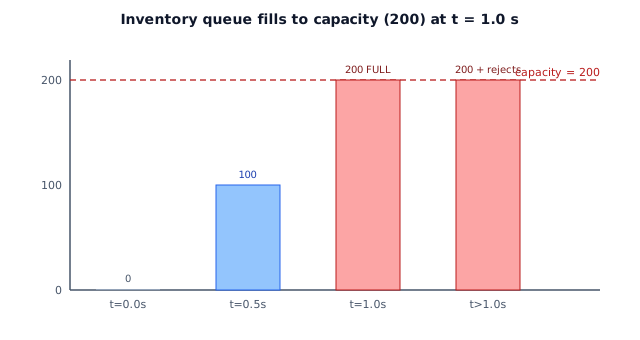
The isolation only holds if each pool is bounded — both its threads and its queue. Suppose inventoryExecutor has 100 threads and a bounded queue of capacity 200, and Inventory has just stalled completely (no task finishes, so no thread frees up). New order traffic arrives at a steady 200 requests/second. Take t = 0 as the instant all 100 threads are already busy, so from here every arriving inventory task must go to the queue.
| Time | Threads busy | Tasks queued | State |
|---|---|---|---|
| t = 0.0 s | 100 / 100 | 0 / 200 | Threads full; queue starts filling at 200/s |
| t = 0.5 s | 100 / 100 | 100 / 200 | 200/s × 0.5 s = 100 queued |
| t = 1.0 s | 100 / 100 | 200 / 200 (FULL) | Remaining 100 slots fill in the next 0.5 s → queue full at t = 1.0 s |
| t > 1.0 s | 100 / 100 | 200 / 200 (FULL) | Queue saturated; new submissions rejected (RejectedExecutionException) |
The arithmetic is the whole point: at 200/s the 200-slot queue fills in exactly one second (200/s × 1.0 s = 200), reaching FULL at t = 1.0 s — not later. Once full, further inventory work is rejected immediately rather than absorbed. That fast rejection is a feature: it caps how much of the system Inventory can consume and gives you a clean signal (rejections) to shed load or open a circuit breaker. Crucially, none of this touches shippingExecutor — its 50 threads and its own queue remain fully available.
When to reach for a bulkhead — and when not to
The bulkhead is a fault-isolation tool, and it is not free. Use the judgment layer, not a reflex.
- Use it when one process calls several independent dependencies with different failure profiles, and you cannot afford a slow one to take down the healthy ones — the classic multi-downstream service.
- Use it when a dependency's latency is unpredictable (third-party APIs, a shared database under contention). Partitioning caps the blast radius.
- Prefer a plain timeout or retry instead when there is only a single dependency: a bulkhead adds no isolation value there, only overhead and thread-hop latency.
- Avoid over-partitioning: every pool reserves threads that sit idle when its dependency is healthy. Ten dependencies with generous fixed pools can waste far more threads than a shared pool would, and thread-context overhead grows. Size to real load, and consider a semaphore bulkhead (a permit counter, no extra threads) when the call is already async or non-blocking — that is exactly the trade-off Resilience4j exposes between its
ThreadPoolBulkheadand its lightweightSemaphoreBulkhead. - Pair it, do not substitute it. A bulkhead contains exhaustion but does not stop hammering a dead dependency; combine it with a circuit breaker (stop calling after repeated failures), timeouts (bound each wait), and bounded queues with rejection (fail fast under overload).
Takeaways
The Bulkhead pattern turns a single shared, exhaustible resource into several disjoint compartments so that failure in one cannot starve the others. In our Order Service that meant a dedicated ExecutorService per dependency, sized to each dependency's load.
- Isolation comes from disjoint budgets. Separate thread pools guarantee that a thread stuck in Inventory is never one Shipping needed — Shipping keeps flowing while Inventory drowns.
- Bound both dimensions. Threads and queue must be bounded. An unbounded queue silently defeats the pattern by absorbing work forever; a bounded one fails fast (rejection) once saturated, which is the honest, useful signal.
- Do the arithmetic. At 200 req/s into a 200-slot queue with all threads busy, the queue is half full at t=0.5s and completely full at t=1.0s — after which new work is rejected. Knowing exactly when saturation hits is what lets you size queues and set alarms deliberately.
- Timeouts need shared budgets to give a hard bound. Two sequential
get(500ms)calls do not guarantee a 500 ms response — back-to-back stalls approach ~1000 ms. Thread a single deadline through both waits when the end-to-end bound must actually hold. - Know your return contract. Collecting results (
Future<Boolean>,Future<TrackingId>) depends on the downstream methods actually returning those types — a real assumption to verify, not a given. - Compose it. Bulkheads contain resource exhaustion; timeouts bound waits; circuit breakers stop hammering the dead; bounded queues shed load. Resilience needs all four working together.
Source
Adapted and expanded from the “Bulkhead Pattern — An Example” lesson in a microservices-patterns course. The bulkhead/stability mechanics were cross-checked against Michael T. Nygard, Release It! Design and Deploy Production-Ready Software (2nd ed., Pragmatic Bookshelf, 2018), which introduces the Bulkhead among the stability patterns, and against the Resilience4j Bulkhead documentation for the ThreadPoolBulkhead versus SemaphoreBulkhead trade-off. The traced queue-saturation numbers and the shared-deadline timeout correction are worked derivations, not quotations from the source.
🤖 Don't fully get this? Learn it with Claude
Stuck on Bulkhead Pattern An Example? Open Claude, copy a block below, and it'll teach you this exact concept — visually and interactively.
Build the mental picture, not memorization.
I just read a lesson on **Bulkhead Pattern An Example** (System Design) and want to truly understand it. Explain Bulkhead Pattern An Example from first principles using ONE vivid real-world analogy and a visual mental model — draw it as ASCII art or a clear step-by-step diagram — with a concrete example using real numbers. Then ask me one question to check I got the mental picture, and wait for my reply. If you're unsure or a claim isn't standard, say so and reason from first principles instead of guessing.
Socratic — adapts to where you're stuck.
Teach me **Bulkhead Pattern An Example** interactively. Ask me ONE guiding question at a time, wait for my answer, and adapt to my confusion — build the idea with me step by step instead of explaining it all at once. If you're unsure or a claim isn't standard, say so and reason from first principles instead of guessing.
Active recall exposes what you missed.
Quiz me on **Bulkhead Pattern An Example** with 5 questions, easy to tricky, ONE at a time. Tell me if each answer is right; at the end, explain clearly what I got wrong and why. If you're unsure or a claim isn't standard, say so and reason from first principles instead of guessing.
Intuition + hook + flashcards for long-term memory.
Help me remember **Bulkhead Pattern An Example** for the long term: give the one-sentence intuition, a memorable hook/mnemonic, a tiny worked example, and 3 active-recall flashcards (Q -> A). If you're unsure or a claim isn't standard, say so and reason from first principles instead of guessing.