The Problem Configuration Management in a Microservices Architecture
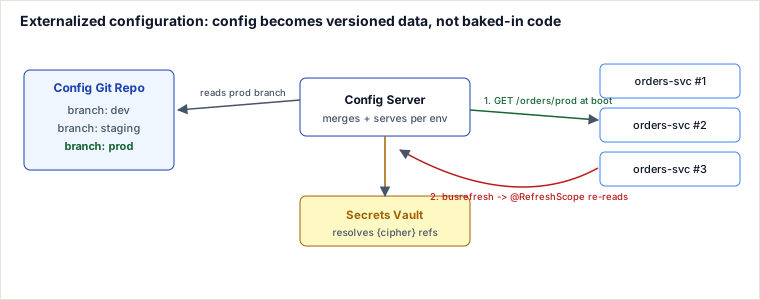
Configuration externalization works by pulling every environment-specific value out of the deployable artifact into a versioned external store that each service reads at startup and can re-read at runtime — so one immutable image runs unchanged in dev, staging, and prod, and changing a value becomes a git commit instead of a rebuild-and-redeploy. The "problem" this page is really about is what happens before you do that: when configuration lives inside the code and inside each running instance.
Why this hurts at fleet scale — with numbers
Take a modest fleet: 40 services, each deployed to 4 environments (dev, staging, prod, DR), each with roughly 15 tunable values (DB URL, pool size, timeouts, Kafka brokers, cache TTLs, feature flags, third-party API keys). That is 40 × 4 × 15 = 2,400 config values that must be correct, consistent, and auditable. Two properties make this qualitatively harder than a monolith with one config.properties:
- Volume & diversity. Every service has its own stack (a Go service tuning
GOMAXPROCSand gRPC deadlines, a Java service tuning HikariCP and JVM heap). There is no single shape of config to standardize on. - Dynamic environments. Instances are created and destroyed by an autoscaler. A brand-new pod at 3 a.m. must obtain correct config with zero human involvement — you cannot SSH in and edit a file.
If those values are baked into the code, a one-line change to a timeout inherits the entire release pipeline: rebuild the image (a 5–10 min CI run), re-run tests, publish the artifact, roll it across every instance. And because the value is now welded to a specific image tag, two instances on different tags silently run different config — the beginning of configuration drift.
Worked example: bumping a DB connection pool from 20 to 50 in prod
Traffic doubled; HikariCP is exhausting its pool and requests are queuing. You need maximum-pool-size raised from 20 to 50 on the orders service in production. Trace the two paths side by side.
| Step | Hardcoded (value lives in the image) | Externalized (value lives in a config server) |
|---|---|---|
| 1 | Edit application.yml inside the service repo | Edit the prod branch of the config repo: spring.datasource.hikari.maximum-pool-size: 50 |
| 2 | git commit, push, trigger CI | git commit, push (PR-reviewed, auditable) |
| 3 | CI builds a new image (~7 min) and re-runs tests | Config server webhook fires; no build |
| 4 | Roll the new image across all instances (restart each) | POST /actuator/busrefresh broadcasts a refresh event |
| 5 | Repeat 1–4 for any other service that shared this value | Each @RefreshScope bean re-instantiates with the new value |
| Time to live | ~10 min–1 hr, restart-induced blips | ~2 s, no redeploy |
| Rollback | Redeploy the previous image tag | git revert + refresh |
The mechanism collapses a risky, minutes-long, artifact-coupled operation into a reversible data change. That is the entire point of the pattern.
The refresh trap (and why the naive version is wrong)
Externalizing the value is only half the job — the running instance must actually pick it up. In Spring Cloud Config, a bean reads config once at construction unless it is annotated @RefreshScope. The naive version looks like it works and silently doesn't:
// WRONG: value is bound once at startup. After /actuator/busrefresh the
// server serves 50, but this bean still holds 20 forever.
@Component
class PoolConfig {
    @Value("${spring.datasource.hikari.maximum-pool-size}")
    int maxPool; // frozen at boot
}

// RIGHT: @RefreshScope discards and rebuilds the bean on a refresh event,
// so it re-binds to the new value (50) from the config server.
@Component
@RefreshScope
class PoolConfig {
    @Value("${spring.datasource.hikari.maximum-pool-size}")
    int maxPool;
}
Why the naive one is wrong: @Value injection resolves at bean creation. Without @RefreshScope, no later event re-runs that injection, so the pushed change never reaches the object doing the work — and you get a false sense that dynamic config "isn't working" when in fact the server is serving the right value. The sharper corollary: some beans must not be blindly refreshed (see Pitfalls).
Pitfalls
- Secrets in plaintext git. The fastest way to leak a production DB password is to commit it to the config repo. Anyone with repo read access — or a mis-scoped CI token — now has prod credentials, and git history keeps them forever. Encrypt values (config server
{cipher}) or delegate to a secrets manager (Vault, sealed secrets, cloud KMS). - Refreshing beans that can't be safely rebuilt. Putting
@RefreshScopeon aDataSourcecan tear down the live connection pool mid-request and drop in-flight transactions. Refresh cheap, stateless config (timeouts, flags, thresholds); treat connection/thread pools as restart-time config or drain them explicitly. - Config server as a boot-time single point of failure. If services fetch config at startup and the server is down, a scaling event can't bring up healthy pods. Add retry with backoff plus a local cached copy, and decide deliberately between fail-fast (refuse to start on stale config) and fail-safe (start on last-known-good).
- Precedence surprises. Sources are layered — command-line args > environment variables > config server > packaged defaults. A stray env var on one host silently overrides the server, and that host behaves differently with no obvious cause.
- Fleet-wide blast radius. A single
busrefreshhits every instance at once. Ship a bad value and the whole service degrades simultaneously. Roll config like code: canary a subset first. - Drift from out-of-band edits. A hotfix typed directly into a running container (or a ConfigMap edited by hand) that never lands back in git means the source of truth is now a lie.
When to externalize into a config server — and when not to
This is a design choice, not a default. The decision hinges on one signal: does config need to change at runtime, or only at deploy time?
- Environment variables (12-Factor, Factor III). Config is injected by the platform at process start. Choose when the fleet is small, values change only when you deploy anyway, and you want zero extra infrastructure. Costs: changing a value means a redeploy/restart; no central audit; no single source of truth across services; secrets sit in the environment in plaintext.
- Kubernetes ConfigMaps + Secrets. Native, GitOps-friendly, and per-namespace. Choose when you already run on K8s and config is deploy-time. Costs: a ConfigMap change doesn't reach running pods unless you restart them (or mount as a volume and watch for changes, which has propagation lag); Secrets are only base64-encoded, not encrypted, without extra tooling.
- Dedicated config server (Spring Cloud Config, Consul, etcd, AWS AppConfig). Choose when you have dozens of services, need dynamic runtime refresh without redeploys, want centralized versioning/audit/rollback, or run feature flags. Costs: a new stateful component to run, secure, and make highly available; a boot-time dependency and SPOF risk; a network hop; and the refresh-scope complexity above.
- Feature-flag platform (LaunchDarkly, Unleash). Choose when flags flip many times a day with targeting rules and instant kill-switches — a general config store is too coarse and too slow for that.
Choose ConfigMaps/env vars when config is deploy-time and you already have a platform to inject it. Prefer a config server when you need runtime changes, a central audit trail, and one source of truth across a large fleet — and accept that you now own another piece of critical infrastructure.
Takeaways
- Externalize so the artifact is immutable and identical across environments; config stops being code and becomes versioned data.
- The real payoff is shrinking the unit of change from "rebuild + redeploy across the fleet" (minutes, risky) to "git commit + refresh" (seconds, reversible via revert).
- Never commit secrets in plaintext — encrypt or delegate to a secrets manager, because git history is forever.
- Dynamic refresh is powerful but sharp: only refresh beans that can safely re-initialize, guard against the config server being a boot-time SPOF, and roll config changes out gradually.
Re-authored/Deepened for this guide. Sources: Chris Richardson, Microservices Patterns (Externalized Configuration pattern); the Spring Cloud Config reference documentation (@RefreshScope, Spring Cloud Bus busrefresh, property precedence); Adam Wiggins, The Twelve-Factor App (Factor III: Config); and the HashiCorp Consul and Vault documentation on centralized configuration and secrets management.
🤖 Don't fully get this? Learn it with Claude
Stuck on The Problem Configuration Management in a Microservices Architecture? Open Claude, copy a block below, and it'll teach you this exact concept — visually and interactively.
Build the mental picture, not memorization.
I just read a lesson on **The Problem Configuration Management in a Microservices Architecture** (System Design) and want to truly understand it. Explain The Problem Configuration Management in a Microservices Architecture from first principles using ONE vivid real-world analogy and a visual mental model — draw it as ASCII art or a clear step-by-step diagram — with a concrete example using real numbers. Then ask me one question to check I got the mental picture, and wait for my reply. If you're unsure or a claim isn't standard, say so and reason from first principles instead of guessing.
Socratic — adapts to where you're stuck.
Teach me **The Problem Configuration Management in a Microservices Architecture** interactively. Ask me ONE guiding question at a time, wait for my answer, and adapt to my confusion — build the idea with me step by step instead of explaining it all at once. If you're unsure or a claim isn't standard, say so and reason from first principles instead of guessing.
Active recall exposes what you missed.
Quiz me on **The Problem Configuration Management in a Microservices Architecture** with 5 questions, easy to tricky, ONE at a time. Tell me if each answer is right; at the end, explain clearly what I got wrong and why. If you're unsure or a claim isn't standard, say so and reason from first principles instead of guessing.
Intuition + hook + flashcards for long-term memory.
Help me remember **The Problem Configuration Management in a Microservices Architecture** for the long term: give the one-sentence intuition, a memorable hook/mnemonic, a tiny worked example, and 3 active-recall flashcards (Q -> A). If you're unsure or a claim isn't standard, say so and reason from first principles instead of guessing.