A Solution to the Monolithic Mayhem
The Sidecar Pattern moves a cross-cutting concern (TLS, retries, telemetry, config sync) out of your application and into a separate process running in its own container, co-deployed alongside the app in the same unit (a Kubernetes Pod), where the two share a network namespace (localhost) and lifecycle but keep separate memory, crash domains, and language runtimes — so the app talks to the sidecar over a loopback socket and stays oblivious to the plumbing.
The name is a motorcycle sidecar: bolted to the main bike, riding everywhere it rides, but its own compartment. That separation — same host, different process — is the entire point. If it ran inside your process it would just be a library.
Correcting the common myth
Two things people get wrong, both of which invert the pattern:
- "The sidecar runs in the same process as the app." No. It is a distinct OS process (usually a distinct container). It shares the Pod's network namespace and volumes, so it reaches the app over
127.0.0.1with no cross-node hop — but a bug or memory leak in the sidecar cannot corrupt the app's heap, and vice-versa. Shared address space would defeat fault isolation and force both to be the same language. - "Scale the auth sidecar independently when logins spike." No. A sidecar is deployed one-per-instance. It is glued to its app container in the same Pod, so it scales with the app: 40 order-service Pods means 40 order sidecars. You cannot run 3 apps and 300 sidecars. Something you scale independently is a separate service, not a sidecar.
A real sidecar: the service-mesh proxy
The canonical production example is Envoy injected by a service mesh (Istio, Linkerd). Your orders service is plain Python speaking unencrypted HTTP and knows nothing about mutual TLS, retries, or metrics. The Envoy sidecar in its Pod handles all of it transparently. Other real sidecars: a log shipper (Fluent Bit tailing a shared volume), a config-reload agent, or a secrets-fetch agent.
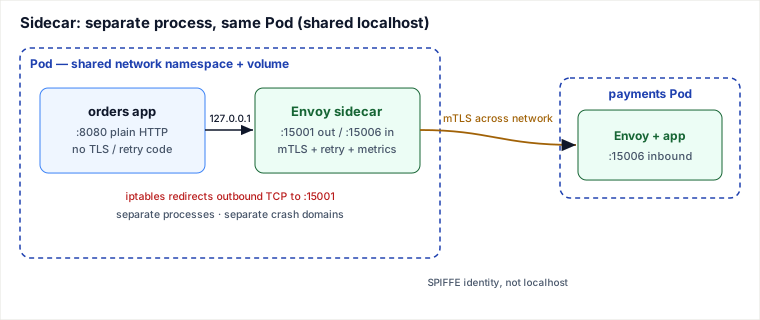
Traced example: orders → payments through the sidecar
Concrete outbound call. The app issues a naive plain-HTTP request; the sidecar quietly makes it secure and resilient.
| # | What happens | Real values |
|---|---|---|
| 1 | App fires a plain HTTP call, thinking it goes straight to payments | GET http://payments/charge on TCP:80 |
| 2 | An iptables rule (installed by the mesh's init container) redirects the outbound packet to the local sidecar | redirect → 127.0.0.1:15001 |
| 3 | Envoy resolves the payments cluster and opens a mutual-TLS connection, presenting the workload's identity | client cert spiffe://cluster/ns/prod/sa/orders |
| 4 | First upstream endpoint is overloaded and rejects | endpoint 10.1.4.7 → 503 |
| 5 | Envoy's retry policy resends to a different healthy endpoint after backoff | policy retryOn: 5xx, attempts: 2, backoff: 25ms → 10.1.4.9 |
| 6 | Second endpoint succeeds; Envoy emits metrics and returns a plain 200 to the app over loopback | upstream_rq_200, rq_time: 42ms |
| 7 | App reads a normal HTTP 200. It never wrote a line of TLS, retry, or metrics code. | zero app changes |
The leverage: the same Envoy is injected next to a Go service, a Rust service, and the Python one. All three get identical mTLS, retries, and observability without shared library code — because the concern lives in a co-located process, not in each language's runtime.
Pitfalls
- Resource multiplication. One sidecar per Pod, not per node or per cluster. At 500 Pods you are running 500 Envoy processes; a mesh commonly adds ~50–150 MB RAM and measurable CPU per Pod. Density-sensitive fleets feel this hard.
- Startup race. If the app container starts and sends traffic before the sidecar's proxy is listening, early requests fail with connection-refused. Meshes fix this with ordering hooks (Istio's
holdApplicationUntilProxyStarts) or native sidecar init-containers — but you must enable them. - Shutdown race on rollout. During a deploy, if the sidecar is killed before the app finishes draining in-flight requests, you get spurious 5xx and connection resets. Drain timeouts must be coordinated.
- Latency tax. Every hop is now app→proxy→network→proxy→app: two extra loopback traversals plus proxy CPU. Usually sub-millisecond on localhost, but it is not free and shows up in tight, chatty call graphs.
- Who broke it? Debugging spans two processes. A failure could be the app, the sidecar config, or the iptables redirect. Silent redirect misconfiguration is a classic "it works on my machine, times out in prod" trap.
- Version skew. Upgrading the sidecar image touches every Pod in the fleet; a bad proxy version is a fleet-wide incident, not a one-service incident.
When to use it, when not to
Reach for a sidecar when: a cross-cutting concern (mTLS, retries/circuit-breaking, rate limiting, tracing, log shipping) must be applied uniformly across many services written in different languages, and you cannot realistically ship and upgrade a shared library in every one of them. It shines for east-west (service-to-service) traffic and when each instance needs its own identity or config.
Trade-offs vs. named alternatives
- vs. Shared library / in-process (gRPC interceptors, Resilience4j, Netflix Ribbon/Hystrix): The library has no extra hop and no extra memory — fastest and leanest. But it couples every service to one language and forces lockstep upgrades across all teams whenever the resilience logic changes. A polyglot shop simply can't. Gain of sidecar: language independence + upgrade decoupling; cost: latency hop + per-Pod overhead.
- vs. Node agent / DaemonSet (one proxy per node, shared by all Pods on it): Far less overhead — one process amortized over many Pods. But you lose per-Pod isolation and per-workload identity, and you inherit noisy-neighbor blast radius: one bad tenant can starve the shared agent. Choose sidecar when per-instance identity/isolation matters; choose DaemonSet when aggregate overhead dominates.
- vs. API Gateway / central proxy: A gateway governs north-south edge traffic at one choke point; it does not secure or retry internal service-to-service calls, and centralizing all east-west traffic through it recreates a bottleneck. They are complementary, not substitutes.
Decide: choose the sidecar when you have polyglot services, east-west traffic, and per-instance identity; prefer a shared library when it's a single language and latency/memory are critical; prefer a DaemonSet agent when per-Pod overhead is the binding constraint and strict isolation isn't required.
Takeaways
- A sidecar is a co-located separate process sharing the Pod's network namespace — never the same process; that separation is what buys language independence and fault isolation.
- It scales one-per-instance, in lockstep with its app — independent scaling means you designed a separate service, not a sidecar.
- You pay for the decoupling with per-Pod memory/CPU, an extra loopback hop, and startup/shutdown ordering hazards.
- Pick it for polyglot, east-west cross-cutting concerns; a shared library wins on raw latency/footprint, a DaemonSet wins on aggregate overhead.
Re-authored and deepened for this guide. Sources: Bilgin Ibryam & Roland Huß, Kubernetes Patterns (Sidecar and Ambassador chapters); the Istio and Envoy documentation on sidecar injection, mutual TLS, and retry policies; Microsoft Azure Architecture Center, "Sidecar pattern"; and the CNCF SPIFFE/SPIFFE-ID identity model.
🤖 Don't fully get this? Learn it with Claude
Stuck on A Solution to the Monolithic Mayhem? Open Claude, copy a block below, and it'll teach you this exact concept — visually and interactively.
Progressively stronger hints — you still solve it.
I'm working on the problem **A Solution to the Monolithic Mayhem** (System Design). Give me a HINT LADDER: start with the tiniest nudge, then wait. Only reveal the next, stronger hint when I ask. Do NOT show the full solution unless I type 'show solution'. Keep me doing the thinking. If you're unsure or a claim isn't standard, say so and reason from first principles instead of guessing.
See the technique, not just code.
Explain the optimal approach to **A Solution to the Monolithic Mayhem** with a VISUAL walkthrough: trace it on a small concrete example using ASCII art / a step-by-step diagram, narrate what changes each step, then give time & space complexity with a one-line derivation. If you're unsure or a claim isn't standard, say so and reason from first principles instead of guessing.
Catch bugs, edge cases, sub-optimality.
I'll paste my solution to **A Solution to the Monolithic Mayhem**. Review it for correctness, missed edge cases, and time/space complexity, then coach me toward the optimal — don't just rewrite it. Ask me to paste my code now. If you're unsure or a claim isn't standard, say so and reason from first principles instead of guessing.
Lock in recognition with look-alikes.
Give me 2 problems that use the SAME underlying pattern as **A Solution to the Monolithic Mayhem**. For each, let me attempt first, then review my answer and name the trigger signal that reveals the pattern. If you're unsure or a claim isn't standard, say so and reason from first principles instead of guessing.