The Inner Workings
A bulkhead works by giving each downstream dependency its own bounded pool of concurrency permits (threads or semaphore slots), so that a slow or dead dependency can block only the permits assigned to it — never the shared worker pool the whole service runs on.
The mechanism: capping in-flight calls per dependency
The failure a bulkhead prevents is resource exhaustion by contagion. Picture a checkout service on a 200-thread request pool. Every request fans out to three dependencies — Payments, Inventory, and Recommendations. Governed by Little's Law, the number of threads a dependency ties up is concurrency = arrival_rate x latency. At 500 requests/sec with healthy latencies the whole service is comfortable:
| Dependency | Latency | In-flight threads (500 rps x latency) |
|---|---|---|
| Payments | 40 ms | 20 |
| Inventory | 25 ms | 12.5 |
| Recommendations | 20 ms | 10 |
| Total busy | ~43 of 200 | |
Now Recommendations — the least important call — degrades to 5,000 ms. Little's Law now wants 500 x 5 = 2,500 concurrent Recommendations calls. There are only 200 threads. Within 200 / 500 = 0.4 seconds every thread in the shared pool is parked inside the hung Recommendations call. Payments and Inventory calls can no longer get a thread. A non-critical widget has taken down checkout. That is the contagion a bulkhead exists to stop.
Worked trace: 15-permit semaphore bulkhead on Recommendations
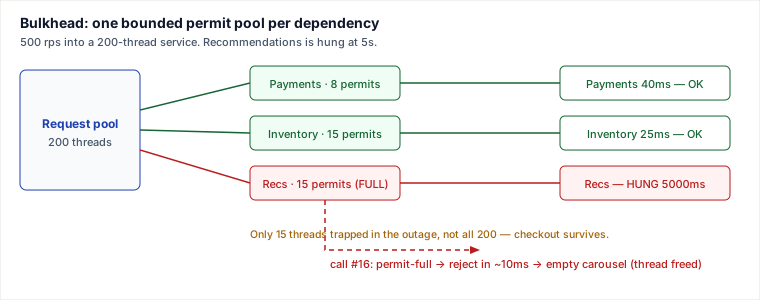
We wrap the Recommendations call in a semaphore bulkhead: maxConcurrentCalls = 15, maxWaitDuration = 10 ms. The permit count is chosen from the healthy in-flight number (10) plus burst headroom. Same 5,000 ms outage, traced concurrently:
- t = 0. Recommendations starts hanging. Calls 1–15 each acquire a permit and block for the full 5 s.
- t < 30 ms. Call 16 arrives, finds 0 free permits, waits up to 10 ms, then throws
BulkheadFullException. The calling thread catches it and returns an empty recommendations list in ~10 ms. - Steady state. Exactly 15 threads are stuck in Recommendations. Every additional Recommendations call fast-fails in ~10 ms and frees its thread immediately.
- Blast radius. Threads held hostage by the outage = 15, not 200. Payments (20) + Inventory (12.5) + Recommendations (15 stuck + fast-fail path) sits far under 200.
- Result. Checkout keeps taking money; the page renders without the recommendations carousel. The failure was isolated to its own compartment.
The permit cap converted a full outage into a graceful, contained degradation — that is the entire job of the pattern.
Two flavors — semaphore vs thread-pool isolation
Semaphore bulkhead (shown above): the caller's own thread runs the work after acquiring a permit. Cheap — just a counter, no context switch, request context (MDC, security) stays on the thread. But it does not add a timeout: a permit is held for exactly as long as the underlying call blocks.
Thread-pool bulkhead (Netflix Hystrix's default): the call is submitted to a separate executor with a bounded queue. This buys you a real timeout (the submitting thread can walk away with a Future.get(timeout)) and offloads blocking I/O off the request thread — at the cost of a context switch per call and loss of ThreadLocal context unless you propagate it explicitly.
Java (Resilience4j semaphore bulkhead):
BulkheadConfig cfg = BulkheadConfig.custom()
    .maxConcurrentCalls(15)          // hard cap on in-flight calls
    .maxWaitDuration(Duration.ofMillis(10))  // fail fast, do NOT queue
    .build();
Bulkhead recs = Bulkhead.of("recommendations", cfg);

Supplier<List<Product>> guarded =
    Bulkhead.decorateSupplier(recs, () -> recClient.fetch(userId));
try {
    return guarded.get();
} catch (BulkheadFullException e) {
    return List.of();   // degrade: render the page without recommendations
}
Go (a semaphore bulkhead is just a buffered channel):
type Bulkhead struct{ sem chan struct{} }

func New(n int) *Bulkhead { return &Bulkhead{sem: make(chan struct{}, n)} }

func (b *Bulkhead) Do(fn func() error) error {
    select {
    case b.sem <- struct{}{}:          // got a permit
        defer func() { <-b.sem }()     // release on the way out
        return fn()
    default:
        return ErrBulkheadFull         // no permit → reject immediately
    }
}
Why the naive version is wrong. Replace the select/default with a plain blocking send (b.sem <- struct{}{}), or set maxWaitDuration to something large, and the bulkhead re-creates the exact exhaustion it was meant to prevent: when Recommendations hangs, callers no longer fail fast — they queue up blocked on the permit acquire, tying up request threads just as surely as the hung call would. A bulkhead only isolates if rejection is fast and non-blocking. The bound on the wait is not a detail; it is the pattern.
Pitfalls
- Blocking acquire with no bounded wait. The bug above — the single most common way a bulkhead silently does nothing. Always use try-acquire or a tiny
maxWaitDuration. - A bulkhead is not a timeout. A semaphore bulkhead caps how many threads a hang can trap, but if the HTTP client has no read timeout, those 15 permits stay stuck for the full hang — or forever. You still need per-call timeouts to recover the permits. Bulkhead bounds the blast radius; timeout ends the blast.
- Sizing off average instead of peak. Set the permit count from Little's Law at your P99 latency plus burst headroom. Too small and you shed load (spurious
BulkheadFullException) during normal traffic spikes; too large and the compartment isn't actually isolating anything. - Thread-pool bulkhead drops request context.
ThreadLocal, MDC log correlation IDs, and security context live on the request thread and do not follow the work onto the executor. Traces break and audit logs go blank unless you wrap the task to copy context across. - Guarding the cheap thing. Wrapping an in-memory cache lookup while the real exhaustion risk is the shared JDBC connection pool. Bulkhead the resource that actually saturates.
- One shared bulkhead across unrelated calls. If two dependencies share a permit pool, a surge in one starves the other — you have coupled the very things isolation was meant to separate.
When to use it, and when not to
Reach for a bulkhead when a single service calls multiple dependencies of differing criticality, and you can name a concrete contagion path: "if dependency X gets slow, it will eat the threads that Y and Z need." The signal is shared, finite concurrency (a thread pool, a connection pool) fronting calls of unequal importance.
Trade-offs vs. named alternatives:
- vs. Timeout alone. A timeout bounds how long one call waits; it does nothing about how many calls pile up. At 500 rps a 2 s timeout still lets 1,000 concurrent calls accumulate before the first one gives up. Timeouts limit duration, bulkheads limit concurrency — you almost always want both. Choose to add a bulkhead when concurrency, not latency, is what saturates you.
- vs. Circuit breaker. A circuit breaker stops calling a dependency once its failure/slow rate crosses a threshold — it's reactive and binary (open/closed). A bulkhead never stops calling; it just refuses to let one dependency consume more than its slice, continuously. The breaker protects the callee and gives it time to recover; the bulkhead protects the caller's other work. They compose: bulkhead caps concurrency, breaker trips when even the capped calls keep failing. Prefer a circuit breaker when the goal is to let a failing dependency recover; prefer a bulkhead when the goal is to keep the rest of your service alive during someone else's outage.
Skip it when the service has a single dependency (there is nothing to isolate from), or when every call is equally critical so shedding any of them is as bad as shedding all — there, capacity planning and a circuit breaker serve you better than partitioning. The cost you pay for a bulkhead is real: extra tuning surface (permit counts per dependency), more rejection paths and fallbacks to write and test, and for the thread-pool variant, context-switch overhead and lost thread context.
Takeaways
- The mechanism is a bounded permit pool per dependency: a hang can trap at most N threads, converting a full outage into a contained, degraded response.
- Size permits with Little's Law (
arrival_rate x latency) plus burst headroom — not by guessing. - Rejection must be fast and non-blocking; a bulkhead that queues callers indefinitely provides zero isolation.
- A bulkhead caps the blast radius but does not end the blast — pair it with timeouts (to free permits) and, often, a circuit breaker (to let the dependency recover).
Sources: Michael T. Nygard, Release It! (2nd ed.) — the Bulkhead stability pattern; Resilience4j Bulkhead documentation (semaphore and thread-pool implementations); Netflix Hystrix wiki — thread-pool isolation and its context-propagation costs; Chris Richardson, microservices.io — Bulkhead pattern; Little's Law for concurrency sizing. Re-authored / deepened for this guide.
🤖 Don't fully get this? Learn it with Claude
Stuck on The Inner Workings? Open Claude, copy a block below, and it'll teach you this exact concept — visually and interactively.
Build the mental picture, not memorization.
I just read a lesson on **The Inner Workings** (System Design) and want to truly understand it. Explain The Inner Workings from first principles using ONE vivid real-world analogy and a visual mental model — draw it as ASCII art or a clear step-by-step diagram — with a concrete example using real numbers. Then ask me one question to check I got the mental picture, and wait for my reply. If you're unsure or a claim isn't standard, say so and reason from first principles instead of guessing.
Socratic — adapts to where you're stuck.
Teach me **The Inner Workings** interactively. Ask me ONE guiding question at a time, wait for my answer, and adapt to my confusion — build the idea with me step by step instead of explaining it all at once. If you're unsure or a claim isn't standard, say so and reason from first principles instead of guessing.
Active recall exposes what you missed.
Quiz me on **The Inner Workings** with 5 questions, easy to tricky, ONE at a time. Tell me if each answer is right; at the end, explain clearly what I got wrong and why. If you're unsure or a claim isn't standard, say so and reason from first principles instead of guessing.
Intuition + hook + flashcards for long-term memory.
Help me remember **The Inner Workings** for the long term: give the one-sentence intuition, a memorable hook/mnemonic, a tiny worked example, and 3 active-recall flashcards (Q -> A). If you're unsure or a claim isn't standard, say so and reason from first principles instead of guessing.