The Architecture of the Retry Pattern
What the pattern actually is
The Retry Pattern is a wrapper around a fallible operation: it intercepts a failure, decides from a policy whether that failure is worth repeating, waits, and calls the operation again until it either succeeds or the policy gives up. The operation itself does not change. Everything that makes retrying safe or dangerous lives in the policy and the loop around it.
The three moving parts
- Retry policy & parameters — the declarative when and how: maximum attempts, which errors count as retryable, and the delay strategy between tries (fixed, exponential, capped, jittered). A policy can be as blunt as “retry 3 times, 2s apart” or as considered as “up to 5 attempts, exponential backoff with jitter, give up on client errors.”
- The invoker (retry loop) — the mechanism that runs the operation and applies the policy: call, catch the failure, ask the policy whether to continue, sleep for the computed delay, call again. On exhaustion it propagates the final error rather than swallowing it.
- Error classification — the loop must separate retryable failures (timeouts, connection resets, 429, 503) from terminal ones (400, 401, 404, validation errors). Retrying the terminal ones only wastes the budget.
Backoff: spacing the attempts
Retrying in a tight loop hammers a service that is already struggling, so real policies insert a wait between attempts. A constant delay (always 5s) is the simplest. Exponential backoff is the workhorse: each retry waits longer than the last — 1s, 2s, 4s, 8s — which both eases load on the failing dependency and gives a transient fault more time to clear. To avoid absurd waits, the delay is capped (capped exponential backoff).
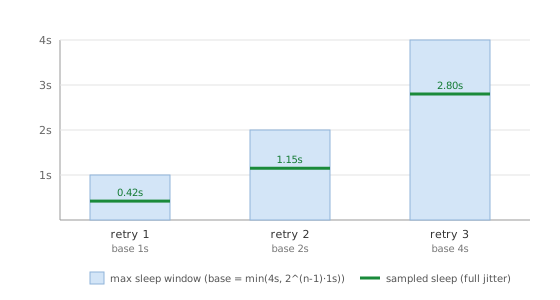
Concretely, take an exponential base of 1s and a cap of 4s, so the base delay for attempt n is base(n) = min(4s, 2^(n-1)·1s). That gives 1s, 2s, 4s, then 4s, 4s, … forever.
A traced run
Put numbers on it. Policy: up to three retries, exponential base 1s, cap 4s, full jitter — so the sleep before attempt n is drawn uniformly from [0, base(n)]. Here is one unlucky run where every attempt fails:
| Attempt | Outcome | base(n) | Sampled sleep (full jitter) | Fires at (elapsed) |
|---|---|---|---|---|
| initial call | fail | — | — | t = 0.00s |
| retry 1 | fail | min(4, 1) = 1s | 0.42s | t = 0.42s |
| retry 2 | fail | min(4, 2) = 2s | 1.15s | t = 1.57s |
| retry 3 | fail | min(4, 4) = 4s | 2.80s | t = 4.37s |
The bar chart above plots exactly this run: each light bar is the full sleep window for that attempt (its base delay), and the green line is where the random draw actually landed. Elapsed times accumulate directly: 0.42 + 1.15 = 1.57, then 1.57 + 2.80 = 4.37.
Note that base(3) = min(4s, 4s) = 4s. That 4s is the raw exponential value (2²·1s), not the cap clamping anything — the two merely coincide at this attempt. The cap only becomes load-bearing from base(4) onward, where 8s, 16s, … would all be pinned back to 4s. This three-retry trace never reaches that point, so every delay shown is pure exponential growth.
Hold this thread. Suppose the caller runs under a 3s SLA deadline. Retry 3 is scheduled to fire at t = 4.37s — after the caller has already given up. We come back to what the loop should do about that in the pitfalls.
Jitter: why randomness beats precision
When many clients fail at the same instant — a brief blip in a shared dependency — a fixed backoff makes them all wait the same interval and then retry in unison, recreating the load spike one cycle later. This is the thundering herd. Jitter de-synchronizes them by randomizing each delay, spreading the retries into a smoother stream. Counterintuitively, adding randomness measurably reduces contention and speeds recovery.
Three canonical formulas (Amazon Builders' Library), writing temp = min(cap, base·2^attempt):
- Full jitter —
sleep = random(0, temp). Widest spread and the lowest expected competition between clients; AWS's own testing makes it the default choice. Trade-off: an unlucky client can draw a near-zero sleep and retry almost immediately. - Equal jitter —
sleep = temp/2 + random(0, temp/2). Keeps half the backoff as a guaranteed floor, then randomizes the rest. Reach for it when you want a minimum spacing between hits (to protect a fragile downstream) and can accept slightly less spread than full jitter. - Decorrelated jitter —
sleep = min(cap, random(base, prev_sleep·3)). Each sleep is anchored to the previous one, so the series ratchets up smoothly and self-limits. A strong general-purpose alternative to full jitter when you want fewer total calls without hand-tuning.
When to use which: default to full jitter; switch to equal jitter when a downstream needs a guaranteed cool-off between attempts; use decorrelated jitter when you want full-jitter-like spread but fewer overall calls.
Retries and circuit breakers are complementary
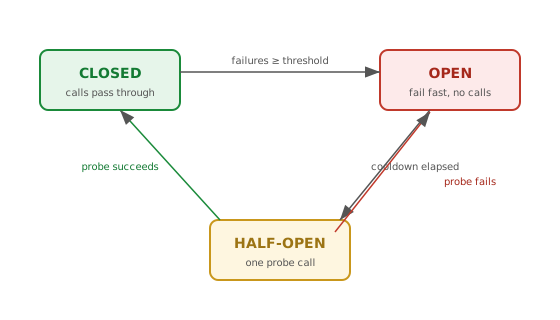
Retries and circuit breakers make opposite assumptions about a failure — which is exactly why they compose. A retry assumes the failure is local and transient: this one call was unlucky, another might work. A circuit breaker assumes the failure is systemic: the dependency is down, so stop trying and let it recover. Put the retry loop inside the breaker: retries handle the fleeting faults, and the breaker caps the blast radius when retries would otherwise keep pounding a dead service.
The breaker is a three-state machine. Closed: calls pass through normally, failures are counted. When failures cross a threshold it trips to Open: calls fail fast without touching the dependency, giving it room to recover. After a cooldown it moves to Half-Open and allows a single probe call: if the probe succeeds the breaker closes; if it fails it snaps back open and the cooldown restarts.
Idempotency and the ambiguous timeout
The dangerous case is not a clean failure — it is the ambiguous timeout: the client saw no response, but the request may already have succeeded on the server. Blindly retrying a non-idempotent write (charge a card, place an order, increment a counter) then executes it twice. Reads and deletes are naturally idempotent and safe to retry; unsafe writes need help. The standard fix is an idempotency key: the client attaches a unique token, the server records it, and a retry carrying the same token is recognized as a duplicate and returns the original result instead of re-executing. Rule of thumb: make an operation idempotent — or give it an idempotency key — before you let a retry loop near it.
Where retries live — and why only one layer
Retries can sit at the immediate caller's client, or be delegated to an API gateway or service mesh that retries transparently between services. The critical constraint is not to stack them. If every hop in a chain retries independently, the counts multiply: three services each retrying three times turns a single failure into 3×3×3 = 27 downstream calls — a retry explosion that can convert a small blip into an outage.
So: own retries at exactly one layer (typically the immediate caller, or the edge — not both), and disable them everywhere else in the path. Then bound the aggregate with a retry budget, often a token bucket, so retries are only allowed while they stay under some fraction of normal traffic (e.g. ~10%). Beyond that ceiling, retries are dropped — which is precisely the behavior you want when a dependency is already saturated.
Pitfalls
- Retrying non-retryable errors. Client errors like 400, 401, 404, and 422 will not change on repeat — retrying them just burns the budget and delays an inevitable failure. Retry only on transient signals: timeouts, connection resets, 429, 503.
- Dropping jitter. Pure exponential backoff still synchronizes clients that failed together; without randomness you rebuild the thundering herd exactly one backoff cycle later.
- Retrying non-idempotent writes without a key. An ambiguous timeout plus a blind retry equals a double charge. Attach an idempotency key, or make the operation naturally idempotent, before retrying it.
- Stacking retries across layers. Retries at the client, the gateway, and the mesh multiply (3×3×3 = 27). Own retries at one layer and cap the total with a retry budget.
- Ignoring the caller's deadline. A loop that only counts attempts will happily sleep past the point where its answer can still be used. In the traced run above the caller's SLA budget was 3s, yet retry 3's 2.80s sleep — on top of the 1.57s already elapsed — schedules the next call for t ≈ 4.37s, well after the caller has given up. Every second spent backing off beyond the deadline is pure waste: it holds connections open and consumes downstream capacity to produce a response nobody is waiting for. A deadline-aware loop threads the remaining budget through each attempt, shortens or skips a sleep that would overrun it, and aborts early with a timeout rather than firing a doomed final call.
Sources
- Marc Brooker, “Timeouts, retries, and backoff with jitter,” Amazon Builders' Library — the full / equal / decorrelated jitter formulas and their measured trade-offs.
- Michael T. Nygard, Release It! (2nd ed.) — retry, timeout, and circuit-breaker stability patterns.
- Microsoft Azure Architecture Center — “Retry pattern” and “Circuit Breaker pattern.”
🤖 Don't fully get this? Learn it with Claude
Stuck on The Architecture of the Retry Pattern? Open Claude, copy a block below, and it'll teach you this exact concept — visually and interactively.
Build the mental picture, not memorization.
I just read a lesson on **The Architecture of the Retry Pattern** (System Design) and want to truly understand it. Explain The Architecture of the Retry Pattern from first principles using ONE vivid real-world analogy and a visual mental model — draw it as ASCII art or a clear step-by-step diagram — with a concrete example using real numbers. Then ask me one question to check I got the mental picture, and wait for my reply. If you're unsure or a claim isn't standard, say so and reason from first principles instead of guessing.
Socratic — adapts to where you're stuck.
Teach me **The Architecture of the Retry Pattern** interactively. Ask me ONE guiding question at a time, wait for my answer, and adapt to my confusion — build the idea with me step by step instead of explaining it all at once. If you're unsure or a claim isn't standard, say so and reason from first principles instead of guessing.
Active recall exposes what you missed.
Quiz me on **The Architecture of the Retry Pattern** with 5 questions, easy to tricky, ONE at a time. Tell me if each answer is right; at the end, explain clearly what I got wrong and why. If you're unsure or a claim isn't standard, say so and reason from first principles instead of guessing.
Intuition + hook + flashcards for long-term memory.
Help me remember **The Architecture of the Retry Pattern** for the long term: give the one-sentence intuition, a memorable hook/mnemonic, a tiny worked example, and 3 active-recall flashcards (Q -> A). If you're unsure or a claim isn't standard, say so and reason from first principles instead of guessing.